Opinion: Thailand Must Honour the Ceasefire: Region 2 Commander’s Remarks Threaten Peace and Stability
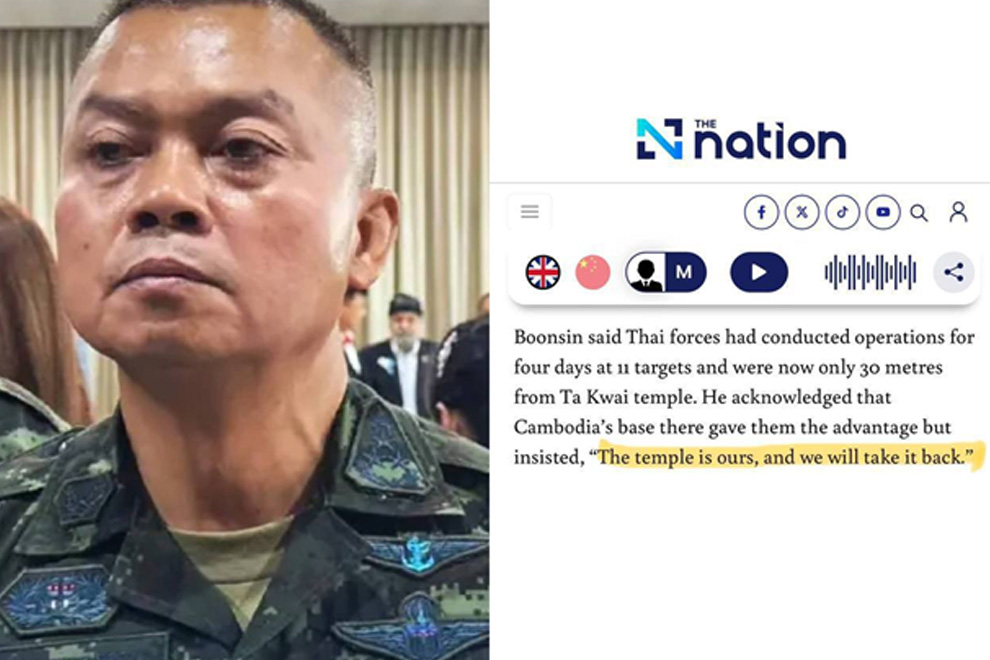 Boonsin Padklang, commander of Thailand’s Second Army Region, has inflamed tensions with his August 10 comments. ANN/The Nation
The ink on the Cambodia–Thailand ceasefire agreement is barely dry, yet the words of Lieutenant General Boonsin Padklang, Commander of Thailand’s Second Army Region, have already cast a long shadow over it.
Today, August 10, he vowed to “reclaim” Ta Krabey Temple for Thailand and suggested closing Ta Mone Thom Temple — both located inside Cambodian territory. This is not mere military bravado; it is an open declaration of intent to violate an agreement his country signed only days ago. Such rhetoric undermines the principles of peaceful coexistence and risks plunging the border back into conflict.
Cambodia has shown restraint and genuine political will to end decades of recurring border tensions. The July 28 ceasefire, reinforced by the 13-point General Border Committee (GBC) agreement of August 7, was embraced by both peoples and welcomed internationally as a turning point. Yet within days, a senior Thai commander publicly announced plans for military action to seize territory — raising serious doubts about the Thai military’s respect for its own government’s commitments.
This is more than provocation. It is a direct violation of the spirit and letter of the ceasefire, a calculated attempt to inflame nationalist sentiment, and a dangerous narrative designed to paint Cambodia as the aggressor. His claim of “3,000 Cambodian casualties” is entirely unsubstantiated, serving only as a pretext for future escalation. Equally troubling is his portrayal of Cambodia’s defensive positions as threats to hospitals and civilians, implying preparations for a “next war” — while ignoring Thailand’s own troop build-ups, fortified positions and incursions into contested zones since the ceasefire took effect.
Cambodia has kept its word. We have deployed military observers, welcomed foreign military attachés to verify the situation and maintained a strictly defensive posture. We have worked through diplomatic channels in full accordance with international law, the ASEAN Charter and the Treaty of Amity and Cooperation in Southeast Asia. The Thai commander’s statements send the opposite message — that the ceasefire is merely a tactical pause before renewed confrontation.
If Thailand is serious about peace, it must prove it — not only in formal meetings, but in the words and actions of its military leadership. Leaving such inflammatory rhetoric unchallenged either reveals a dangerous lack of civilian control over the military or reflects a deliberate “two-track” strategy: speaking peace in public while preparing for war in private.
Cambodia joins the international community call on Thailand to: 1. Reaffirm its commitment to the July 28 ceasefire and the August 7 GBC agreement, 2. Instruct all military commanders to end statements and actions that risk reigniting conflict and 3. Engage sincerely in joint verification and troop withdrawal mechanisms to uphold the agreements already signed.
Peace along our border is fragile. It cannot survive if one side treats solemn commitments as disposable. The facts are clear: Cambodia honours the ceasefire; Thailand’s military, by the words of its own senior commander, is undermining it.
War benefits no one. Respect for agreements benefits all. If peace is truly the goal, the time for Thailand to prove it is now.
Roth Santepheap is a geopolitical analyst based in Phnom Penh. The views and opinions expressed are his own.
The Phnom Penh Post