NA commission reviews draft conscription law
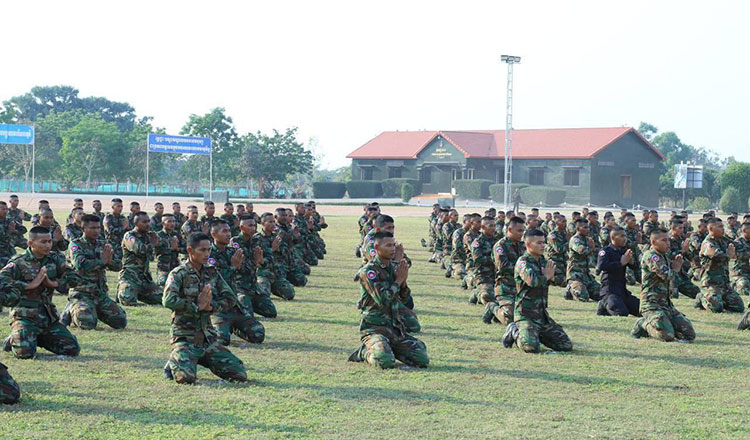 Troops undergo martial arts training in Banteay Meanchey province. Royal Cambodian Army
#National
Synopsis: Legislation aims to strengthen national defence, covering exemptions, benefits, and penalties for evasion.
The National Assembly’s Commission on Interior, National Defence, Civil Service and Border Affairs held a meeting Monday to review the draft conscription law with government representatives headed by Defence Minister General Tea Seiha.
The discussion followed the National Assembly Standing Committee’s approval of the draft and its referral to an expert commission for further study.
The draft law proposes that Cambodian men aged 18 to 25 undertake mandatory military service, which may be extended by up to six months.
Individuals holding multiple nationalities but residing in Cambodia would also be subject to the same obligations.
Women would not be required to serve but could volunteer. Exemptions would apply to monks, religious leaders, persons with disabilities, and those engaged in national duties.
The draft stipulates penalties for evasion, including fines and prison sentences ranging from six months to five years, depending on the severity of the case.
The government has outlined benefits for those who complete service, including priority for public and private sector employment, job security and salary protection for current employees, the ability to resume studies without losing academic standing, and access to allowances and provisions during service.
Commission chairman Kep Chuktema added that the meeting was not intended as a question-and-answer session, but a platform to gather input to improve the quality of the draft law.
“The National Assembly and the Royal Government are working together to ensure this law serves the interests of the nation and its people,” he said.
Gen Seiha added that the 2006 conscription law no longer adequately reflects current needs, making revisions necessary to enhance defence capabilities, safeguard territorial integrity, and foster patriotism among younger generations.
The draft law, approved by the Council of Ministers on April 23, comprises eight chapters and 20 articles, outlining the framework for military service as both a civic duty and a foundation for strengthening the armed forces.
Mr Hun Manet previously said the government is considering a hybrid approach combining voluntary enlistment with mandatory conscription to meet annual personnel requirements.
He added that while voluntary service would be prioritised, compulsory measures could be implemented if recruitment targets are not met. Cambodia sees around 300,000 citizens reach conscription age every year.
Youk Chhang, Director of the Documentation Centre of Cambodia, said the law represents an effort to strengthen national defence, but added ongoing challenges in improving military professionalism and skills.
He suggested Cambodia could draw lessons from the United States Army, particularly in integrating military history into training.
He added that a stronger focus on history lessons could enhance strategic thinking, risk assessment, and the effective use of modern technology.
Youk said military history education can help develop future leaders, strengthen discipline, and build a more adaptive and professional armed force capable of meeting Cambodia’s evolving security needs.
-Khmer Times-