Cambodia and the Regional Impact of To Lam’s 2026 China Visit
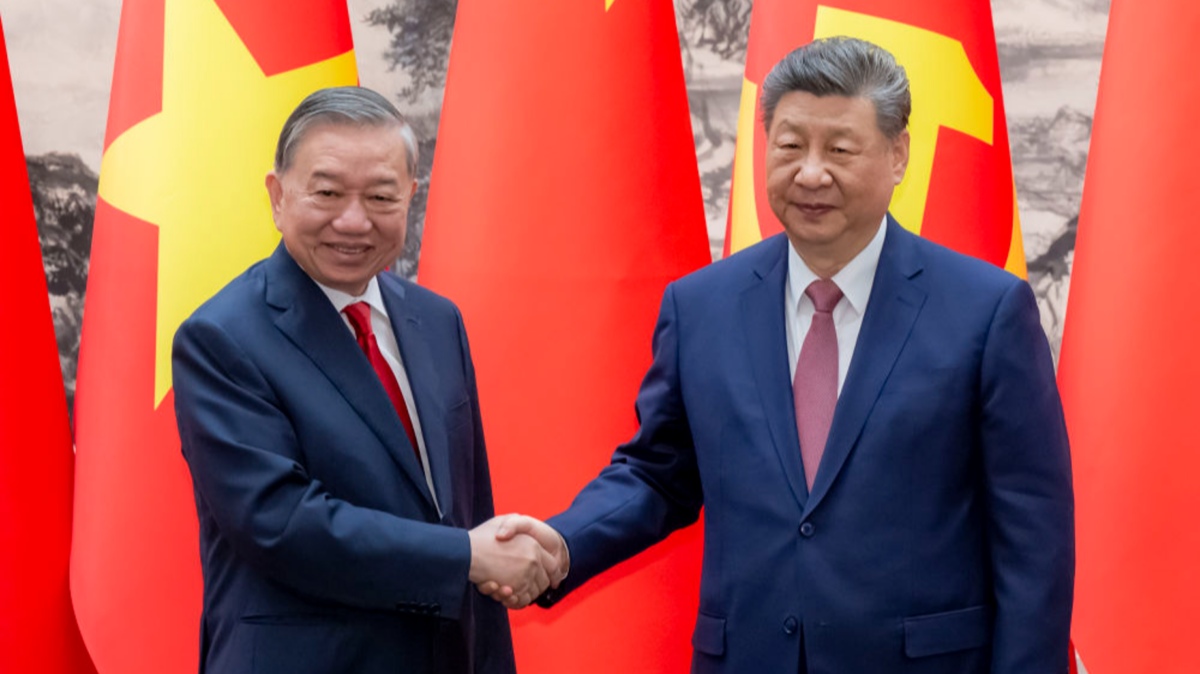 Chinese president Xi Jinping (right) meets with To Lam, general secretary of the Communist Party of Vietnam Central Committee and president of Vietnam, in Beijing, April 15. Xinhua
April 2026 marks a pivotal moment in Southeast Asian diplomacy, as Vietnamese Communist Party General Secretary and President, To Lam, conducts a state visit to China. This event is far more than a routine diplomatic exchange; it is a strategic milestone that will shape the future of China-Vietnam relations and, importantly, reverberate across the region – including Cambodia. As these two neighbouring countries celebrate the 75th anniversary of their diplomatic ties, their evolving partnership is set to influence the region’s stability, development, and diplomatic landscape for years to come.
Against this backdrop, the significance of this summit for Cambodia cannot be overstated. The outcome will affect not only Vietnam and China but also the broader fabric of Southeast Asian affairs, with implications for trade, security and regional cooperation. Therefore, understanding the dynamics at play is essential for Cambodian policymakers, businesses and the public, who stand to benefit – or face challenges – from the shifting balance of power and partnership in the region.
To fully appreciate these dynamics, it is important to recognise that Vietnam and China’s relationship is deeply rooted in history, stretching back thousands of years. The two countries have shared borders, cultures and ideologies, but their interactions have often been marked by conflict and asymmetry. For centuries, Vietnam was subject to Chinese domination, invasion, and subjugation. This legacy has shaped Vietnam’s national identity and its cautious approach to relations with its large, powerful neighbour.
Despite their shared communist identity, the relationship has often been described as “love and hate”. Strategic interests, historical grievances and latent doubts continue to influence their interactions. Vietnam’s pragmatic foreign policy has allowed it to navigate these challenges, maintaining positive developments and results even in the face of asymmetry.
Moving into the modern era, in 2008, China and Vietnam elevated their ties to a “comprehensive strategic partnership”. Since then, cooperation has deepened across multiple fields, including politics, economics and security. High-level visits have become more frequent, with President Xi Jinping making two official visits to Vietnam during his current term. These exchanges have been described by Chinese scholars as the “golden stage” of China-Vietnam relations.
The partnership has moved beyond ceremonial visits to include shared political agendas. During Xi’s 2023 visit, the relationship was elevated to “a community of common destiny that carries strategic significance”. The revival of the phrase “comrades and brothers” signals renewed ideological closeness, which has helped warm diplomatic ties. For Cambodia, these developments offer a model of how smaller states can manage relations with powerful neighbours through strategic engagement and diplomatic flexibility.
Vietnam has reciprocated with high-level visits to China, including those by General Secretary To Lam. These exchanges promise further deepening of the “comrades and brothers” status, with both countries now led by a single power figure holding the most influential titles, facilitating streamlined coordination.
Meanwhile, Cambodia’s own history with China and Vietnam is complex, involving periods of conflict, cooperation and shifting balancing. The Vietnam-China experience demonstrates the importance of historical awareness, strategic patience and diplomatic adaptability. Cambodian leaders can draw inspiration from Vietnam’s ability to engage with China constructively while safeguarding national interests.
Economics is the engine driving China-Vietnam relations. As of 2025, China has remained Vietnam’s largest trading partner for over 20 consecutive years – its largest import market and second-largest export market. Vietnam is also China’s largest trading partner in ASEAN and, in 2024, was its fourth-largest global trading partner.
Despite this success, however, Vietnam runs a significant trade deficit with China, amounting to $115.6 billion in 2025. China is also the second-largest investor in Vietnam, with $3.64 billion in capital and leading in new venture counts. Vietnam’s attractiveness to Chinese investors stems from its strategic location, cost-effective labour, improving infrastructure and integration into the global economy through more than 15 free trade agreements.
In recent years, the “China + 1” strategy, prompted by US tariffs, has made Vietnam a relocation destination for Chinese manufacturers seeking to diversify their production and mitigate trade risks. This shift has enabled Vietnam to capture a greater share of China’s exports to the US market, especially in textiles, garments and electronics. Despite new regulatory challenges, Chinese businesses continue to prosper, fostering deeper supply chain integration and cross-border manufacturing collaboration with Vietnam.
Notably, Vietnam’s export industries – electronics, textiles, furniture and light manufacturing – are heavily dependent on Chinese raw materials. In 2025, Vietnam’s imports from China rose 20% compared to 2024, reaching $186 billion. This creates a supply chain conundrum: Vietnam’s export success is paradoxically reliant on Chinese imports, making diversification challenging.
By comparison, Cambodia’s economy is similarly intertwined with China, but it is also seeking to diversify its trade and investment partners. Vietnam’s experience shows the value of leveraging geographic advantages, labour resources and global trade agreements to attract investment. At the same time, it underscores the risks of over-dependence on a single partner and the importance of building resilient supply chains.
In this context, Cambodian policymakers should consider strategies for enhancing economic competitiveness, continuing to improve infrastructure, and negotiating favourable trade agreements. Vietnam’s emergence as a regional manufacturing and logistics centre offers valuable lessons for Cambodia, which could position itself as an attractive destination for supply chain integration and industrial development in Southeast Asia.
Turning to security, security cooperation between Vietnam and China has recently deepened, with both sides establishing a ‘3+3’ strategic dialogue on diplomacy, defence and public security. Their first joint naval drill in July 2025 marked a significant step forward, even as Vietnam remains a claimant in the South China Sea disputes.
Vietnam and China have conducted joint naval patrols 38 times since 2006. The new security dialogue and naval exercises reflect a convergence of interests, as both countries seek to manage disputes and maintain stability. China’s motivation is partly to divide Southeast Asian claimant states and strengthen its neighbourhood diplomacy, using peripheral states as buffers against external powers.
For Vietnam, meanwhile, it has declared a new era of national development, aiming for middle-income status by 2030 and high-income status by 2045. China’s market and technological prowess are key to Vietnam’s progress, with agreements on cross-border railways and roads further cementing ties.
For Cambodia, these developments offer both challenges and opportunities. Improved China-Vietnam security ties may create a more stable regional environment, reducing the risk of conflict and opening space for cooperation. At the same time, Cambodia must adapt to shifting balancing and ensure its own security interests are protected, especially as great power competition intensifies in the region.
Given this, Cambodia’s own security cooperation with China is well-established, but there is room for greater engagement with Vietnam and other neighbours. By participating in regional security dialogues and exercises, Cambodia can contribute to collective stability and enhance its strategic position.
Diplomatically, Vietnam has skilfully managed its relations with both Beijing and Washington, maintaining neutrality to avoid being caught between competing powers. The US remains Vietnam’s most important export market, with deepening security ties and shared concerns over freedom of navigation. Despite this, Vietnam has resisted pressure to align too closely with either side, choosing a path of non-alignment and peaceful development.
Politically, Vietnam and the US upgraded their diplomatic relations to the highest status in 2023. Security ties are deeper than those with China, evident in financial assistance, joint naval exercises and military transfers. Both nations share concerns over freedom of navigation and law enforcement in the South China Sea. Vietnam and the US are also converging with other Indo-Pacific partners, with the US remaining a counterweight to China for Vietnam.
In light of these developments, for Cambodia, Vietnam’s “bamboo diplomacy” offers valuable insights. By balancing relations with major powers, Cambodia can protect its national interests, foster economic growth and avoid being sidelined in regional affairs. Cambodia’s efforts to diversify its partnerships and move beyond the outsiders’ perception of Cambodia as a “client state” status with China are supported by the positive momentum in China-Vietnam relations.
Therefore, Cambodia should continue to pursue a policy of strategic autonomy, engaging with multiple partners and avoiding entanglement in great power rivalries. The evolving China-Vietnam-US dynamic provides a framework for Cambodia to further enhance its diplomatic flexibility and regional influence.
Importantly, the warming of China-Vietnam relations presents Cambodia with a rare opportunity to strengthen ties with both neighbours. As China prioritises its relationship with Vietnam, Cambodia can use this positive dynamic to restore and deepen its own cooperation with Vietnam – without risking its close partnership with China.
This convergence, in turn, provides the Cambodian People’s Party and the government with a more stable environment for pursuing national development. Economic integration, infrastructure projects and security cooperation all become more feasible in a region where great power tensions are managed through dialogue and pragmatic engagement.
Moreover, Cambodia can leverage these dynamics to break away from perceptions of being a “client state”, diversify its foreign policy and participate more fully in regional progress. However, adaptation is essential – Cambodia must remain alert to changing circumstances and ensure its policies are flexible enough to respond to new challenges.
On the regional stage, ASEAN remains a crucial platform for Cambodia to engage with Vietnam, China and other regional partners. By promoting dialogue, cooperation and conflict resolution, ASEAN can help maintain regional stability and support Cambodia’s development goals.
To maximise these opportunities, Cambodia should actively participate in ASEAN initiatives, contribute to regional economic integration, and advocate for peaceful solutions to disputes. The China-Vietnam rapprochement strengthens ASEAN’s collective bargaining power and enhances its role as a driver of regional progress.
In terms of infrastructure, China and Vietnam have signed agreements on constructing railways and roads, including cross-border projects in Vietnam. These infrastructure initiatives are vital for regional connectivity, trade and development. Cambodia can benefit from participating in such projects, enhancing its transportation networks and facilitating economic integration.
Furthermore, the Belt and Road Initiative (BRI) offers opportunities for Cambodia to attract investment, improve infrastructure and boost economic growth. By coordinating with Vietnam and China, Cambodia can maximise the benefits of regional connectivity and ensure sustainable development.
Beyond politics and economics, social and cultural exchanges play a vital role in fostering mutual understanding and goodwill. Vietnam and China have a rich history of cultural interaction, with shared traditions, languages and values. Cambodia can promote people-to-people ties with both neighbours, encouraging tourism, education and cultural cooperation.
By investing in education, language training and cultural programs, Cambodia can build bridges across borders and enhance its regional profile. These initiatives contribute to peace, stability, and prosperity, reinforcing Cambodia’s position as a dynamic and inclusive member of the Southeast Asian community.
Despite the current “golden stage” of China-Vietnam relations, risks and challenges remain. Chief among these are maritime disputes in the Paracel and Spratly Islands. The 2014 Haiyang Shiyou 981 oil rig incident remains the gravest issue, a violation of Vietnam’s sovereignty that still resonates deeply. Recently, both sides have responded to each other’s actions in the South China Sea with greater pragmatism, prioritising stability and development.
Even so, sovereignty remains an uncompromisable threshold. Should actions exceed this threshold, the relationship could be overturned. Cambodia must be vigilant, monitoring regional developments and preparing for potential disruptions.
Consequently, Cambodia’s foreign policy should be flexible and responsive, allowing for rapid adaptation to changing circumstances. By maintaining open channels of communication with Vietnam, China and other partners, Cambodia can anticipate challenges and seize opportunities.
Ultimately, General Secretary To Lam’s visit to China is strategically timed to secure external resources for Vietnam to achieve its ambitious growth target of 10.5% for the next three quarters. The visit is a precious opportunity, coinciding with Vietnam’s need for support from Chinese businesses. Politically, the presence of a single power figure in both governments promises greater mutual exchanges and deeper diplomatic activity.
For Cambodia, the visit is a signal of shifting regional priorities – a “golden stage” that offers a fragile but essential window for development and strategic hedging. As Vietnam and China prioritise economic and regime security over maritime friction, Cambodia stands to benefit from greater regional stability and new opportunities for cooperation.
By learning from Vietnam’s balancing act and adapting to the evolving landscape, Cambodia can pursue its own “Era of National Rise”, shaping a future of prosperity and security in the heart of Southeast Asia. Through strategic engagement, economic diversification and diplomatic flexibility, Cambodia can build a resilient, dynamic, and inclusive society, ready to meet the challenges and opportunities of the decade ahead
Mai Hai Binh is a graduate student at University of Social Sciences and Humanities – Vietnam National University of Ho Chi Minh City. Nguyen Tuan Khanh is a lecturer at University of Social Sciences and Humanities – Vietnam National University Ho Chi Minh City. Dr Nguyen is also an adjust senior lecturer at Institute for International Studies and Public Policy, RUPP. Assoc. Prof. Neak Chandarith is director of Institute for International Studies and Public Policy, RUPP. The views and opinions expressed are their own.