Opinion: Ten key points to remember about Thai aggression in the current border conflict
 Opinion: Ten key points to remember about Thai aggression in the current border conflict
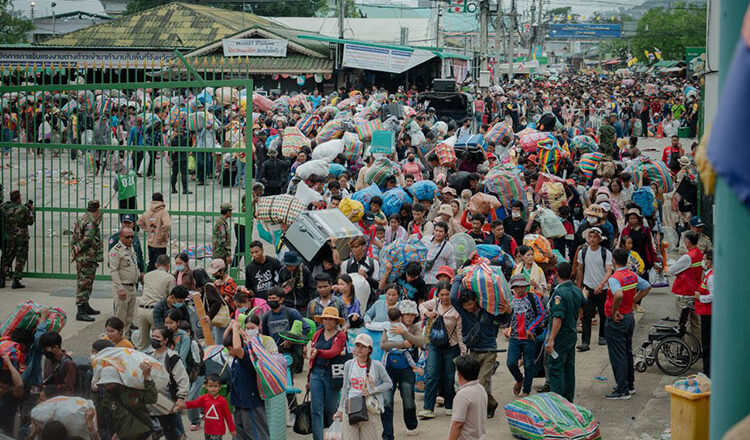
Cambodia migrant workers have returned in huge numbers since fighting broke out on July 14. To date, more than 400,000 people have returned to the Kingdom. FB
The Phnom Penh Post | It has been five days since Cambodia and its people were first forced to endure brutal acts of aggression from the Thai military along the border in the areas of the Ta Mone Thom, Ta Mone Touch, and Ta Krabey temples. Thailand has expanded this aggression to the three provinces bordering Cambodia, especially the Preah Vihear temple area, which the International Court of Justice (ICJ) ruled in favour of Cambodia of on June 15, 1962, determining that the temple and the area around the Preah Vihear temple belong to Cambodia.
UNESCO listed the temple as a World Heritage Site on July 7, 2008, to protect and preserve it for humanity. Unfortunately, in the last four days of fighting, Thailand has not only used F-16s fighter jets, but it also internationally banned cluster bombs to bomb Cambodia. Thailand also bombed the Preah Vihear Temple, causing extensive damage, in total disregard for international law and this important world heritage site.
A few days ago, on August 25, the Thai military commander and the Thai King issued a decree of martial law in eight districts along the border, seemingly as part of preparations to attack Cambodia from the sea and all along its borders, rejecting the mediation and resolution mechanisms from ASEAN, the UN and third parties. They have told the international community that Cambodia is the one who instigated the conflict, while Thailand is the one who crossed the “red line” first, starting with their 10-point actions against Cambodia as follows.
On May 28, Thai soldiers crossed the disputed area and shot at Cambodian soldiers in the trenches without any warning, killing a Cambodian soldier, Suon Rorn. From this point on, Cambodia also agreed to negotiate with Thailand, the Thai military chief in the area and the Thai commander in chief, but the Thai leaders always behaved differently to the way they agreed, whether it was the military or political leadership. They “shook hands then stepped on our feet”. This means that Thailand never respected any agreement with Cambodia, never following the bilateral mechanism that it likes to talk about and clsims to want to represent. seeing that the bilateral negotiation mechanism never worked and was always trampled on and disrespected by Thailand, Cambodia decided to submit the dispute to the International Court of Justice (ICJ) for adjudication in order to resolve the dispute and prevent further disputes for future generations. However, the Thai side not only refused to use international legal mechanisms, but also threatened to cut off off electricity, internet and the sale of oil, fuel and goods to Cambodia on June 12, causing caused Cambodia to cut them off first before Thailand acts.
Thailand unilaterally closed the border with Cambodia without informing Cambodia in advance on June 24, changing the hours from 6am-10pm to 8am-4 pm. This prompted Cambodia to retaliate by opening them at 9am and closing them at 3pm. Later, the Thai commander of Army region Two and their military closed all checkpoints unilaterally. Cambodia later decided to close all checkpoints following Thailand, which further escalated the conflict caused by the Thai side.
The Thai commander of Army region Two, Bun Sin Phatklang told a group of students that if there was a war with Cambodia, the Thai army would destroy the Cambodian army in just three days.
On the morning of July 13, 2025, two Thais assaulted a Cambodian soldier, offering to shake hands before punching him in the face and fleeing.
Thai soldiers have built roads and cleared trees in the disputed area, in violation of bilateral agreements during the tension.
A group of soldiers wandered off their usual patrol route in the triangle area into Cambodian territory on July 16, stepping on landmines left over from the Khmer Rouge era along the border, with one soldier losing a leg and two others also injured.
Another patrol wandered off their regular route a few days later, triggering another landmine incident. Thailand accused Cambodian forces of laying new mines, in breach of the Ottawa Convention Treaty on the prohibition of anti-personnel mines, when it fact the mines in question were remnants of past wars.
On July 22, the commander of Army Region Two warned that he would close the Ta Moan Temple to Cambodian visitors, and then began to erect barbed wire barricades around it on July 24. Prime Minister Hun Manet warned them at the time that this was a “red line” that should not be crossed.
On July 24, 2025, Thai soldiers erected barbed wire around Ta Moan Thom Temple, but the Cambodian army forbade them, yet the Thai soliders continued to erect it. After erecting it, the Thai soldiers fled to their trenches. When the Cambodian soldiers went to remove the barbed wire, the Thai soldiers started firing on the Cambodian soldiers, which led the clash to break out. Thailand then expanded the invasion to other directions along border with Cambodia in their Northeastern part.
10 Thailand appears to have an internal political crisis to ignite a war of aggression with Cambodia to attract nationalism for the Thai royal family and military, which did not have much support from the Thai youth or public. Every time Thailand has internal problems or political crises in its own country, it always started a war with Cambodia.
These are ten key points that the world must understand about the current conflict.
Cambodia has always been a peaceful loving nation and used international law mechanisms to resolve disputes with Thailand and other conflict areas to maintain good friendship, but Thailand has always rejected international legal mechanisms and has always wanted to invade Cambodia, in accordance with the wishes of the current Thai king, who once promised revenge on Cambodia after Thailand lost the adjudication at Preah Vihear Temple during the reign of King Bhumibol Adulyadej, the father of King Maha Vajiralongkorn, the current Thai king to Cambodia in 1962.
Cambodia has always respected international law to maintain peace with its neighbours, the region and the world, yet Thailand has always rejected solutions, including a recent ceasefire proposal by the Malaysian prime minister, who serves as the current ASEAN chair.
He spoke with the Cambodian prime minister and the acting Thai prime minister, and both reportedly agreed to a ceasefire. Just an hour later, Thailand rejected the agreement.
US President Donald Trump has also called for an immediate ceasefire, with Cambodia agreeing. Thailand broke this agreement with Cambodia and the US, to launch yet another aggressive attack on Cambodia.
Bin Yan is a young, independent political analyst. The views and opinions expressed are his own.