Senior Cambodian official details Thai breaches on international law at APF
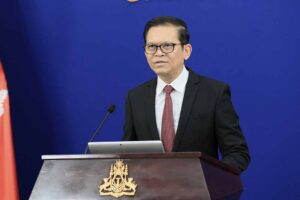
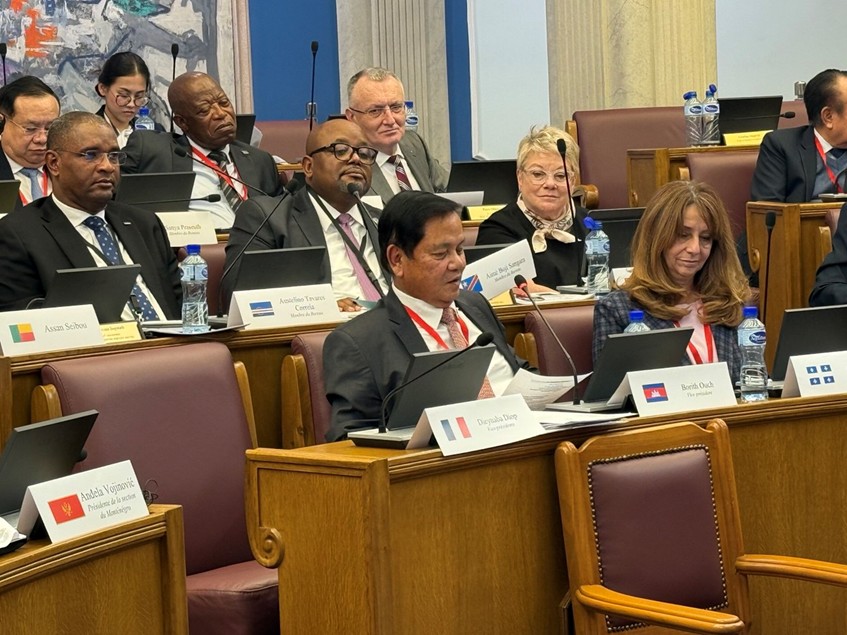 Ouch Borith (centre), first vice-president of the Senate and vice-president of the Assemblée Parlementaire de la Francophonie (APF). FN
#National
The situation along the land border has severely deteriorated because existing principles and mechanisms, intended to prevent the spread of conflict, have not been fully respected or effectively implemented by the Thai side, said Ouch Borith, vice president of the Assemblée Parlementaire de la Francophonie (APF).
During the Executive Committee meeting of the APF, held from January 30 to 31, 2026, at the Parliament of Montenegro, Borith, who also serves as first vice-president of the Senate, delivered a speech on “The Political Situation in Southeast Asia”, during which he detailed the issue of Thailand’s invasion of Cambodia.
He stated that the Southeast Asian region, long praised as a model of shared economic growth, is currently facing serious tensions that are affecting stability and raise questions about the fundamental principles and overall trust of the entire region.
Borith noted that respect for the rules and principles of international law is worryingly declining, which provides an opportunity for the implementation of unilateral measures to force recognition of a de facto situation created by power and the influence of force. This undermines the multilateral legal framework.
He added that the current situation along the land border between Cambodia and Thailand has severely deteriorated. This development is even more concerning because existing principles and mechanisms, intended to prevent the spread of conflict, have not been fully respected or effectively implemented.
He explained that at the regional and international levels, the ASEAN Charter and the UN Charter clearly stipulate peaceful dispute resolution and respect for sovereignty. At the bilateral level, the 1904 Treaty, the 1907 Convention, and the annexed maps attached to these documents form a set of legally binding instruments, recognised at both bilateral and international levels, which clearly define the demarcation of the border between the two countries.
Borith added that despite these mechanisms, incidents continue to occur frequently, and the risk of conflict spreading remains high.
“This is due to Thailand’s disrespect for the aforementioned legal documents and its unilateral attempts to change the status quo of the territory based on maps unilaterally prepared by the Thai side, which have no agreed legal basis or international recognition,” he said.
“This deviation from the framework reached its most dangerous level during the military operations that took place from December 7 to December 27, 2025, and became even more severe after the entry into force of the ceasefire adopted at the extraordinary meeting of the General Border Committee (GBC) on December 27, 2025,” he added.
Borith noted that, in violation of these agreements, Thai troops continued to invade Cambodian territory, even constructing barriers, including razor wire fences and shipping containers, blocking access to the homes of civilian populations and prolonging the evacuation of many people.
“What is even more serious is that these activities have been accompanied by the continued presence and control of several areas clearly located within Cambodian territory, constituting an illegal occupation, as well as destructive actions against civilian homes and infrastructure,” he pointed out.
“Are we witnessing the emergence of what is called a new order, where law is determined by the strong, or the resurgence of a policy of imposing a situation created from the sadness of an order based on coercion rather than on law?” he asked.
He added that Thailand has implemented a situation where actions contradict words and commitments, distorting the truth and creating confusion in understanding, turning white into black and black into white.
“This country has violated the territory of others, donned the guise of a victim, and used the abusive pretext of so-called legitimate self-defence to confront a threat that it itself directly created,” he said.
“In the modern international order, and with sincere respect, it is incomprehensible to claim that a small state, weaker both economically and militarily, would have the insane ambition to invade or seize the territory of a neighbouring country that is infinitely stronger.
“From a legal perspective, Cambodia’s position is very clear. The border must be based on legally binding instruments, including, for example, all rulings of the International Court of Justice concerning Preah Vihear Temple. These decisions are not options and cannot be negotiated. Any attempt to alter the de facto situation on the ground through force is a serious violation of international law,” he said.
Cambodia vehemently protests the illegal occupation of parts of its sovereign territory. Any illegal occupation cannot create any legal effect. Borith called on the Francophone parliamentary community to urge Thailand to respect international laws.
“Cambodia demands the unconditional withdrawal of all foreign military presence from its territory, as well as the restoration of conditions that allow civilian populations to return safely,” he added.
-Phnom Penh Post-
———————