Cambodia needs a military doctrine for an age of uncertainty
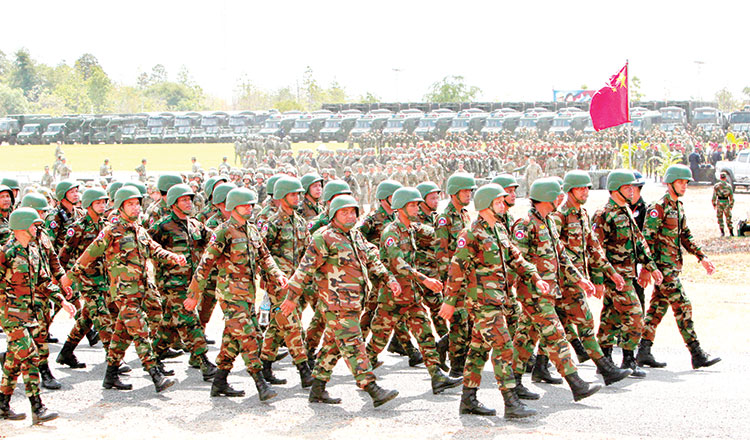 Combined troops from Cambodian and Chinese armies during the ‘Golden Dragon’ exercises at the Military Police Training Centre in Samakki Meanchey district in Kampong Chhnang province 2024. KT/Heng Chivoan
#opinion
Cambodia is a peaceful country. It seeks no conflict, threatens no neighbor and remains committed to neutrality, nonalignment and peaceful coexistence. But peace does not protect itself. To sustain peace, we need to prepare for war.
In a world where international law is under stress, power politics is returning, borders are contested and new technologies are changing the character of war, Cambodia needs a clearer military doctrine for self defense.
A military doctrine is not a war plan. It is not a call for militarization. It is a national guide for how the armed forces think, prepare, organize, lead and act in times of peace, crisis and conflict. We need to address this question: How can a small state defend its sovereignty, protect its people and preserve peace in an increasingly unstable world?
Cambodia’s defense posture is fundamentally defensive, while becoming more agile, resilient, and interoperable. This approach is consistent with Cambodia’s longstanding commitment to neutrality, nonalignment, peaceful coexistence, and the protection of national sovereignty against foreign coercion and aggression.
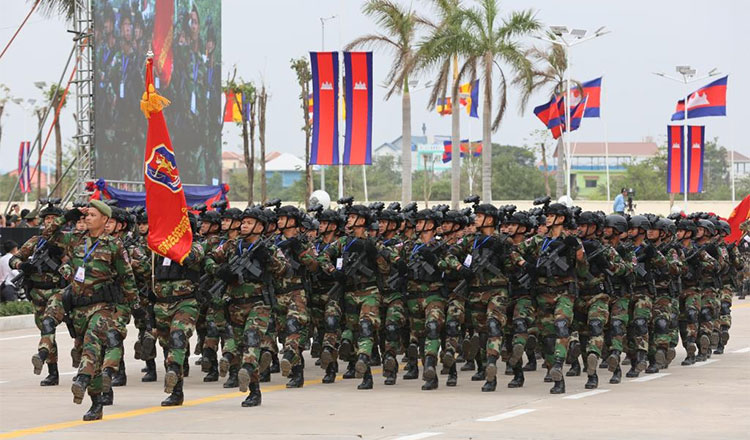
The use of force to alter the status quo, violate international boundaries, or create faits accomplis on Cambodian territory can never be accepted. Cambodia is committed to defending its sovereignty with moral high ground by upholding the spirit of international law, while enhancing domestic resilience and national cognitive power and mobilizing international support.
A small state does not measure success by destroying an opponent. It measures success by denying any adversary the ability to change its borders by force, preserving national unity, building credible deterrence, protecting the population and restoring peace on terms consistent with international law.
This is why Cambodia needs a doctrine of peace through preparedness. Border surveillance, maritime awareness, rapid intervention forces, reserve capacity, secure communications, professional military education and disciplined command are instruments of peace because they reduce vulnerability and deter miscalculation.
Border forces should serve as the first line of defense, equipped with clear responsibilities, surveillance tools, mobility and rapid reporting systems. Main combat forces should be organized as mobile joint intervention units, ready to reinforce border areas, respond to crises and manage escalation.
Maritime security must also move closer to the center of national defense thinking. Cambodia’s coastline, ports, maritime resources and sea lines of communication are strategic assets. There is a serious need for reform in this field.
As Ream and other maritime infrastructure are modernized, Cambodia should strengthen maritime domain awareness, coastal defense, port security and international maritime cooperation.
Fighting power has three dimensions: physical power, moral power and conceptual power. Physical power includes personnel, equipment, logistics, infrastructure, mobility and firepower. Moral power includes leadership, discipline, legitimacy, cohesion, patriotism and public trust. Conceptual power includes doctrine, strategy, operational art, professional military education and the ability to learn from history and contemporary conflict.
For Cambodia, the moral dimension is decisive. The armed forces must be deeply connected to the people. We need to strengthen our “people’s war” against foreign aggression.
Public trust, national cohesion and civil-military solidarity are part of national defense. A military that is respected by the people has deeper resilience. A military that serves the people in disasters, emergencies and development tasks strengthens the foundation of national security.
The armed forces must be ready to support emergency response, transport, engineering, medical services, communications and continuity of government.
Cambodia also needs a more modern command philosophy. The country should adopt what may be called disciplined mission command: centralized intent, decentralized execution.
Senior leaders should define the political purpose, military objectives, boundaries and priorities. Subordinate commanders should then be given the flexibility to act within that intent, using local judgment and initiative.
This model is especially suitable for Cambodia. It preserves political control over sensitive issues such as sovereignty, borders and internal stability, while allowing tactical flexibility in fast-moving situations.
Leadership must therefore be treated as a combat capability. Cambodia’s military leadership doctrine should be simple: lead with character and integrity, command with competence, act with initiative and learn continuously.
Strategic leaders must set vision, allocate resources and guide reform. Operational leaders must translate strategy into plans, readiness and joint coordination. Tactical leaders must lead from the front, maintain discipline and make sound decisions under uncertainty.
Professional military education is equally essential. Doctrine should require regular exercises, after-action reviews, study of military history, officer and noncommissioned officer development, cross-service education and doctrine cells within military education institutions. A military that does not learn becomes rigid. A military that learns becomes adaptive.
Technology must also be incorporated into doctrine. Cambodia needs affordable, practical and asymmetric defensive capabilities: drones for border and maritime surveillance, secure communications, intelligence systems, logistics digitization, cyber support, civil-military innovation partnerships and stronger local maintenance capacity. Technology should serve sovereignty, not dependency.
Finally, Cambodia’s doctrine must rest on clear ethical and political foundations. The armed forces must be loyal to the nation, religion, King, Constitution and legitimate government. They must be defensive in purpose, professional in conduct and lawful in the use of force. They must protect public trust through discipline, integrity, restraint and service.
The doctrine Cambodia needs can be summarized in one motto: Firm in sovereignty, flexible in action, united with the people.
Cambodia must be firm in defending its independence and territorial integrity. It must be flexible in adapting to new threats, technologies and forms of warfare. And it must remain united with the people, because the ultimate foundation of national defense is national cohesion.
The first step should be the publication of a capstone military doctrine that connects national defense policy, command philosophy, force design, leadership, training, technology and reform.
This should be followed by the adoption of disciplined mission command across military schools and commands; the reorganization of forces around border defense, mobile intervention, maritime security and joint support; and the creation of a doctrine-learning cycle based on exercises, reviews and regular revision.
In an age of uncertainty, peace belongs not to the passive, but to the prepared. For Cambodia, the purpose of military doctrine is not to prepare for war. It is to protect sovereignty, preserve peace and ensure that the Cambodian people can live in peace and dignity.
Chheang Vannarith is Chairman of National Assembly Advisory Council (NAAC). The views here are his own.
-Khmer Times-