Cambodia’s Strategic Window Is Closing: Diplomacy Must Become Deterrence
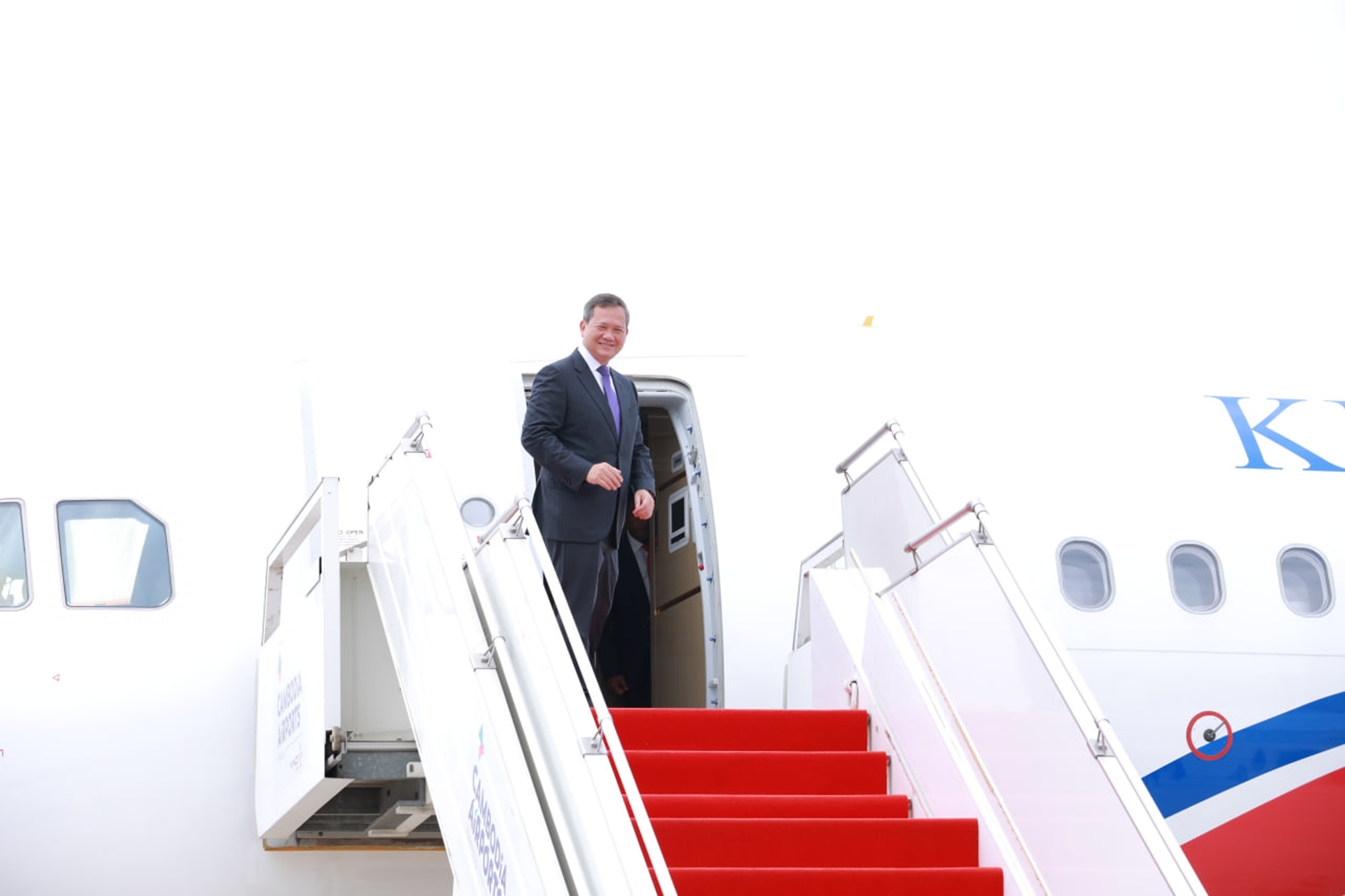 Prime Minister Hun Manet departs on a state visit in 2025. The author has suggested that now is the perfect time to recalibrate Cambodian foreign policy to guarantee security. FB
#opinion
Prime Minister Hun Manet’s participation in the US’ newly established “Board of Peace” should not be treated as a ceremonial diplomatic engagement. It is a signal — and perhaps one of the last strategic openings Cambodia has to recalibrate before regional and global conditions become less forgiving.
Cambodia is entering a geopolitical era where neutrality is no longer automatically respected, where international law is increasingly optional for powerful states and where economic dependency can be weaponised as effectively as military force. In such a world, small states do not collapse because they are wrong. They collapse because they are isolated, predictable, and strategically overexposed.
Cambodia must recognise a hard truth: the window for strategic repositioning is open now, but it will not remain open for long.
The World Has Shifted — and Cambodia Cannot Pretend Otherwise
For decades, Cambodia has anchored its external posture in sovereignty, non-interference and international legal frameworks. These remain essential principles. But principles are not protection. The global order is increasingly shaped by power competition. Multilateral institutions still exist, but their effectiveness is constrained by veto politics, rival blocs, and selective enforcement. The UN is not a neutral referee. International courts are not enforcement bodies. Global norms are routinely invoked by major powers when convenient and ignored when inconvenient.
In other words, the system is evolving into a transactional order — one where outcomes are increasingly decided by leverage, not legality. Cambodia must therefore abandon one dangerous assumption: that being legally correct guarantees strategic safety. International law can support Cambodia’s claims. It cannot substitute for Cambodia’s preparedness.
Cambodia’s Vulnerability Is Not External Pressure — It Is Strategic Predictability
Cambodia’s foreign policy has produced stability and growth, but it has also produced strategic narrowing. Over time, Cambodia has become diplomatically predictable — and in geopolitics, predictability is not stability. It is vulnerability.
When a country is perceived as having limited strategic alternatives, it becomes easier to pressure. Investors hesitate. Partners calculate risk. Neighbours test boundaries. Competitors assume the country lacks room to manoeuvre.
This is how small states lose influence without losing territory: they become strategically constrained.
Cambodia does not need to abandon any partnership. But Cambodia must reduce dependency on any single strategic pillar. A country with only one major external anchor becomes easy to corner.
Diversification is not ideology. It is survival. Thailand Is Not a “Past Conflict.” It Is a Future Risk.
Cambodia and Thailand enjoy functional relations today, supported by trade and cross-border movement. Yet history should caution against complacency. Border tensions between the two states have never been purely legal disputes; they are deeply connected to domestic politics, nationalist mobilisation and symbolic legitimacy.
The Preah Vihear crisis proved a central lesson: even after international legal clarification, political escalation remains possible. Cambodia should not assume that “normal relations” are permanent. Stability can be disrupted quickly by election cycles, military posturing or opportunistic nationalist narratives. When border disputes re-emerge, they are rarely confined to the frontier. They expand into diplomacy, media legitimacy, economic leverage and alliance politics.
Thailand holds stronger institutional defence relationships with Western partners and deeper integration into international security networks. Cambodia must prepare for the possibility that future disputes will be shaped as much by global perception and strategic alignment as by legal facts.
Preparedness is not paranoia. It is responsible governance.
Cambodia’s Reconnection with Washington Must Be Treated as a Strategic Asset
Cambodia’s engagement with the US should not be measured by symbolism or short-term diplomatic optics. It must be treated as a structural strategic opportunity.
The US is not a moral guarantor, and Cambodia should not expect external powers to act altruistically. But Cambodia can still use engagement with Washington to build strategic depth — and strategic depth is deterrence.
This requires moving from episodic diplomacy to institutional architecture: a permanent security dialogue with measurable deliverables, expanded cooperation in peacekeeping and humanitarian operations, joint training focused on non-escalatory defence areas and structured maritime transparency initiatives.
The objective is not to provoke neighbours. The objective is to ensure Cambodia is not isolated. A strategically connected state is harder to pressure. A strategically isolated state is easy to test.
The EU and US Trade Relationship Is Not Only Economic — It Is Geopolitical
Cambodia’s access to US and EU markets is not merely about growth. It is about strategic resilience.
Economic dependency is now a tool of pressure. Sanctions, tariff barriers, due diligence laws and supply chain restrictions are increasingly used as geopolitical instruments. Cambodia cannot claim sovereignty while ignoring the strategic reality that trade access has become a national security issue.
Cambodia should pursue a deliberate strategy to position itself as a trusted export platform by strengthening labour compliance, enforcing transparent supply chain standards, demanding beneficial ownership accountability for exporters, integrating anti-trafficking enforcement into economic policy and aggressively dismantling cybercrime networks and scam compounds.
This is not about satisfying Western moral expectations. It is about removing risk signals that discourage investment and undermine national leverage. A country perceived as a high-risk jurisdiction will inevitably pay the price — in market access, finance and diplomatic credibility.
Human Rights Criticism Is Not Only a Moral Issue — It Is a Strategic Liability
Cambodia’s relationship with the West has repeatedly been trapped in a cycle of rhetoric: the West condemns, Cambodia rejects, and the stalemate continues.
This cycle is strategically costly. Human rights scrutiny is not merely reputational. It carries concrete consequences: trade preferences, investment confidence, international legitimacy, and diplomatic manoeuvrability. It restricts Cambodia’s ability to build balanced partnerships and weakens its ability to mobilise support in moments of dispute.
Cambodia will not reduce scrutiny through argument alone. It must reduce scrutiny through measurable governance improvements. This does not require political destabilization. It requires strategic institutional reforms that strengthen the state while lowering international friction.
Cambodia should prioritise reforms with high strategic impact: legal safeguards to prevent politically perceived prosecutions, transparent dispute mechanisms for labour and land issues, predictable judicial procedure standards and election dispute transparency supported by professional monitoring frameworks.
A confident state does not fear reforms that strengthen institutions. Weak institutions invite both internal fragility and external pressure. Governance credibility is geopolitical capital.
Cambodia Must Stop Treating Foreign Policy as Personality-Driven
Cambodia’s diplomacy has too often relied on personal relationships, short-term messaging and reactive decision-making. That model is dangerous in a world of strategic competition.
Cambodia needs institutional foreign policy capacity: strategic planning units, crisis scenario frameworks, risk forecasting mechanisms, disciplined strategic communications and a professional diplomatic corps with technical expertise. Foreign policy cannot remain a series of responses. It must become a doctrine.
A Strategic Doctrine for Cambodia: Sovereignty Through Depth
Cambodia’s future security will not be protected by declarations. It will be protected by strategic depth — the accumulation of diversified partnerships, economic resilience, institutional credibility and global relevance.
Cambodia must pursue a doctrine based on three pillars: diversification as deterrence, credibility as protection and connectivity as sovereignty. This is not theory. It is the reality of modern state survival.
Conclusion: Cambodia Must Act Before It Is Forced to React
Cambodia is not facing immediate crisis. That is precisely why this is the moment to act.
Strategic recalibration is easiest before pressure arrives, not after. When crisis comes, choices narrow and dependence deepens. If Cambodia waits until it is tested — by regional tension, economic coercion or diplomatic isolation — it will already be negotiating from weakness.
Prime Minister Hun Manet’s participation in Washington should therefore be treated as more than diplomacy. It should be treated as a pivot point: a chance to build strategic architecture that prevents future vulnerability.
Cambodia must not mistake stability for security.
In the next geopolitical era, sovereignty will not belong to those who are merely right. It will belong to those who are prepared — and those who are strategically connected before the crisis begins.
Panhavuth Long is founder and an attorney-at-law at Pan & Associates Lawfirm. The views and opinions expressed are his own.
-Phnom Penh Post-
———————