Twisting Narratives on the History of “Khom” and the Authentic Heritage of Prasat Chan
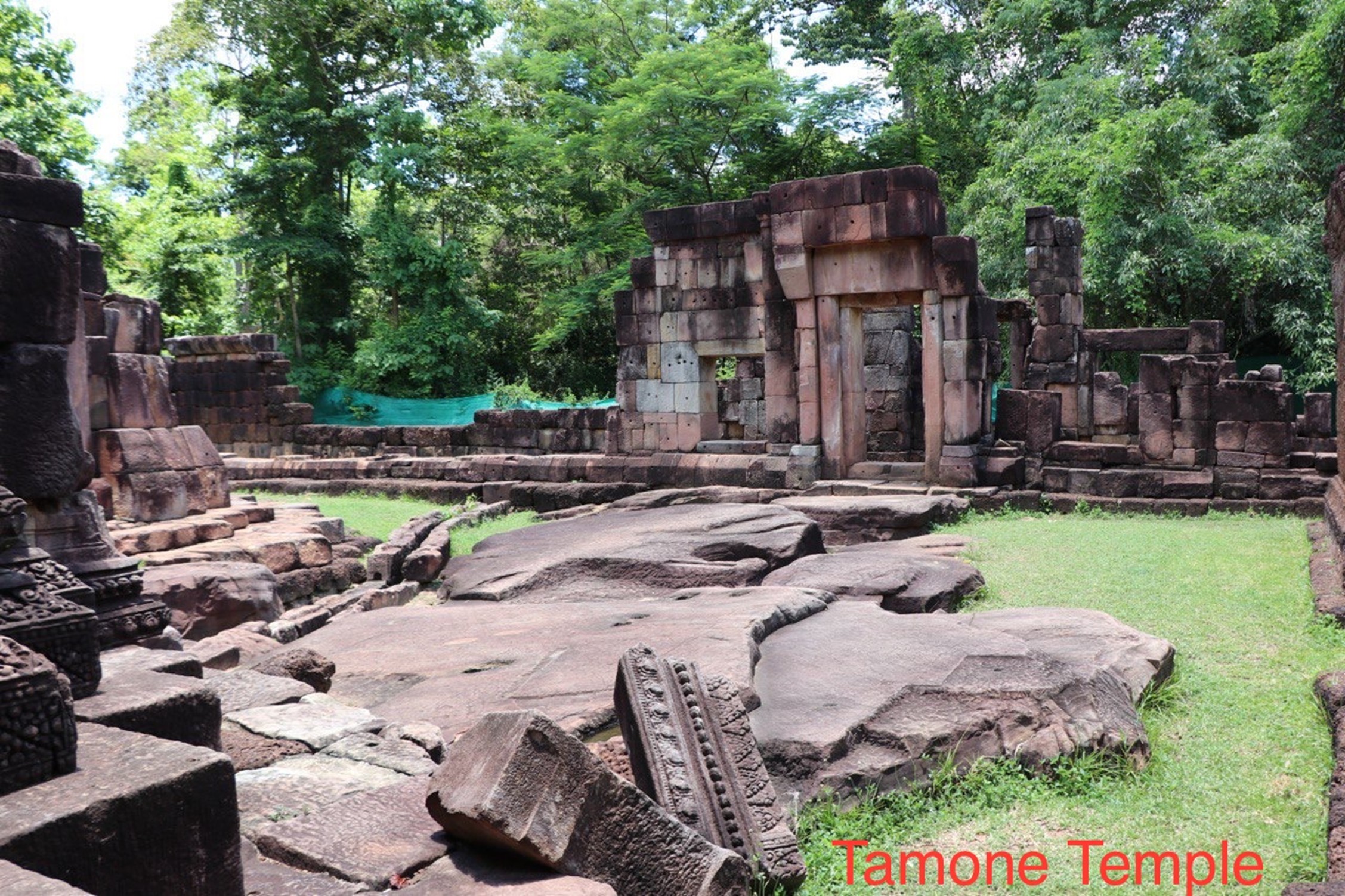 IMAGE: The Ta Mone Temple has been international recognised as Cambodian territory for more than a century. Supplied
#Opinion
Recent Thai narratives concerning Prasat Chan and the Ta Mone Temple complex reflects a profound misunderstanding of history, archaeology, international law and internationally accepted principles of cultural heritage conservation. More seriously, it represents deliberate rhetorical tactics aimed at reshaping historical narratives to imply that Ta Mone Thom belongs to Thailand, despite the temple being situated within Cambodian sovereignty, as clearly established under international law.
Even more concerning, the narrative perpetuates a long-standing distortion surrounding the term “Khom”, which must be addressed clearly, responsibly and based on verifiable historical evidence.
1. “Khom” = Khmer:
In historical, epigraphic and archaeological scholarship, “Khom” is not an ethnic group, a civilisation or a lineage distinct from the Khmer. The term Khom appears primarily in later Thai and Lao chronicles as an exonym, a name used by others, to refer to the Khmer people and Khmer civilisation, particularly during and after the Angkorian period.
All so-called “Khom temples” are, in academic reality, Khmer temples, constructed between the 9th and 13th centuries during the height of the Khmer Empire. Their builders, patrons, architects, religious systems, inscriptions, construction techniques and cosmological layouts are unequivocally Khmer.
This is demonstrated by:
– Sanskrit and Old Khmer inscriptions identifying Khmer kings, deities and donors
– Khmer architectural styles (Baphuon, Angkor Wat, Bayon, etc.)
– Hydraulic, symbolic and cosmological planning consistent with Angkor
– Direct political, administrative and religious integration into the Khmer imperial system
To claim that modern Thai people are the “descendants of Khom” while Khmer people are not is historically false, logically incoherent and unsupported by any credible scholarship. Thai ethnogenesis occurred centuries later, shaped by Tai-speaking migrations, regional assimilation and state formation processes distinct from the Angkorian Khmer civilisation.
2. Thai are Not the Descendants of “Khom” According to Real History
Historically, the Khmer civilisation predates the formation of Thai kingdoms such as Sukhothai and Ayutthaya. During the Angkorian period, large parts of present-day Thailand were within the Khmer empire, the so-called “raja mandala”, not the reverse.
The historical record shows:
– Khmer temples existed before Thai polities emerged
– Early Thai states adopted Khmer court practices, religious concepts and administrative models
– Thai chronicles themselves acknowledge borrowing from Khmer civilisation
Thus, the claim that Thai people are the rightful heirs of “Khom heritage” while Khmer are not is a revisionist narrative, constructed to retroactively legitimize cultural and territorial claims rather than to reflect historical reality.
3. The Thai Article as a Political and Cultural Misrepresentation
The Thai narrative employs a serious rhetorical trick: it equates modern reconstruction with historical legitimacy, while portraying authentic ruins as evidence of incapacity or neglect. This approach subtly advances the notion that Ta Mone Thom belongs to Thailand because it has been rebuilt, despite its location within Cambodian territory.
This narrative conflates:
– Restoration with ownership
– Modern construction with ancient heritage
– Financial capacity with historical legitimacy
Such reasoning is fundamentally flawed and contradicts both heritage ethics and international law.
4. Ta Mone Thom Is Situated Under Cambodian Sovereignty
Ta Mone Thom Temple is situated within Cambodian territory, in accordance with the Franco–Siamese Treaties of 1904 and 1907, which established the modern international boundary between Cambodia and Thailand.
These treaties:
– Were negotiated and signed under international law
– Defined borders using watershed lines and official maps
– Are legally binding and internationally recognised
Cambodia’s sovereignty over the Ta Mone Thom complex is therefore not a matter of opinion, restoration activity or modern tourism development, but a matter of established international legal instruments. No amount of reconstruction, narrative manipulation or cultural appropriation can alter this legal reality.
5. Restoration Is Not Proof of Ownership, Nor of Cultural Authenticity
The Thai narrative praises the total reconstruction of Ta Mone Thom while denigrating the condition of Prasat Chan as a “failure” of heritage stewardship. This comparison fundamentally misunderstands the ethics of conservation.
According to internationally recognised standards, such as the Angkor Charter, the Venice Charter, UNESCO conservation guidelines and ICOMOS principles, complete reconstruction that replaces original fabric with modern materials destroys authenticity, even if the result appears visually “impressive”.
A monument that has been rebuilt almost entirely in modern times ceases to be a primary historical document. It becomes an interpretative structure, not archaeological evidence.
In contrast, Prasat Chan, though in a ruined state, remains:
– Archaeologically authentic
– Stratigraphically intact
– A truthful record of time, use, damage, and abandonment
Its stones stand where history left them, not where modern authorities decided they should be placed. This is not neglect; it is ethical restraint.
6. Preservation Is Not Poverty; It Is Responsibility
The claim that Prasat Chan is “abandoned”, “destroyed”, or “forever lost” because it has not been rebuilt reflects a fundamental misunderstanding of modern heritage management.
Contemporary conservation prioritises:
– Risk mapping and structural diagnosis
– Minimum intervention
– Reversibility
– Respect for original materials
Choosing not to rebuild is not a sign of incapacity, ignorance or lack of lineage. It is a professional and ethical decision to protect historical truth rather than manufacture spectacle.
To equate heritage value with financial capacity or cosmetic restoration is to reduce culture to construction and history to appearance.
7. The False Accusation of Opportunistic Claims
The Thai narrative alleges that Khmer authorities “wait” for others to rebuild temples before claiming them. This accusation ignores a fundamental principle: Cultural heritage is not claimed by reconstruction; it is recognised by history, archaeology and sovereignty.
Prasat Chan lies within Cambodian territory and forms part of the same Khmer sacred, political and cultural landscape as the Ta Mone complex. Its legitimacy does not depend on visual completeness, tourism readiness or modern rebuilding.
The notion that heritage becomes legitimate only after it is “made beautiful” reveals a mindset that prioritises territorial ambition and spectacle over historical integrity.
8. Real Heritage Is Not New Stone
The core issue is not Cambodia versus Thailand. It is authentic heritage versus refabricated or reinvented history.
– A rebuilt monument may impress visitors
– An authentic ruin educates humanity
Real heritage is not measured by polish, tourism revenue or nationalist pride. It resides in original stones, original placement and uninterrupted historical truth.
Prasat Chan has not lost its soul; it has preserved it.
The narrative that Khmer people are incapable custodians of so-called “Khom heritage” collapses under historical, archaeological, and legal scrutiny. Khmer civilisation is the civilisation that built these monuments.
History does not need to be rebuilt but to be respected.
It needs to be understood, protected and left honest.
If heritage is to serve humanity rather than politics, then authenticity, not spectacle, must remain the guiding principle.
Roth Serei is a Cambodian Scholar. The views and opinions expressed are his own.
-Phnom Penh Post-