Aggression Is Not a War on Scams
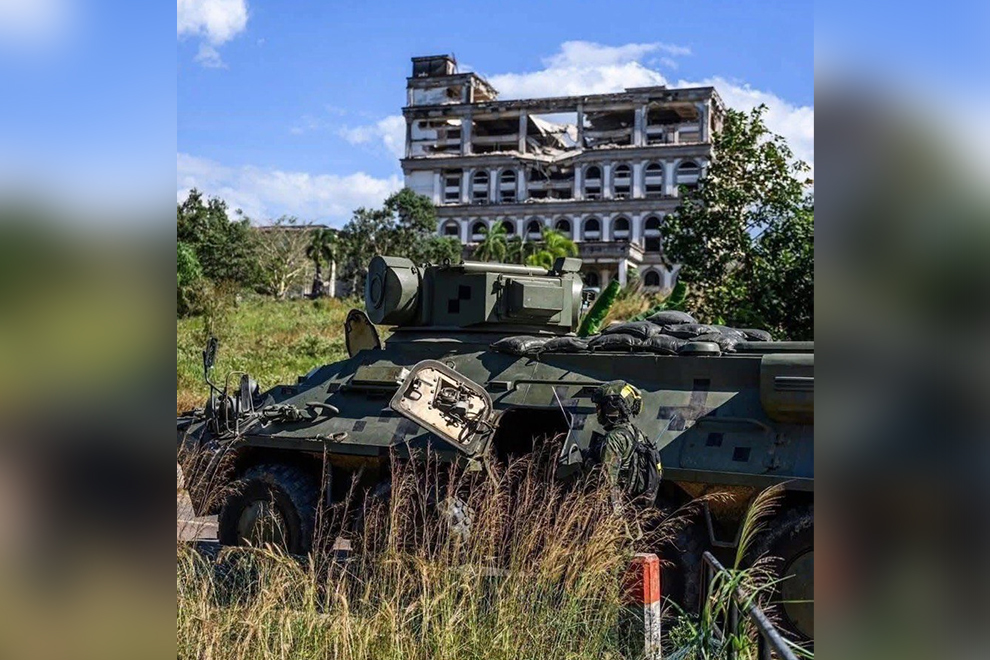 A Thai armoured vehicle near buildings that were destroyed by Thai artillery strikes in the Thma Da area of Pursat Province in December. FB
#opinion
If Thailand’s actions were limited to combating transnational scam networks, Cambodia would not be witnessing the deployment of military-grade weapons or damage to civilian infrastructure and residential areas. Law enforcement operations do not normally involve armed military deployments that disrupt civilian life, damage public facilities or assert control over land where another country’s civilians reside.
Cambodia must also note that these actions are accompanied by political rhetoric. On multiple occasions, senior Thai officials — including the current prime minister — have framed Thailand’s posture toward Cambodia in explicitly military terms. Public statements suggesting that confrontation would end only when Cambodia is no longer perceived as a security threat, or when its military capacity is sufficiently weakened to ensure long-term deterrence, raise concerns about the underlying intent of these operations.
When such statements are considered alongside the visible use of military assets and the destruction of civilian infrastructure, legitimate questions arise regarding the stated purpose of the actions. The convergence of force and rhetoric blurs the distinction between law enforcement and strategic pressure, undermining confidence in claims that these measures are purely defensive or criminal-justice based.
At a more fundamental level, alleged criminal activity within one state does not confer upon another state the right to use force, occupy territory or conduct military operations. International law recognises no doctrine under which accusations of crime justify armed intervention against a sovereign state. Even where transnational crime presents serious challenges, responses must remain grounded in cooperation, legal processes and respect for sovereignty.
As a member of the ASEAN community, Thailand is also bound by shared regional commitments, including respect for sovereignty, non-interference, and the peaceful resolution of disputes. Cambodia is a sovereign state with functioning institutions and the capacity to address criminal activity within its own territory.
Allegations of scams do not diminish Cambodia’s status as a country, nor do they justify the use of force by a neighbouring state. Where concerns exist, ASEAN principles require dialogue, cooperation and mutual assistance — not unilateral military action. Treating crime control as grounds for cross-border force risks undermining the very regional norms that ASEAN was established to protect.
Cambodia places this position on record not to escalate tensions, but to clarify realities. Actions involving weapons, damage to civilian infrastructure and the exercise of control over territory — particularly areas where Cambodian civilians have lived for many years — cannot be reconciled with established frameworks for cooperative anti-crime efforts.
Cambodia remains committed to peace and regional stability. That commitment rests on transparency, restraint, and mutual respect, not on arrangements that require one nation to accept prolonged vulnerability or insecurity in order to reassure another.
If Thailand maintains that its actions constitute a campaign against criminal scams rather than a confrontation with Cambodia, this claim must be demonstrated through conduct, not assertions. Continued military seizure, occupation and control of territory cannot be characterised as law enforcement.
Under international law, prolonged occupation transforms stated intentions into demonstrable acts of territorial aggression. Absent the return of occupied land and the full withdrawal of military forces, Thailand’s position that it is conducting a purely anti-scam operation cannot be sustained; such conduct constitutes an act of invasion and aggression under international law.
Panhavuth Long is founder and an attorney-at-law of Lawyer, Pan & Associates Law Firm. The views and opinions expressed are his own.
-The Phnom Penh Post-