
Enhancing national resilience through economic security
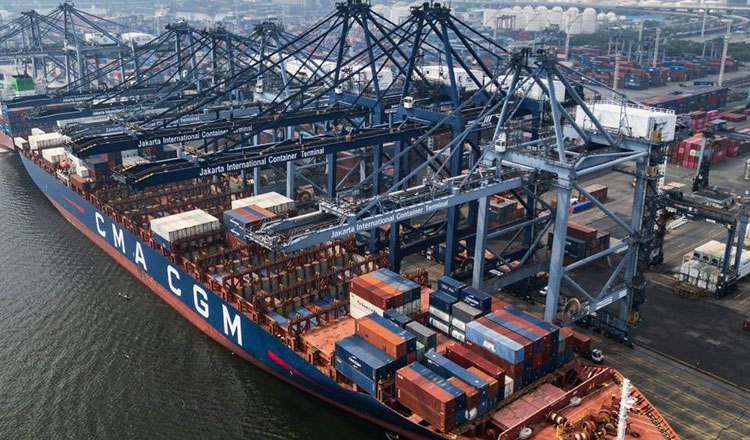 Aerial photo shows cargo containers stacked aboard a ship at the Jakarta International Container Terminal in Tanjung Priok Port, Jakarta, in August 2025. Cambodia must build up local production capacity and domestic supply chains to boost national resilience. AFP
#Op_ed
In an increasingly uncertain world shaped by geopolitical rivalry, technological disruption, and economic volatility, the meaning of national security has expanded.
Security today is not defined solely by military strength. Economic security and social cohesion have become fundamental to national resilience.
A nation’s ability to protect its economic system, strengthen domestic industries, and adapt to external shocks is now essential to safeguarding sovereignty and sustaining development.
Cambodia’s policymakers are increasingly aware of this strategic reality. The recent National Assembly seminar on fortifying national resilience and advancing science, technology, innovation, industry, and trade governance reflected a growing national consensus: resilient economic foundations are indispensable to a resilient state.
Informed governance and strategic policymaking
In her welcoming remarks, Nin Sophoan, Chairwoman of Commission 9 of the National Assembly, stressed that the seminar was intended to equip lawmakers with deeper insights into Cambodia’s development priorities and the major global trends shaping the future.
Strengthening parliament’s legislative, oversight, and representative functions requires a clear understanding of technological change, economic transformation, and geopolitical shifts.
Her message underscored an important truth: effective policymaking must evolve alongside national priorities, especially in areas such as digital transformation, industrial upgrading, and economic competitiveness.
Navigating a turbulent global environment
In her opening speech, Samdech Khuon Sudary, President of the National Assembly, highlighted the increasingly complex and volatile global environment in which Cambodia must operate. Armed conflicts, intensifying geopolitical competition, and disruptions to global supply chains, energy markets, and trade flows are creating new risks, particularly for smaller and open economies.
Yet Cambodia has continued to demonstrate resilience. With economic growth reaching around 5.2% in 2025, the country has shown that its economic fundamentals remain sound and that its people retain the unity and determination needed to weather global uncertainty.
Still, resilience cannot be taken for granted. Sustaining growth and stability will require proactive policies that strengthen economic security and reduce structural vulnerabilities to external shocks.
Six strategic priorities for strengthening national resilience
In her address, Sudary outlined six strategic priorities for reinforcing national resilience and economic security.
First, Cambodia must expand local production capacity and build up domestic supply chains. The national economy must become more inclusive, more internally connected, and more resilient to external pressures. Supporting “Made in Cambodia” products and diversifying markets are essential steps in this direction.
Second, Cambodia must continue building the capacity of small and medium enterprises. SMEs are the backbone of the national economy. They need greater support in technological adoption, innovation, digital transformation, and access to both domestic and international markets.
Third, the country must accelerate the expansion of ICT infrastructure and digital ecosystems. Digital transformation is no longer optional; it is a strategic necessity. It enhances productivity, enables e-commerce, strengthens local production networks, and supports Cambodia’s integration into the global digital economy.
Fourth, greater attention and resources must be directed towards the informal sector, which remains a vital pillar of the national economy. Millions of Cambodians depend on informal economic activities for their livelihoods. They are resilient, hardworking, and entrepreneurial, yet they often lack access to finance, technology, legal protection, and stable markets. Strengthening this sector is not only an economic imperative but also a social one.
Fifth, Cambodia must promote seamless inter-ministerial coordination, stronger executive-legislative cooperation, and more effective parliamentary oversight. Legal and regulatory frameworks need to be modernised to support economic security.
In this regard, the call for a comprehensive national economic security policy framework, alongside a clear national resilience strategy and implementation mechanism, is both timely and necessary.
Sixth, national resilience requires a whole-of-government and whole-of-society approach. Government alone cannot achieve this mission. The private sector, academia, civil society, and citizens must all work together to build a resilient and adaptive nation.
National resilience cannot be built overnight. It demands strong, clean, and smart institutions, seamless coordination, continuous innovation, and national unity. With a shared vision and collective effort, Cambodia can turn adversity into opportunity.
Technology and innovation as engines of resilience
The seminar also underscored the growing importance of science, technology, and innovation as strategic assets in a modern economy.
Hem Vanndy, Minister of Industry, Science, Technology and Innovation, emphasised that economic resilience depends on expanding domestic production capacity, diversifying industries, and strengthening innovation ecosystems. Industrial transformation and technological upgrading are essential if Cambodia is to move beyond labour-intensive production and enter higher-value segments of the economy.
He noted that Cambodia’s manufacturing sector continues to expand, with more than 3,000 factories employing over 1.2 million workers nationwide. This reflects the country’s growing industrial base. Yet the next stage of development must be driven not merely by expansion, but by innovation, productivity, and technological advancement.
Digital transformation and cybersecurity
Another indispensable pillar of economic resilience is digital transformation.
Post and Telecommunications Minister Chea Vandeth emphasised that geopolitical competition is increasingly extending into the digital domain. Cyberattacks, technology restrictions, and competition in artificial intelligence are becoming defining features of contemporary global power dynamics.
For Cambodia, strengthening digital infrastructure and cybersecurity is therefore not simply a technical matter; it is a matter of national security. Expanding telecommunications networks, improving data protection, and building national capabilities in emerging technologies will help protect digital systems while also creating new opportunities for economic growth.
At the same time, digital governance and technological innovation can make public administration more efficient, transparent, and responsive, thereby strengthening both state capacity and public trust.
Trade diversification and economic integration
Economic resilience also depends on strong and diversified trade relations.
Commerce Minister Cham Nimul highlighted the importance of enhancing trade competitiveness and expanding market access for Cambodian products. Trade diversification and deeper integration into regional and global value chains are vital to mitigating the risks associated with global economic uncertainty.
By promoting value-added production, supporting exporters, and broadening economic partnerships, Cambodia can strengthen its position in the global trading system. Maintaining open, predictable, and rules-based trade relations will remain essential to the country’s long-term prosperity.
Human capital as foundation of innovation
No economic transformation can succeed without human capital.
Professor Chhem Kieth Rethy, Senior Minister at the Office of the Council of Ministers, emphasised the urgent need to strengthen STEM education and develop skills relevant to the digital economy. In the 21st century, scientific knowledge and technological expertise are increasingly decisive determinants of national competitiveness.
This makes investment in education, research institutions, and workforce training not merely desirable, but indispensable. A robust innovation ecosystem requires talent, skills, and a culture of learning.
By equipping young Cambodians with the capabilities needed for the knowledge economy, Cambodia can lay the foundation for sustained growth, technological adaptability, and long-term national resilience.
Whole-of-government and whole-of-society approach
Enhancing national resilience ultimately requires a whole-of-nation approach.
Government institutions, the private sector, academia, and civil society must work together to build a dynamic economic ecosystem capable of adapting to global change. Parliament, in particular, plays a crucial role in shaping legislation, overseeing implementation, and ensuring that national strategies respond effectively to emerging risks and opportunities.
As Sophoan rightly emphasised, informed policymaking and institutional cooperation are indispensable to strengthening national resilience and advancing sustainable development.
Securing Cambodia’s future
The message emerging from the National Assembly seminar is clear: economic security is national security.
By investing in science, technology, industrial development, digital transformation, and human capital, Cambodia can strengthen its capacity to navigate an increasingly complex and contested global environment.
Resilience does not mean retreating from globalisation. It means building the strength to adapt, innovate, and compete in a changing world. Through strategic leadership, effective governance, and collective national effort, Cambodia can transform today’s challenges into opportunities and build a stronger, smarter, and more resilient future.
-Khmer Times-
—————-