Cambodia-Thailand: The choice between building an iron curtain or a lasting, legal border
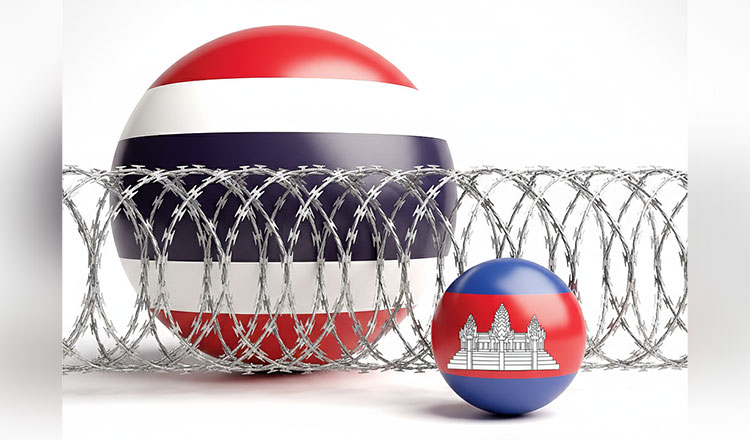 Cambodia and Thailand must decide if they want to build an iron curtain or a peaceful border between them. Khmer Times illustration
#opinion
The deadly border wars between Cambodia and Thailand in 2025 beg a serious question: Would the permanent neighbours prefer to build an iron curtain or a legal border between them?
There are several border models that Cambodia and Thailand should contemplate, considering they are eternal neighbours who cannot move away from each other unless one of them is wiped off the world map.
First, there is the iron curtain which was manifested in a few models during the Cold War.
For instance, there was the wall that divided Eastern and Western Germany, the heavily fortified Berlin Wall that stood for 28 years from 1961 to 1989.
And then there was the iron curtain in Hungary that was described in detail in a documentary entitled 1989 – The fall of the Soviet Union, produced by Anders Ostergaard and Erzsebet Racz.
In the documentary, the Hungarian reformist communist Prime Minister Miklos Nemeth (1988-1990) played a crucial role in dismantling the Hungarian Iron Curtain by opening the border with Austria in 1989.
He described how he had uncovered secret financial mismanagement by the communist state in the construction and maintenance of the electric border fence, which was constantly triggered by intruders, including wild rabbits, and thus constantly woke the border guards, depriving them of sleep.
Unnecessary spending, particularly on the construction of a superfluous border fence, had left Hungary bankrupt and heavily indebted.
Other models Cambodia and Thailand might want to emulate are the old Franco-German border model or the new Franco-German border.
The old Franco-German border was soaked with blood. The border was determined by the Congress of Vienna in 1815. The border changed after the French defeat during the Franco-Prussian War (1870-1871), where the French Third Republic was forced to yield Alsace-Lorraine to the new German Empire in 1871. The territory was returned to France 48 years later after the Treaty of Versailles in 1919. The border changed again in 1941 when Nazi Germany de facto annexed the region (without international legal recognition or a treaty). The current border was re-established after the defeat of Nazi Germany in World War II.
These borders are no different from the modern-day border situation between Cambodia and Thailand.
Since the fall of Angkor in the 15th century, the Cambodia-Thailand border, or the former Khmer -Siam border, has been characterised by a moveable boundary line leading to the shrinking of Cambodia and expansion of Thailand.
Since the start of the 20th century, after the Franco-Siamese treaties of 1904 and 1907, the only legally binding border treaties, concluded between these two nations, the bilateral border has undergone constant changes.
During World War II, Thailand, allied with Japan, claimed much of Cambodian territory, including the Temple of Preah Vihear, but returned it to France in 1946 as a condition for joining the United Nations. Following Cambodia’s independence in 1953, Thai troops reoccupied the Temple of Preah Vihear, prompting Cambodia to take the dispute to the International Court of Justice (ICJ) in 1959.
The ICJ ruled in 1962, rendering ownership of the Preah Vihear temple to Cambodia.
The conflict over the ownership of the temple and surrounding area erupted again in 2008 and in 2011.
But the most recent disputes in July and again in December last year were also the most deadly and large-scale border irredentism attempts.
The question is, how many more wars must Cambodia and Thailand fight, and how much more blood must be shed by both peoples, before a legal and lasting border can be established between these two permanent neighbors?
Must Cambodia and Thailand fight a third world war before their border is finally fixed?
Consider another border model: the modern-day Franco-German border that was finally settled by World War II. The current Franco-German border allows free movement of people, thanks to the 1985 Schengen Agreement. The border exists physically as a 450km line often following the Rhine River, with towns like Strasbourg and Kehl connected by bridges, trams, and seamless crossings.
This modern border feels more like a highway toll gate. It is completely different from border between India and Pakistan in Kashmir, where a highly theatrical Attari-Wagah border ceremony is performed regularly with an intense mood of nationalism.
The last border model that Cambodia and Thailand should ever wish for is the Russia-Ukraine border that is currently being redrawn with blood.
Among the various border models mentioned above, there is no better option for Cambodia and Thailand than to prioritise the construction of a legal, stable and peaceful border modelled on the modern border between France and Germany, guaranteeing smooth passage and exchange of people on both sides of the border.
A border that doesn’t look like a border. A border that acts as a bridge, a symbol of long-standing friendship and mutual trust between France and Germany, after centuries of bloody conflicts that finally ended with World War II.
The author is a Cambodian writer and civil servant at the Ministry of Economy and Finance. The opinions expressed here are his own.
-Khmer Times-