Thailand’s Narrative Is Moving Faster Than Verification. The Border Crisis Now Has a New Center of Gravity.
 Thailand’s Narrative Is Moving Faster Than Verification. The Border Crisis Now Has a New Center of Gravity.
-Opinion-
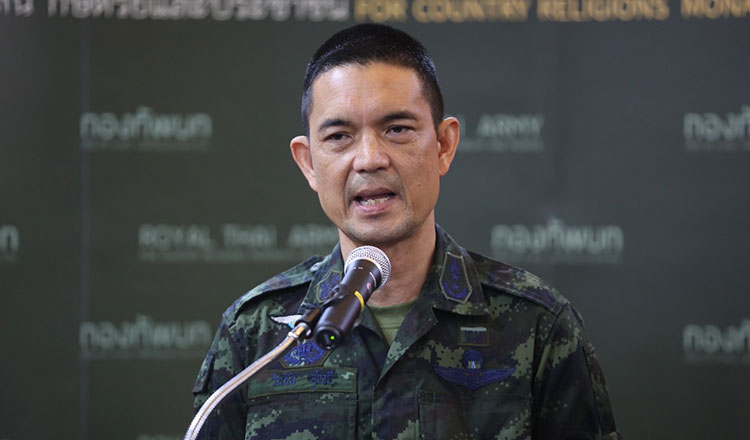
Thailand’s latest briefing on its confrontation with Cambodia reveals far more about Thailand’s internal landscape than about the incidents it claims to describe. When a government gathers its entire security and administrative spectrum into a single performance, from the Foreign Ministry and Government House to the Army, Navy, Air Force, Police, and even the Commerce Ministry, it is not displaying a unified front. It is concealing the fractures beneath it. In international affairs, a lineup that large is rarely a demonstration of coherence. It is a sign that the state fears its own institutions might contradict each other if allowed to speak independently. The unity on screen signals disunity off screen.
The Thai state’s narrative is expanding instead of stabilising. Each new statement adds more names, more institutions, more letters, more diplomatic recipients, more procedural steps, but not more evidence. The imbalance between certainty in rhetoric and silence in forensics has become the defining feature of this crisis. Neutral demining organisations have not been granted full access. No independent technical data has been released. No verifiable timestamps or chain of custody records have been published. Instead, Thailand is flooding the world with volume. They are attempting to replace fact-based legitimacy with procedural legitimacy, hoping that if enough institutions are named, enough letters are sent, and enough diplomatic engagements are announced, the absence of verification will become obscured.
The presence of the Commerce Ministry in a briefing ostensibly about landmines is one of the most revealing signals. Mines do not involve trade officials. Their appearance means Thailand is not only responding to a border incident; it is responding to economic anxiety. Behind the scenes, key sectors fear that the United States may align its trade position with its expectations under the Kuala Lumpur agreement. The Thai state therefore needs to reassure domestic investors and international partners that stability remains intact and that the crisis will not imperil market confidence. The choreography of the briefing was not designed for Cambodia’s ears. It was designed for Thailand’s financial class and for foreign governments whose economic decisions carry enormous weight.
The invocation of the United Nations, the Security Council, the Mine Ban Convention, ASEAN observers, diplomatic corps, and global embassies serves another strategic function. This is not merely internationalisation. This is over-internationalisation, used as a shield. When a narrative is broadcast into enough institutions simultaneously, responsibility becomes diffused. Pressure becomes scattered. Verification becomes someone else’s problem. This tactic is seen in states that aim to create diplomatic inertia before facts can be independently examined. By saturating the international space with early accusations, Thailand hopes to establish the allegation as a diplomatic reality long before the ground itself can be scrutinised.
The deeper question is why Thailand needs the story to be true more than it needs the facts to be correct. The answer is structural. The mine narrative gives the government moral legitimacy, military prestige, political protection, and economic reassurance. It simplifies the crisis into a humanitarian frame that is easier to control than the more complex realities of troop movements, local command decisions, or internal political pressures. Landmines evoke danger, urgency, and international sympathy. Border clashes evoke accountability. The Thai state has chosen the narrative with the least internal cost.
For international observers, it matters that the Kuala Lumpur agreement was witnessed by the United States and Malaysia. Thailand’s unilateral suspension puts both guarantors in a difficult position. If the allegations eventually collapse under independent verification, the credibility damage will ripple beyond Bangkok. Malaysia would face questions about the integrity of its mediation. The United States would confront pressure over its tolerance for treaty disruption in a region where stability is already delicate. These geopolitical realities explain why Thailand is working so quickly to secure its narrative before Washington or Kuala Lumpur arrive at their own assessment.
The speed is itself a signal. When a state accelerates communication faster than verification can occur, the behaviour becomes more important than the claim itself. Thailand is moving its narrative ahead of inspectors because inspectors represent the one terrain they cannot control. And once a government begins to outrun verification, every new briefing becomes less about clarifying events and more about protecting the narrative from collapse. This is why the briefing repeated the same points across multiple spokespersons. This is why evidence was replaced with procedure. This is why the story is expanding instead of contracting.
The internal dynamics within Thailand are a missing part of the international conversation. The Thai Army is not monolithic. Region 2, which borders Cambodia, has its own institutional culture and its own factions. The government’s decision to place every uniform on stage reveals a fear that differing internal narratives might leak, especially if the technical basis of the mine claim is weaker than advertised. Such signals are not lost on experienced analysts. When a state tries too hard to present one voice, it usually means there were many before the microphone switched on.
The ASEAN dimension also deserves attention. ASEAN norms rely on mutual consent, deescalation, and quiet diplomacy. Thailand’s unilateral suspension of the Kuala Lumpur agreement breaks these norms in a way that complicates regional coherence. If the dispute escalates or the narrative collapses, ASEAN will face fresh questions about its ability to manage intra-regional tension when member states act ahead of verification.
For Cambodia, the restraint shown so far has created a stark contrast. By avoiding reactive escalation and maintaining a call for independent inspection, Cambodia has shifted the burden of proof back onto Thailand. Silence and consistency are powerful in diplomacy. They highlight the urgency and theatricality of the other side. If the soil is examined and the findings diverge from Thailand’s narrative, the consequences will be severe. But Thailand knows this. This is why verification remains postponed while narrative production remains accelerated.
What emerges from all these layers is a picture of a state trying to stabilise its internal audiences, preempt external pressure, and build a diplomatic record before facts arrive. Thailand is using institutions as camouflage, not as mechanisms of accountability. It is appealing to global bodies not for scrutiny but for insulation. It is expanding its story because contraction would require evidence that may not withstand neutral examination. And it is racing not against Cambodia, but against the moment when inspectors step onto ground that has already been described in too much detail.
For an international audience, the core issue is no longer the claim itself but the speed with which Thailand is trying to convert allegation into architecture. When communication becomes faster than verification, the world must ask what truth the state is trying to outrun. Until the ground is examined by neutral hands, every new Thai briefing is not a clarification. It is a reminder that narrative has become the centerpiece of this crisis, and the truth may lag behind it.
Ponley Reth is a Cambodian writer and commentator based in Phnom Penh. The views and opinions expressed are his own.
-Khmer Times-