Thailand’s Version of Events Doesn’t Tell the Whole Story
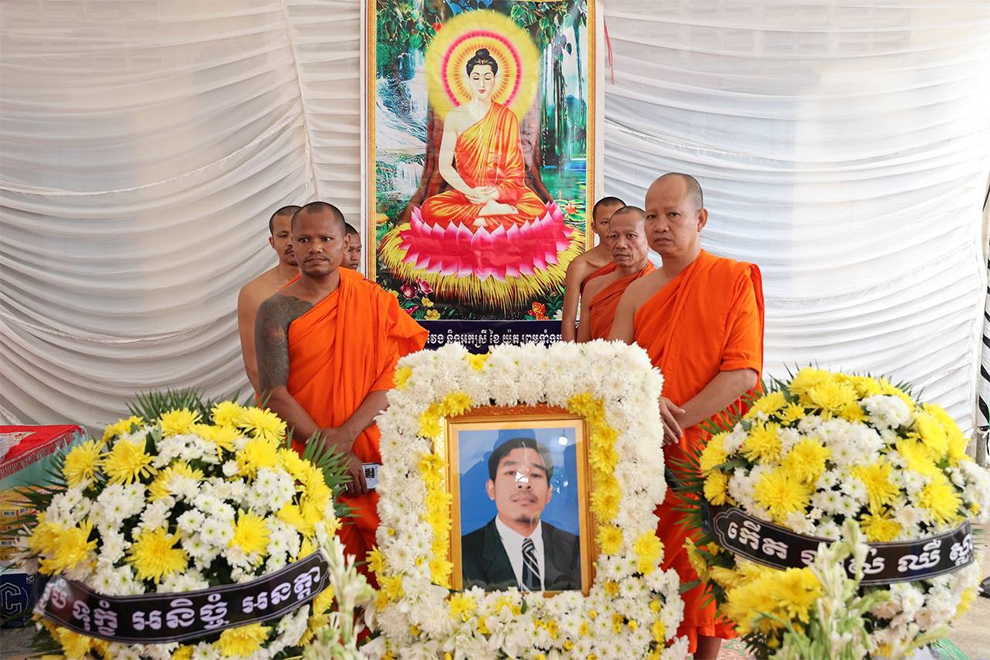 [Buddhist monks at the funeral service for Dy Nai, a 36-year-old Cambodian civilian who was shot dead by Thai soldiers on November 12. Supplied]
-Opinion-
On November 17, the Thai Ministry of Foreign Affairs held a press briefing outlining its version of recent border incidents with Cambodia, claiming Cambodian forces initiated clashes at Prey Chan village, Banteay Meanchey province, and that Cambodia violated the Joint Declaration signed between the two nations under witnessed by US President Donald Trump and Malaysia PM Anwar Ibrahim. Thailand presented these claims as evidence of Cambodia’s “aggression”, while emphasising its own peaceful approach, consultations with international witnesses and diplomatic activism through the UN and other forums. That’s a professional liar!
While Thailand paints itself as the champion of peace and international law, the reality on the ground and the broader historical context tell a very different story. Cambodia has consistently upheld its obligations under the Joint Declaration of Peace, refraining from unilateral military action and working through international mechanisms to resolve disputes. In contrast, Thailand’s military posture in the border areas — combined with frequent incursions, unilateral claims of Cambodian “initiations” and the continued presence of heavy weaponry near sensitive zones — reflects a persistent pattern of provocation, not restraint.
Thailand’s narrative conveniently omits the fact that many reported “incidents” originate from Thai military movements, exercises or unverified claims that have not been independently confirmed by neutral observers. Cambodia has repeatedly invited ASEAN and international observers to assess the situation, demonstrating transparency. Thailand, however, appears focused on broadcasting a one-sided account to the world, rather than engaging in genuine dialogue or abiding by agreed frameworks.
Furthermore, Cambodia has always prioritised peace, dialogue and adherence to international law. Cambodia’s responses — protests lodged through diplomatic channels, cooperation with ASEAN observation mechanisms and engagement with international humanitarian law regarding landmines — underscore a principled, law-abiding approach. Thailand, in contrast, seeks validation from international partners like the US and Malaysia to justify its unilateral claims, suggesting a preference for political optics over substantive conflict resolution.
The international community should note that Cambodia is the party actively choosing dialogue over confrontation, and compliance over provocation. Thailand’s repeated framing of itself as the aggrieved party obscures the reality that Cambodia remains committed to peace, while Thailand’s rhetoric and selective reporting suggest a troubling comfort with militarised posturing. True peace is not merely about issuing statements to embassies or filing letters with the UN; it is about respecting boundaries, international law and mutual commitments.
Thailand’s public diplomacy may seek to present a façade of legality and morality, but the evidence of Cambodia’s restraint and Thailand’s recurring provocations paints a clearer picture: Cambodia is the responsible party committed to peace, while Thailand is risking escalation by framing incidents in a manner designed to vindicate its own military ambitions. The world should see through these narratives and encourage both nations to recommit sincerely to dialogue, international law and the Joint Declaration, rather than allowing one party to monopolise the story for domestic and regional political gain.
Roth Santepheap is a geopolitical analyst based in Phnom Penh. The views and opinions expressed are his own.
-The Phnom Penh Post-