Cambodia’s Balanced Diplomacy Amid Renewed China–Japan Tensions Over Taiwan Question
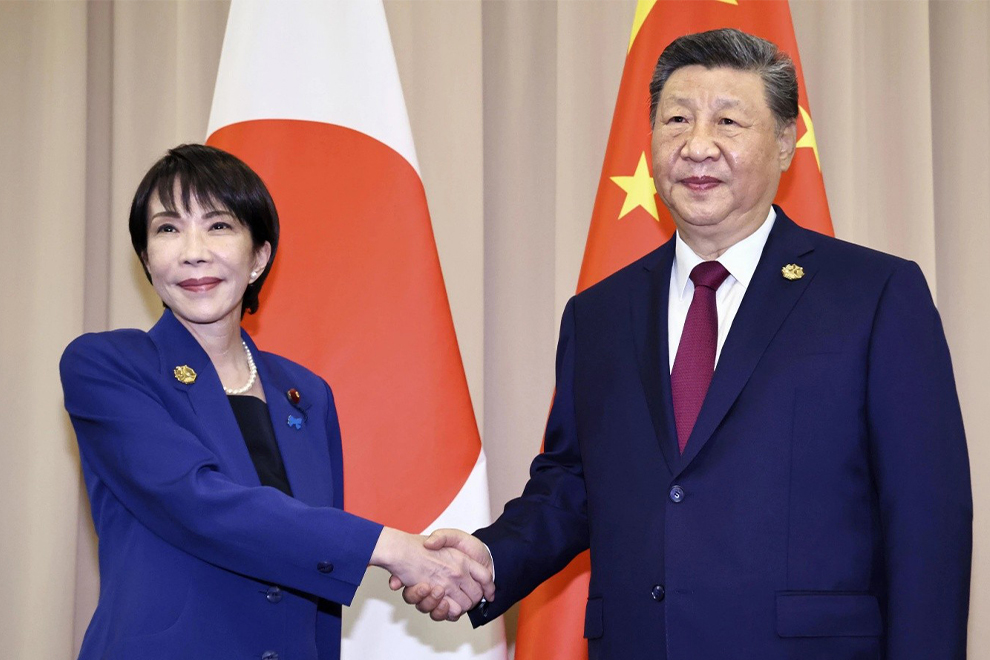 [Chinese President Xi Jinping (right) shakes hands with Japanese Prime Minister Sanae Takaichi, in Gyeongju, South Korea, on October 31. Kyodo News]
-Opinion-
The recent heightened diplomatic tensions between China and Japan over the Taiwan question have highlighted once again the fragility of East Asia’s security environment. As Beijing reiterates its long-held positions and Tokyo signals a growing willingness to engage more directly on Taiwan-related matters, regional states are increasingly confronting the risks of escalation between two of Asia’s most influential powers.
For Cambodia, a country that maintains close strategic and development partnerships with both China and Japan, these tensions are neither distant nor abstract. They carry real implications for regional stability, economic linkages and the long-term trajectory of Asia’s growth. Yet, despite the sharpening rhetoric between Beijing and Tokyo, Cambodia’s position remains consistent: a firm adherence to neutrality, support for peaceful dialogue, and respect for internationally recognised diplomatic frameworks, including the One-China policy, under which the Taiwan issue is recognised as China’s red line that cannot be crossed under any circumstances.
Cambodia’s approach begins with clarity. Phnom Penh has long upheld the One-China principle as the foundation of its diplomatic relationship with the People’s Republic of China. For Cambodia, this is not a matter of political convenience but an expression of its broader foreign-policy philosophy — non-interference, respect for sovereignty and opposition to external involvement in domestic affairs. Cambodia’s own historical experience, marked by periods of foreign intervention and geopolitical contestation, has reinforced its commitment to these norms.
At the same time, Cambodia continues to value both China and Japan as two of its most dependable and constructive partners. Each has played an essential role in Cambodia’s post-conflict reconstruction, economic development and institutional capacity-building.
From China’s major infrastructure investment and economic cooperation to Japan’s long-standing support in governance, education and human resource development, both countries have significantly shaped Cambodia’s modern development trajectory. Phnom Penh views these partnerships as long-term, mutually reinforcing and indispensable.
Cambodia highly values the traditional diplomatic behaviour shown by both China and Japan in regional conflicts, including Cambodia’s border issues with Thailand, where they consistently supported dialogue, consultation and peaceful settlement through diplomacy and international law — while firmly discouraging any slide toward military confrontation.
This constructive history makes their current tensions especially concerning and strengthens Cambodia’s call for both partners to return to restraint and peaceful problem-solving.
It is precisely because of these dual friendships that Cambodia views rising China–Japan tensions with particular concern. The two states together anchor East Asia’s supply chains, innovation ecosystems and financial flows. A deterioration in their relationship — especially if linked to a Taiwan crisis — would pose significant risks to regional economies, including those of Southeast Asia. For Cambodia, which depends heavily on regional trade networks, investment flows and tourism, stability in East Asia is not a peripheral issue. It is central to national development.
Cambodia therefore advocates strongly for restraint and renewed dialogue between China and Japan. While their strategic perceptions differ, both countries share fundamental interests in peace, economic interdependence and the stability of maritime trade routes. These shared interests should guide their engagement and serve as guardrails against miscalculation.
Neutrality plays a central role in Cambodia’s diplomatic posture. Unlike hedging strategies common among some middle powers, Cambodia’s neutrality is straightforward: maintaining constructive relations with all partners while avoiding entanglement in major power rivalries. This approach aligns with the long-standing principles of ASEAN diplomacy — consensus-building, non-confrontation and respect for sovereignty. As geopolitical tensions intensify, small states like Cambodia must navigate carefully, ensuring that regional rivalries do not compromise national development objectives.
Cambodia also believes that ASEAN itself has a role to play as a stabilising force. The association’s ability to convene all major powers through platforms such as the East Asia Summit and ASEAN Regional Forum offers opportunities for continued dialogue even during periods of heightened tension. Cambodia supports ASEAN efforts to reduce strategic mistrust and encourage communication among its external partners, including China and Japan.
Cambodia’s message is clear and pragmatic: peace serves all, while conflict would undermine decades of economic progress across Asia. Reflecting its own consistent commitment to the peaceful resolution of its border conflict with Thailand, Cambodia calls on Thailand to fully and faithfully respect the ceasefire and peace accord. With global uncertainties already mounting — from supply-chain realignments to shifting trade policies — Asia cannot afford an escalation in the Taiwan Strait or a deepening rift between two of its largest economies.
Phnom Penh’s hope is that both Beijing and Tokyo will continue to prioritise diplomacy, manage their strategic differences responsibly and avoid actions that could raise the risk of unintended confrontation. The constructive diplomatic approach they have demonstrated in addressing the Cambodia-Thailand border conflict — through dialogue, consultation and peaceful means — can serve as a model for managing their own differences. Cambodia stands ready to support regional efforts that promote stability, confidence-building and peaceful coexistence.
In an increasingly complex geopolitical landscape, Cambodia’s approach is anchored by principle and experience: firm adherence to the One-China policy, fostering friendship with both China and Japan, and upholding neutrality to safeguard peace and development. Importantly, neither China nor Japan has pressured any country to choose sides. This demonstrates that small states can play a meaningful role in a polarised world — not by choosing a side, but by consistently advocating for dialogue, stability and cooperation.
Dr. Kin Phea is director-general of the Royal Academy of Cambodia’s International Relation’s Institute. The views and opinions expressed are his own.