Opinion: Media has choice to be bridge or barrier in Cambodian-Thai relations
 Opinion: Media has choice to be bridge or barrier in Cambodian-Thai relations
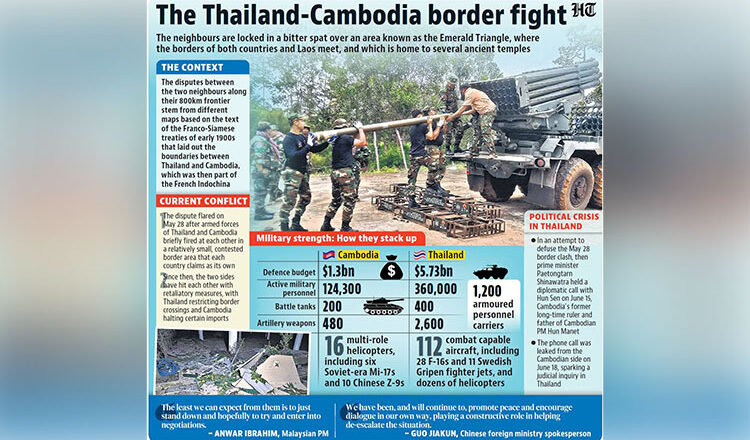
In the current climate of Cambodia-Thai border tensions, one question keeps resurfacing: is the media playing the role of a bridge between nations, or is it becoming a barrier to peace? The answer depends on how journalists choose to report—and unfortunately, some choices being made today are deeply troubling.
Certain segments of the Thai media have set a dangerous trend. Instead of careful fact-checking and measured reporting, we see speculation, distortion, and sensationalism taking centre stage.
This isn’t journalism—it’s a manipulative mouthpiece serving as political tool at the expense of truth, regional harmony, and even human lives.
When facts are twisted, when images are framed with hostility, and when commentary masquerades as news, the result is not just public confusion. It’s the erosion of trust—between peoples, governments, and neighbors who share a long, complex history.
In this time of conflict between Cambodia and Thailand, the Thai media should know better than to lie to the Thai people, who deserve the truth. However, being often influenced by the political agenda, Thai media has continued to produce propaganda reporting and distort reality, aiming to deceive international communities and twist public opinion.
It is obvious when narratives are slanted and based on emotion rather than fact. The biased Thai media has launched its biggest lie and disinformation campaign in history to rally public sentiment and fuel nationalism and distrust against Cambodia.
Official sources from the Cambodian government showed 873 cases of fake news in the second quarter of 2025, about 200 of which were disinformation and malinformation pertaining to the Cambodia-Thailand border dispute. More than 10 of them were AI-generated fake news, most of which sourced from Thailand.
Good journalism has the power to cool tensions, to clarify, to inform, to explain. Professional reporting serves the truth for the common good instead of creating chaos.
Media in the civilised world avoid actions that stir up conflict or manipulate emotions. Their role is to clarify, not confuse; bridge, not divide. But that demands ethics: commitment to facts, rejection of speculation, and the humility to admit when information is incomplete. Without these principles, the media stops serving the public good and starts lighting the fires of division.
And let’s not forget the wider consequence: the credibility of journalism itself. If the public cannot trust their media to tell the truth in times of crisis, then journalism ceases to hold value. In an age already drowning in fake news and information warfare, this is a loss we cannot afford.
There is still time to take the higher road and recover. Thai media must recommit to their responsibility—not just to their national audience, but to regional peace. That means verifying before publishing, putting fact and truth before nationalism, and producing balanced stories that support peace building and reconciliation.
Sok Sant is a social-political analyst. The opinions expressed here are his own.