Ta Krabei Temple: A Thousand Years of Heritage Shattered by Military Aggression
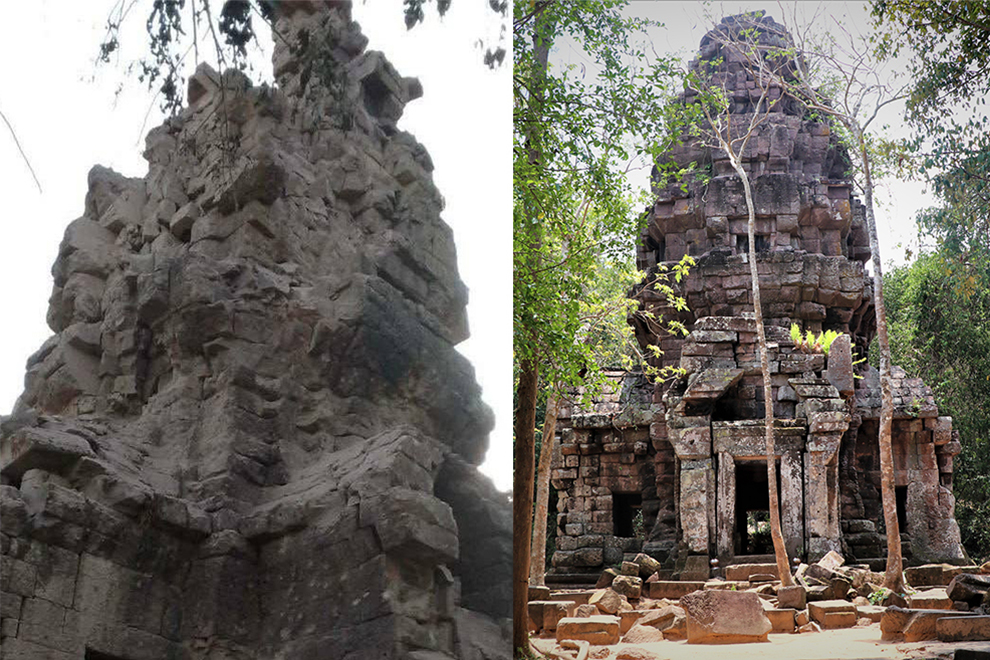 [The Ta Krabei Temple after (left) and before the December 8 bombing by Thai forces. Supplied]
-Opinion-
Ta Krabei Temple stood for nearly a millennium as one of the quiet sentinels of Khmer civilisation. Built in the 11th century under Kings Suryavarman I and Udayadityavarman II, it rested deep within the Dangrek mountains, protected by forest and preserved by the devotion of local Cambodians. Even after French explorers documented it in the early 1900s, Ta Krabei remained a remote sanctuary — visited, cared for and remembered only by the Cambodian people who understood its cultural and spiritual worth.
For centuries, the temple survived, untouched by war, untouched by time and untouched by any historical claim from Thailand. It has never appeared in Thai chronicles, never served Thai religious or cultural life and never been administered, visited or preserved by Thailand. Its identity has always been unmistakably Cambodian.
Yet on December 8, a monument that nature protected for a thousand years was devastated within minutes by the Thai military.
This was not collateral damage. Heavy weapons were fired into the area of a known cultural site, shattering stones carved by Khmer ancestors, collapsing structures that had endured for centuries and permanently damaging a temple that holds deep historical and spiritual meaning for millions of Cambodians. What Cambodia had carefully safeguarded for generations was reduced to ruins by a force that chose to ignore not only the ceasefire but also the fundamental principles of cultural protection under international law.
No responsible nation or professional army can justify the destruction of a sacred monument. Cultural heritage is not a battlefield target — it is a legacy belonging to all of humanity. The deliberate or reckless firing of heavy weapons at an ancient temple is not an act of defence; it is an attack on civilization itself.
This alarming incident is part of a wider pattern. On the same day, military action damaged conservation facilities at Preah Vihear Temple, a UNESCO World Heritage Site. The strikes on Ta Krabei and Preah Vihear are not isolated mistakes. They form a disturbing escalation in which cultural sites — protected by international conventions — have become casualties of indiscriminate military aggression.
The world cannot remain silent. Neutrality in the face of cultural destruction is not diplomacy; it is abdication. UNESCO, ASEAN and all institutions tasked with safeguarding heritage must take immediate action. They must condemn the attacks, call for an end to military operations targeting or endangering cultural sites and insist on independent assessments to document the damage inflicted.
The stakes extend beyond Cambodia. If a military force can damage a thousand-year-old temple without consequence, what message does that send to conflict zones around the world? What heritage site, in any nation, is safe when international norms are ignored?
The destruction at Ta Krabei Temple must be formally recognised as a cultural crime. It must be recorded, investigated and remembered — not only for the loss it represents, but for the warning it carries. When history is attacked, when heritage is shattered, it is humanity that suffers.
Cambodia now mourns a sacred monument that once stood as a symbol of our ancestors’ genius and devotion. But mourning must be combined with resolve. The international community must ensure that no further damage is inflicted on the temples along the border, and that those responsible for cultural destruction are held accountable.
Ta Krabei was not lost to erosion, age or neglect.
It was damaged by the decisions of a military that chose force over restraint, and aggression over respect for shared human history.
The world must protect what remains. And the world must remember what was lost.
Roth Santepheap is a geopolitical analyst based in Phnom Penh. The views and opinion expressed are his own.
-The Phnom Penh Post-