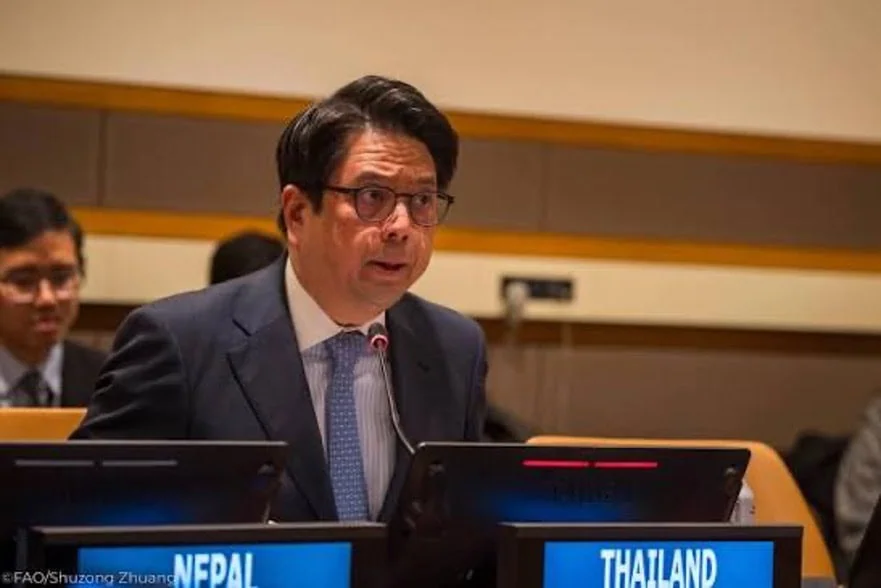
On September 28, during Thailand’s Right of Reply at the 81st Session of the United Nations General Assembly, Ambassador Cherdchai stated that the Cambodians referred to as internally displaced persons were people residing in areas that had originally been opened as temporary shelters in the 1970s, and characterised their continued presence as an encroachment on Thai territory. Thailand’s Permanent Mission also reaffirmed its stated preference for dialogue and diplomacy.
This raises a fundamental question: If Thailand is confident that these areas are unequivocally within Thai territory, why not allow the Cambodia–Thailand Joint Boundary Commission (JBC) to complete its work through the agreed legal and technical mechanisms?
That is the most constructive question that both sides should address.
The answer should come from the JBC, not unilateral assertions
Borders between sovereign states should not ultimately be determined by public statements, political rhetoric, military presence or competing unilateral maps. They should be established through the treaties, agreements, technical processes and internationally recognised principles applicable to the two countries.
Cambodia has repeatedly called for the resumption of joint survey and demarcation work through the JBC. In September 2026, Cambodia again called for the JBC to commence border survey and demarcation as soon as possible, referring to the existing bilateral agreements and the December 2025 Joint Statement. Cambodia has also stated that its position is based on the historical Franco-Siamese agreements, relevant maps and records, the 2000 Memorandum of Understanding, the 2003 Terms of Reference and other mutually agreed documents.
Thailand, for its part, has also recognised the JBC as an important bilateral mechanism. The sixth JBC meeting, held in Phnom Penh in June 2025, produced technical understandings concerning boundary pillars, joint survey work and the use of modern technologies such as LiDAR and orthophoto mapping.
Therefore, the logical way forward is not to debate endlessly over whose public statement is stronger. The logical way forward is to let the JBC work.
If there is disagreement over the location of a boundary, let the technical experts from both countries examine the evidence together. Let them examine the treaties, maps, boundary pillars, historical records, survey data and other legally relevant materials. Let the conclusions emerge through an agreed bilateral process.
This would be far more constructive than allowing competing narratives to deepen mistrust between two neighbouring peoples.
International law should be the common language.
Cambodia and Thailand are modern states and members of the United Nations and ASEAN. Both countries have repeatedly expressed their commitment to peaceful settlement of disputes and respect for international law.
For that reason, the border issue should be approached according to legal instruments and agreed procedures rather than unilateral assertions.
Cambodia has maintained that the land boundary should be addressed on the basis of the relevant Franco-Siamese conventions and treaties, the maps and records associated with the historical delimitation process, and subsequent bilateral agreements including the 2000 MOU. Cambodia has also emphasised the principle of the inviolability of established frontiers and peaceful settlement.
At the same time, Thailand has its own interpretation of the relevant territorial and security issues and has publicly argued that certain areas claimed by Cambodia are within Thailand’s territory. Those differences are precisely why the bilateral mechanisms exist.
A border dispute cannot be resolved simply by each side repeating its own interpretation.
It must be resolved through evidence, law, negotiation and mutually agreed technical procedures.
Dialogue must be meaningful and continuous.
Another important issue is the question of bilateral dialogue.
Cambodia has repeatedly called for the resumption of border survey and demarcation activities through the JBC, while Cambodian officials have stated that diplomatic communications were sent proposing meetings and the deployment of joint survey teams. In June 2026, Cambodia’s State Secretariat of Border Affairs said that several proposed activities had faced postponements and called for the process to resume.
It is important, however, to acknowledge that bilateral contacts have not completely stopped. The two sides have held JBC discussions and, as recently as September 29, 2026, the Cambodian and Thai Regional Border Committee secretariats held an informal meeting under the observation of ASEAN Observer Teams.
The real challenge, therefore, is not simply whether representatives meet. The deeper question is whether these meetings can produce concrete progress on the ground.
A meeting without implementation cannot build lasting confidence.
Both sides should therefore ensure that established mechanisms meet regularly, that agreed technical work proceeds, and that differences are addressed through direct communication rather than through competing public narratives.
The humanitarian dimension cannot be forgotten.
Behind every argument about maps, treaties and sovereignty are ordinary people.
Cambodian authorities have reported that around 20,000 Cambodian civilians have remained displaced and unable to return to their homes in affected border areas. Other Cambodian official reports have documented specific communities whose return has reportedly been prevented by developments on the ground.
Regardless of the competing interpretations of territorial status, the humanitarian concern should be shared by both countries.
Families should not become permanent victims of an unresolved boundary dispute.
If both governments genuinely want to rebuild trust, one practical confidence-building measure would be to facilitate the safe, voluntary and dignified return of displaced civilians wherever this can be done consistently with the ceasefire arrangements, security requirements and applicable legal mechanisms.
The objective should be simple: people should be able to return safely to their homes once the necessary security and boundary arrangements have been established.
Trust requires action, not only words
Cambodia and Thailand cannot change their geography. They will remain neighbours.
The question is what kind of relationship they choose to build.
Thailand’s own permanent mission to the UN has recently emphasised that the two countries should pursue mutual trust, peaceful coexistence and cooperation. Cambodia has likewise repeatedly emphasised peaceful settlement through bilateral mechanisms and international law. If Thailand claims that Cambodian people live in their land, please allow JBC of both countries to work. If Thailand claims that they want to rebuild trust, please come for the meetings with Cambodia.
Dr. Seun Sam is a policy analyst at the Royal Academy of Cambodia. The views and opinions expressed are his own.