Migratory Birds Offer a Natural Flight Path to Growth and Resilience
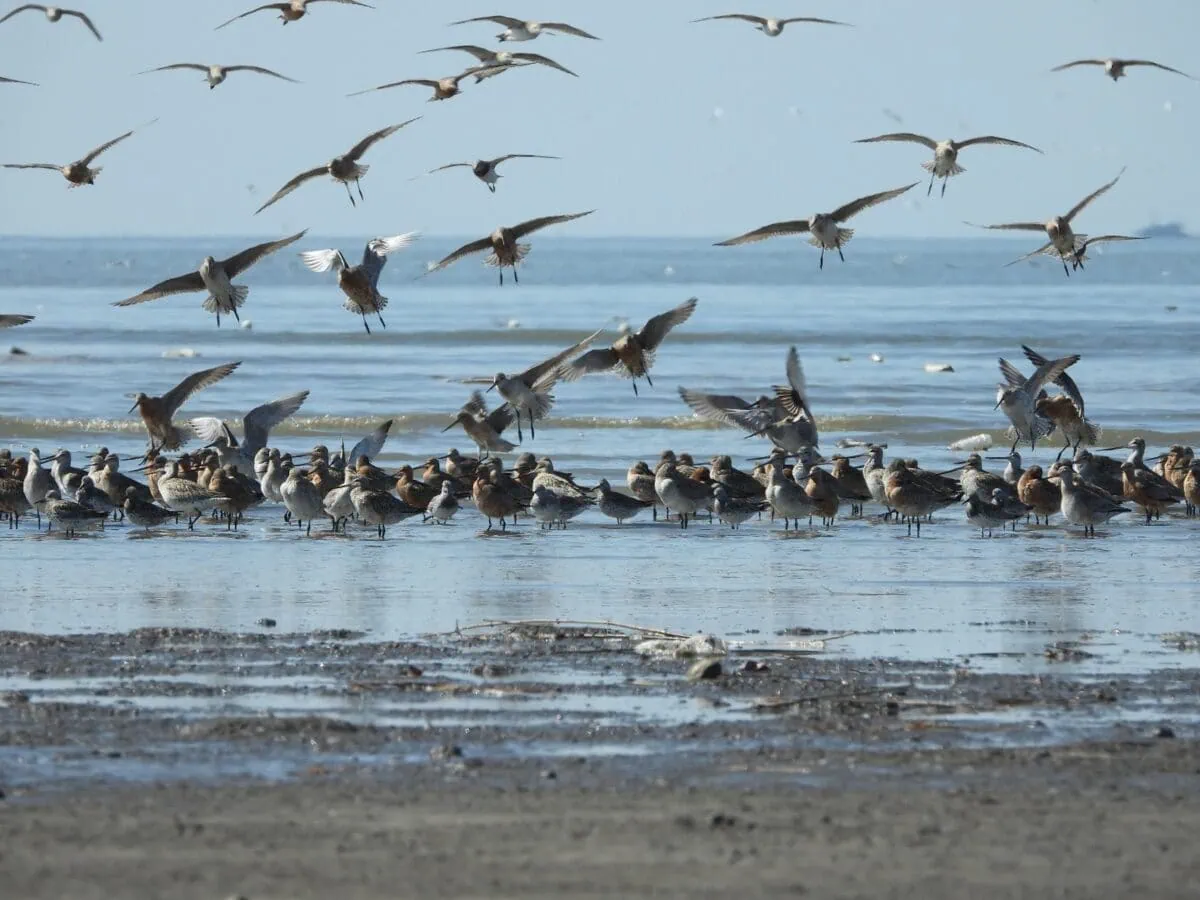 Wetlands provide migratory birds with food and temporary shelter, while sustaining vital ecosystems, livelihoods and communities across Asia and the Pacific. Yong Ding Li
#Opinion
Some of the world’s most valuable infrastructure has no owner, no border and no name most people would recognise. It’s the network of wetlands that keeps migratory birds alive during their odysseys across the planet.
A shorebird called the eastern bar-tailed godwit makes the longest known, nonstop flight of any bird. The bird’s arduous 11,000-kilometre migration is only possible because of a chain of wetlands which sustains its journey. This is a story of connection and reflects the inseparable ties between nature conservation and human development, as the livelihoods of countless people are also intertwined with the health of these wetlands.
The godwit is just one of millions of birds that travel along the East Asian–Australasian Flyway, linking breeding grounds in the Arctic and northern Asia with other parts of the planet. But even record-breakers need to land. Along its route across Alaska, New Zealand and China, the godwit depends on wetlands to stop, feed and recover before continuing on. If one stopover is lost or degraded, the pressure increases on the wetlands that remain, weakening the resilience of the entire system.
The godwit’s story points to something larger than the survival of individual bird species. The Convention on Wetlands (1971), the world’s oldest multilateral environmental agreement, recognises the multifaceted and indispensable roles these ecosystems play.
Sites designated as Wetlands of International Importance support hundreds of millions of people worldwide, providing food and water, sustaining fisheries and agriculture, and reducing flood risk and coastal damage. They function as natural infrastructure, delivering ecosystem services that would otherwise demand costly, artificially built alternatives. Wetlands are among the most efficient investments available in nature today.
Too often though, wetlands are treated as local assets, when actually their real value should be measured at a regional, and even, global scale.
Degradation brings a cost that does not stay contained to a single site. One lost wetland shifts pressure onto those that remain, and the communities and industries that depend on these strained wetlands then pay the price. Healthy economies cannot exist without healthy ecosystems.
Yet wetlands continue to disappear; 22% of global wetlands have been lost since 1970, the equivalent of more than half a billion football pitches. And one in four of the world’s remaining wetlands are in poor ecological condition. Asia and the Pacific feels these losses particularly keenly, as urbanisation, infrastructure expansion, changing weather patterns and population growth are rapidly reshaping landscapes.
Investment in natural infrastructure has not kept pace with the scale of loss, and what exists is largely ad-hoc: small, site-based projects that protect individual wetlands without addressing the pressure building across a wider system. To close that gap, cross-border investment is needed at the scale of the flyway itself. Just as the godwits link wetlands, so must we.
Launched in 2021, the Regional Flyway Initiative (RFI) was built around this idea, bringing the Asian Development Bank (ADB) together with BirdLife International and the East Asian–Australasian Flyway Partnership to protect migratory birds and the ecosystem services wetlands provide.
It is founded firmly on science to identify where investment can have the greatest impact across the flyway. A recent Scientific Reports study developed through the RFI identified 147 priority sites across 10 participating countries, including coastal and inland wetlands that support threatened species.
With further scientific analysis building the business case, ADB and its partners aim to mobilise $3 billion over 10 years and support the protection or sustainable management of at least 50 of these priority sites, many of which are listed by the Convention on Wetlands. In turn, the RFI and its expansion into other regions, is a practical contribution to the convention’s aim to manage these sites effectively, so their number, area and ecological connectivity continue to grow.
Early investments show how this approach is working. In Hunan Province in China’s South Dongting Lake Ramsar Site, a major freshwater wetland, ADB is supporting a $308 million project which will restore nearly 12,000 hectares of wetlands. It will improve the quality of water and the broader ecosystem, bringing benefits for thousands of residents through sustainable farming, aquaculture and eco-tourism.
More investments have followed suit. In the Philippines, a $3 million Global Environment Facility-supported project is being implemented across three priority wetlands, linking habitat restoration and improved site management with sustainable livelihoods and natural resilience.
These projects are at an early stage. But they do show how it is possible to pursue biodiversity goals along with improved water management, food security and job creation — not as a separate environmental agenda.
The flyway approach is also gaining traction beyond Asia and the Pacific. The Americas Flyways Initiative — developed by BirdLife International, the National Audubon Society, and the Development Bank of Latin America and the Caribbean — is adopting a similar model. And on another side of the planet, the African–Eurasian Flyway Initiative, established by the World Bank and BirdLife International, also reflects a growing recognition that investments protecting the priority wetlands along the flight paths of migratory birds come with wider sustainable development benefits, far beyond individual sites and national borders.
The RFI is still young, but it is already showing what happens when conservation and development stop competing for the same funding and start working from the same plan.
Migratory birds survive because they can rely on a chain of healthy habitats, not any single site. Investment now needs to follow the same logic, crossing borders the way the birds do.
Scott Morris is ADB vice-president (East and Southeast Asia, and the Pacific); Dr. Musonda Mumba is secretary-general of the Convention on Wetlands. The views and opinions expressed are their own.
-Phnom Penh Post-