We cannot keep betting our energy future on a strait we do not control
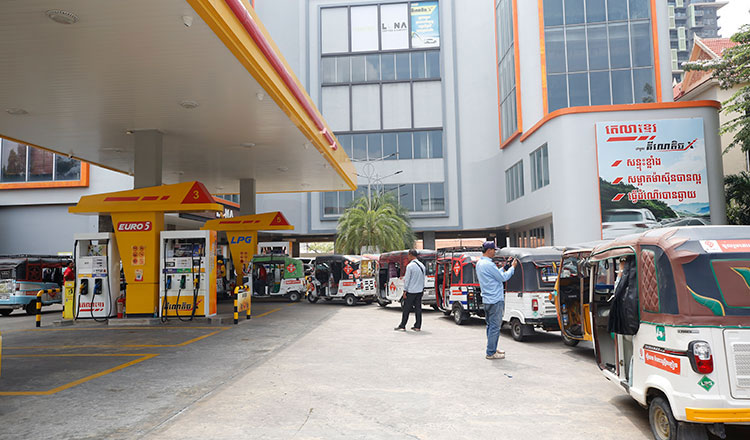 File photo of tuk-tuk queuing up at a fuel station on Preah Norodom Boulevard, Phnom Penh. KT/Chor Sokunthea
#Opinion
A few months ago, I found myself waiting in a long line outside a fuel station in Phnom Penh. Tuk-tuk, motorcycles and delivery trucks stretched around the block. The shortage was not caused by anything that had happened in Cambodia. It began thousands of kilometres away, in the narrow waters of the Strait of Hormuz.
That scene should be a wake-up call.
Cambodia’s energy security is shaped less by decisions made in Phnom Penh than by events unfolding in one of the world’s most volatile maritime chokepoints. The Strait of Hormuz, a channel only 33 kilometres wide at its narrowest point, carries roughly one-fifth of global oil and liquefied natural gas supplies. When conflict disrupts shipping there, fuel prices rise everywhere – including in Cambodia.
The lesson is simple but uncomfortable: we cannot continue betting our economic future on a supply route we neither control nor influence.
Cambodia imports most of its petroleum products from regional suppliers such as Thailand, Vietnam, Singapore, Malaysia and China. Yet these countries are themselves deeply integrated into global energy markets. Their refineries depend on crude oil whose price is determined by international supply, much of which normally flows through the Strait of Hormuz.
When that flow is disrupted, Cambodia feels the consequences regardless of where its fuel tankers originate. Higher prices, tighter supply and transport disruptions inevitably work their way through regional markets until they reach Cambodian consumers.
This is precisely what happened during the recent escalation of conflict in the Middle East.
As global oil prices climbed, some regional suppliers tightened exports to protect domestic markets, while Cambodia’s border tensions with Thailand further complicated fuel logistics. Temporary shortages emerged, prices increased, and businesses faced growing uncertainty.
Cambodia weathered the crisis, but largely by improvising. That is not resilience. It is vulnerability temporarily disguised as adaptability.
The deeper problem is that Cambodia still lacks the strategic buffers expected of an economy increasingly dependent on reliable energy. Petroleum reserves remain limited, leaving little room to absorb prolonged supply disruptions.
The country’s exposure extends far beyond motorists. Fuel powers agricultural machinery, freight transport, manufacturing, tourism and electricity generation. Every supply shock ripples across the broader economy, raising production costs and squeezing household incomes.
Fortunately, Cambodia has also demonstrated that smart policy can reduce – not eliminate – that vulnerability.
Over the past several years, the country has steadily expanded renewable energy, hydropower and electricity infrastructure while encouraging greater electrification across the economy. These investments have helped moderate fuel demand and reduced the country’s petroleum import bill even as global energy markets became more volatile.
This is not simply environmental policy. It is national security policy.
Every electric bus replacing a diesel vehicle, every irrigation pump powered by electricity instead of imported fuel, and every additional megawatt of renewable generation reduces Cambodia’s exposure to geopolitical crises occurring thousands of kilometres away.
But incremental progress is not enough.
The world has entered an era of recurring geopolitical disruption. Strategic competition among major powers, regional conflicts, cyberattacks and supply-chain shocks are becoming structural features of the international system rather than temporary exceptions.
Energy security can no longer be treated as a technical issue managed solely by one ministry. It has become a central pillar of national resilience.
That requires moving beyond policy statements towards concrete action.
Cambodia should accelerate the establishment of a genuine strategic petroleum reserve capable of cushioning prolonged supply disruptions. It should deepen regional electricity interconnection through the ASEAN Power Grid to diversify sources of supply and strengthen energy resilience.
Investment in renewable energy, battery storage and electric mobility should be viewed not only as climate initiatives but also as strategic insurance against future geopolitical shocks.
Equally important, Cambodia needs stronger institutions dedicated to anticipating crises before they unfold.
Too often governments respond only after fuel queues form, prices spike and businesses begin struggling. Instead, Cambodia should establish a permanent national strategic foresight and risk assessment capability that continuously monitors geopolitical developments, supply-chain vulnerabilities and emerging threats to critical infrastructure.
Risk analysis, strategic foresight, scenario planning should become a routine part of national decision-making. A special task force should be formed to work on this.
This is ultimately a question of leadership.
The world has changed faster than many governments have adapted. The comfortable assumption that globalisation would always deliver cheap energy and uninterrupted supply chains no longer holds.
Countries that recognise this reality early will be better prepared for future shocks. Those that cling to outdated assumptions will repeatedly find themselves reacting to crises they failed to anticipate.
Cambodia cannot prevent conflict in the Middle East. It cannot guarantee the security of the Strait of Hormuz nor control the price of global oil.
But it can control how prepared it is.
National resilience is not built during a crisis. It is built before one arrives.
The next disruption may come from the Middle East, the South China Sea, cyberattacks on critical infrastructure or another geopolitical flashpoint entirely. The source matters less than the lesson.
Cambodia must stop treating energy shocks as isolated emergencies and begin preparing for them as recurring realities.
Because the true measure of energy security is not whether fuel eventually reaches our pumps. It is whether the nation can continue functioning when the world beyond its borders becomes increasingly unpredictable.
Chan Kunthiny is a Phnom Penh-based geopolitical and security analyst. The opinions expressed here are the author’s own.
-Khmer Times-