The growing human cost of Myanmar’s political crisis
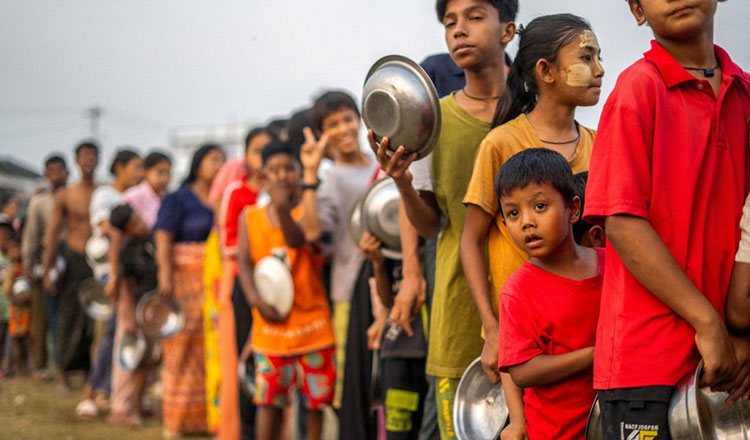 People queue for food and relief supplies after a strong earthquake in Amarapura, Myanmar, April 1, 2025. AFP
#opinion
While strolling the streets of downtown Kuala Lumpur, where tourists congregate, one invariably encounters hordes of Myanmar nationals manning food establishments as well as young Myanmar men and women working as foot reflexologists and massage therapists, vying for customers.
Such individuals would not have fled to distant shores if their own country were not deeply troubled — and had not been that way for what seems like an eternity.
These young people, like their counterparts everywhere, ought to be the future of their country.
That these Myanmar youth are compelled to leave their own country is a tragedy to them individually and their country collectively.
Countries like Malaysia and Thailand, which host this diaspora, have a greater stake than most in ensuring that peace returns to Myanmar.
Myanmar should welcome its nationals back to take full advantage of their skills and experience.
But the sticky point is how to attain that elusive peace in the war-torn country.
To its credit, ASEAN has stood as one in demanding that Myanmar abide by the agreed principles.
An opportunity appeared recently when ASEAN foreign ministers met their Myanmar counterpart in Bangkok. But it appeared to be little more than an opening gambit.
The Myanmar government naturally wants the legitimacy that comes with its acceptance back into ASEAN.
The question is whether it is willing to meet ASEAN even halfway by acceding to certain preconditions.
Myanmar will, perhaps not unreasonably, argue that ASEAN seems bent on “interfering” in the country’s internal affairs, even though non-interference is a core principle of the bloc.
But no other Asean country has been wracked so persistently by internal rifts and civil wars. The Myanmar government should welcome ASEAN’s involvement to heal deep-seated wounds.
That said, ASEAN, too, must know its own limitations. The centrality of ASEAN must remain one of the main precepts of the regional organisation to ensure its relevance in the face of a fast-changing geopolitical environment.
Myanmar’s junta chief-turned-president has been welcomed as a head of state by China and India, two of its powerful neighbours.
All eyes are now on United States President Donald Trump — will he also offer the Myanmar government the legitimacy it so craves?
ASEAN seems to have its work cut out in retaining its centrality while contributing to a more promising future for Myanmar and its people.
The writer views developments in Malaysia, the region, and the world from his vantage point in Kuching.
-Khmer Times-