Beijing talks back Fuxian consensus on Cambodia-Thailand dispute
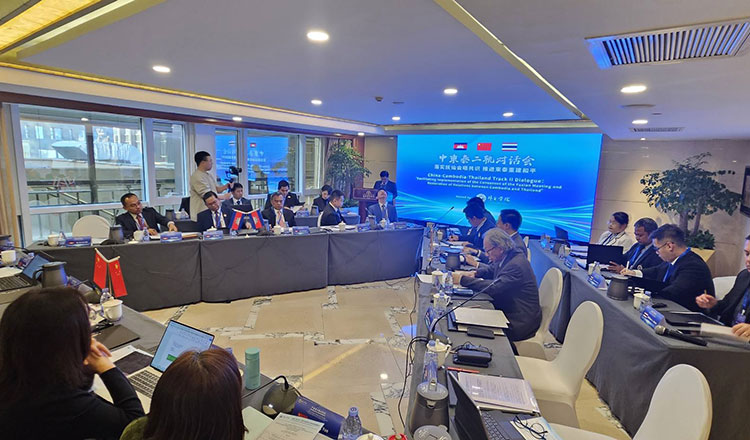 Scholars and policy experts participate in the China-Cambodia-Thailand Track II Dialogue in Beijing. CCRS
#National
Synopsis: Senior scholars and policy experts convene in China to implement regional agreements and restore diplomatic stability between neighbouring nations.
Senior scholars and policy experts gathered in the Chinese capital for the China-Cambodia-Thailand Track II Dialogue to address persistent tensions along the Cambodia-Thailand border. Hosted by China Foreign Affairs University (CFAU), the discussions focused on implementing a five-point consensus to consolidate the ceasefire and restore political mutual trust.
The dialogue focuses on the “Fuxian Meeting” framework, which prioritises restoring normal exchanges and maintaining regional stability. Cambodian representatives, including Pou Sothirak of the Cambodian Centre for Regional Studies and Kin Phea of the Royal Academy of Cambodia, participated in “open and frank” discussions with their regional counterparts.
“China plays a constructive role in finding a peaceful solution through the Fuxian ceasefire agreement,” Sothirak said, highlighting the significance of external mediation in the peace process.
According to CFAU, participants explored practical strategies to ensure the effective implementation of joint ceasefire statements. A key part of the talks involved defining the support Cambodia and Thailand expect from China, particularly regarding humanitarian demining efforts and technical aid for the ASEAN Observer Team. There was also an initial discussion on the possible role of the Chinese military in helping to consolidate the ceasefire if needed.
Phea told Khmer Times that long-term stability hinges on three critical pillars. First, bilateral mechanisms like the Joint Boundary Commission must be revitalised and shielded from domestic political pressures. Second, the ASEAN Observer Team needs additional resources and clearer mandates to prevent accidental escalations. Lastly, China is viewed as a stabilising guarantor, expected to provide reassurance through quiet diplomacy and support for monitoring arrangements, rather than acting as a coercive mediator.
“When peace does not deliver visible benefits, the political cost of renewed confrontation remains dangerously low,” Phea warned, stressing the need for tangible improvements in border livelihoods.
Strengthening humanitarian assistance was another key topic. Experts discussed the immediate support Cambodia and Thailand expect from China in addressing humanitarian issues, such as resettling displaced people along the border and helping restore their livelihoods.
On rebuilding political mutual trust and restoring normal exchanges, discussions centred on steps to resume engagement at multiple levels and across various sectors between Cambodia and Thailand.
Participants also considered how to ensure the timely and successful convening of the Fifth Lancang-Mekong Cooperation Leaders’ Meeting, to be held in Thailand.
-Khmer Times-
—————-