Thailand cannot bomb first and occupy later
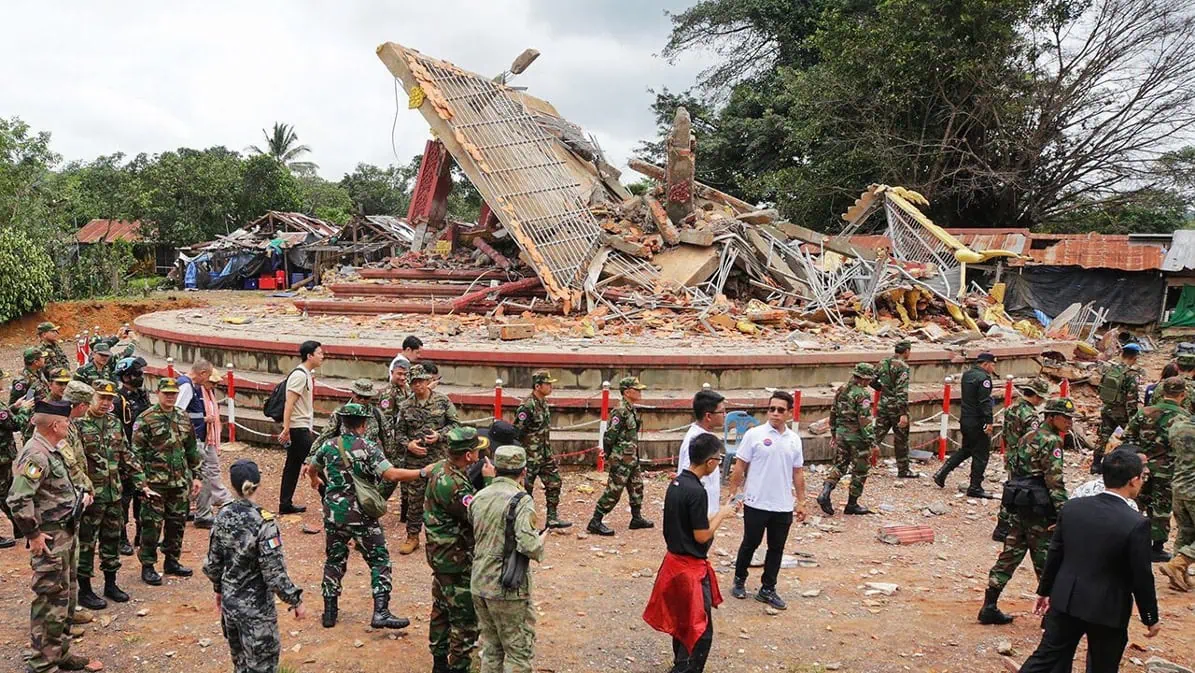 The Cambodian government encourages the ASEAN Observer Team (AOT) to observe the situation along the border, as well as the damage caused by Thai shelling and airstrikes. Supplied
In the realm of international relations, the sequence of actions matters profoundly, as does the integrity of the justifications offered for the use of force.
Thailand’s recent military activities near the Cambodian border, framed under the banner of combating cross-border scam operations, raise serious questions about adherence to established norms of sovereignty, proportionality and good faith in dispute resolution.
A nation cannot initiate kinetic operations — bombing or shelling — establish de facto control through occupation, and only subsequently craft a narrative designed to retroactively legitimise its conduct. Such a pattern undermines the foundations of the post-World War II international order, which was built precisely to prevent powerful states from reshaping borders or exerting control through faits accomplis.
The principle is straightforward: territorial integrity is not conditional on the character of activities occurring within that territory. Cambodia, like every UN member state, possesses sovereign rights over its recognised borders. Any allegation of criminal activity — whether involving cyber-scam compounds, human trafficking or other illicit enterprises — must be addressed through lawful channels: diplomatic engagement, joint law enforcement cooperation, extradition requests or, where appropriate, multilateral mechanisms involving ASEAN or the UN.
Unilateral military strikes followed by physical occupation invert this logic. They place the application of force before evidence, due process or mutual agreement. This approach echoes historical precedents that the international community has repeatedly condemned, from colonial-era annexations to more recent instances of hybrid aggression masked as security operations.
Turning an anti-scam campaign into a narrative shield for military expansion compounds the problem. No one disputes that Southeast Asia faces a severe challenge from sophisticated scam syndicates. These operations, often involving coerced labour, online fraud targeting victims across the globe and ties to organised crime, have devastated communities and eroded trust in digital economies. Thailand has legitimate security interests in neutralising threats emanating from its borders. Intelligence sharing, coordinated raids and economic pressure on enablers are all valid tools. However, when these efforts morph into sustained cross-border military presence, infrastructure seizures or control over disputed or adjacent territories, the anti-crime pretext begins to appear instrumental rather than genuine.
Observers note that scam compounds have proliferated in porous border regions precisely because of weak governance, corruption and economic desperation in parts of Cambodia, Thailand, Laos and Myanmar.
Yet the solution cannot be one neighbour unilaterally redrawing lines of control. If Thailand possesses credible intelligence about specific sites, the transparent path involves presenting that evidence to Phnom Penh, other ASEAN partners or relevant UN bodies. Joint operations, observer missions or third-party verification could neutralise criminal infrastructure without violating sovereignty. Instead, the pattern of “bomb first, occupy second, justify later” risks transforming a legitimate law enforcement concern into a territorial dispute with far-reaching consequences for regional stability.
Furthermore, Thailand cannot credibly ask the international community to accept that buildings allegedly used for criminal purposes have somehow ceased to be located within Cambodian territory. Geography does not bend to moral outrage or security imperatives. A structure does not migrate across an internationally recognised border simply because illicit activities occur inside it.
Claims that certain compounds “effectively” operate as extensions of Thai jurisdiction, or that Cambodian sovereignty is suspended due to the host government’s alleged inability or unwillingness to act, set a dangerous precedent. Such arguments resemble “failed state” doctrines or “responsibility to protect” rationales applied selectively and without authorisation. They erode the norm of sovereign equality and invite reciprocal claims by other states facing their own cross-border challenges.
Consider the broader implications. ASEAN has long prided itself on the principles of non-interference and peaceful dispute settlement, as enshrined in the Treaty of Amity and Cooperation. Unilateral military action fractures this consensus. It invites Cambodia to internationalise the issue, seek support from larger powers and potentially escalate through asymmetric responses or alliances. It also complicates global efforts against transnational crime.
When anti-scam rhetoric becomes entangled with irredentist or expansionist undertones, international donors, investors and law enforcement partners grow sceptical. Funding and cooperation for genuine counter-crime initiatives may dry up if perceived as covers for geopolitical manoeuvring.
The historical and legal context reinforces this caution. Border demarcations between Thailand and Cambodia have been contentious for decades, with flashpoints around Preah Vihear and other areas adjudicated by the International Court of Justice. Reopening these wounds under a new security pretext risks reigniting dormant disputes. Modern international law, from the UN Charter’s prohibition on the threat or use of force (Article 2(4)) to the inviolability of borders in the Helsinki Final Act and subsequent declarations, rejects the acquisition of territory by force.
Even defensive actions must meet strict criteria of necessity and proportionality. Preemptive or punitive occupation rarely satisfies these tests when less coercive alternatives exist.
Thailand’s defenders might argue that Cambodia has failed to dismantle scam networks despite repeated warnings, that Thai citizens are victimised and that urgent action was required.
These concerns deserve acknowledgment. Effective governance gaps in parts of Cambodia have indeed allowed criminal ecosystems to thrive, sometimes with local complicity.
However, the remedy lies in capacity-building, economic development, targeted sanctions on enablers and sustained diplomatic pressure — not in military faits accomplis. The international community should support robust anti-scam efforts, including intelligence fusion centres, financial tracking and victim support programmes. But it cannot endorse a model where states claim the right to bomb and occupy first and negotiate legality afterward.
Moreover, the optics and long-term strategic costs weigh heavily against this approach. In an era of great-power competition, Southeast Asia benefits from stability and rule-based order. Actions that appear to normalise border violations empower narratives used by revisionist actors elsewhere. Smaller states watching the Thailand-Cambodia dynamic may conclude that self-help through force is viable when multilateral avenues move slowly. This fragments regional cohesion at a time when collective responses to climate change, supply chain resilience and maritime security are urgently needed.
In conclusion, the core issue transcends any single incident or compound. It concerns whether powerful states retain the prerogative to act as judge, jury and executioner in their neighbourhoods, retrofitting legal and moral justifications to match operational outcomes. Thailand, as a respected middle power with a professional military and vibrant economy, has much to lose by pursuing this path. It risks isolating itself diplomatically, damaging its reputation as a responsible actor, and inviting countermeasures that could prolong instability. Cambodia, for its part, must demonstrate greater commitment to rooting out criminal sanctuaries on its soil.
The responsible course is clear: de-escalation, verifiable withdrawal to recognised lines, transparent investigation of scam networks with international observers, and good-faith negotiations facilitated by ASEAN or neutral mediators. Anti-crime cooperation should be decoupled from territorial ambitions.
Buildings used for scams remain on Cambodian territory until borders are legally altered through mutual agreement — an outcome that must never be achieved at the barrel of a gun.
The international community should insist on this principle not out of naivety about the scam threat, but because the alternative — a world where “bomb first, occupy second, justify later” becomes acceptable — threatens far greater harms than any single criminal compound.
Regional peace and the rules that sustain it are too precious to sacrifice for short-term tactical gains.
Dr. Seun Sam is a policy analyst of the Royal Academy of Cambodia. The views and opinions expressed are his own.
-Phnom Penh Post-