Cambodia says no as Thailand mulls border MoU referendum
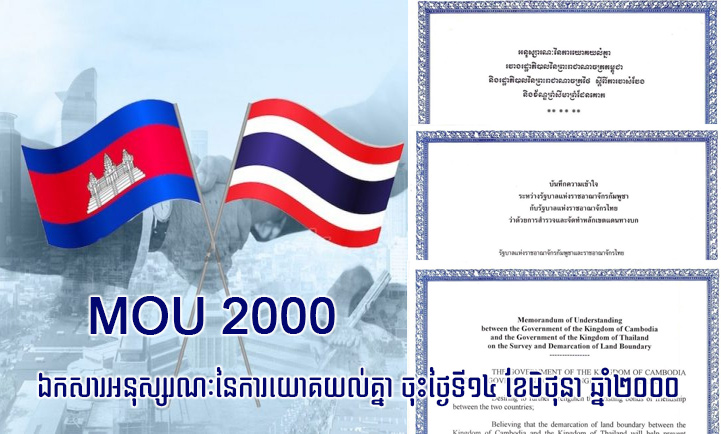 Cambodia says no as Thailand mulls border MoU referendum
Synopsis: Cambodia insists the 2000 and 2001 MoUs on land and maritime boundaries cannot be unilaterally revoked as Thailand signals plans for a public vote to cancel the agreements.
As the new Thai government tries to nullify major territorial agreements with Cambodia, Phnom Penh has made it clear that international law prohibits such a unilateral decision.
On Tuesday, the newly elected Thai Prime Minister Anutin Charnvirakul announced his government will conduct a national referendum on whether Thailand should cancel the 2000 Memorandum of Understanding on land boundary demarcation (MoU43) and the 2001 Memorandum of Understanding on overlapping maritime claims (MoU44), which the country had entered into with Cambodia.
Describing the MoUs as “controversial”, Anutin said he personally favoured abolishing the agreements but insisted the public must first be consulted.
He noted that while the cabinet has the authority to revoke the MoUs immediately, it preferred to involve the people.
“This is not about passing responsibility but about respecting the people’s voice,” he said.
“Since no agreement could be reached under the MoUs, why should we keep them when Thailand gains nothing? If they are useful, we will keep them. If not, we should abolish them.”
Anutin stated that the government will await the completion of a House special committee’s study of the agreements before moving forward with the referendum.
Cambodia did not respond positively to Anutin’s announcement.
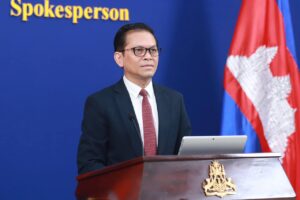
Seng Dyna, Secretary of State and spokesman for the Ministry of Justice, said yesterday that the agreements, particularly the Memorandum of Understanding between Cambodia and Thailand on the Survey and Demarcation of the Land Boundary (MoU 2000), cannot be unilaterally revoked.
“Therefore, the MoU 2000 remains in force until its purpose—the survey and demarcation of the land boundary between Cambodia and Thailand—is fulfilled. No party may withdraw from it without the consent of the other,” he said.
First, although labelled as a Memorandum of Understanding (MoU), the document functions as an international agreement with the same legal force as a treaty, having been registered with the United Nations and promulgated under Article 102 of the UN Charter, Dyna said.
Under customary international law and the jurisprudence of the International Court of Justice (Somalia v Kenya, 2017), any written agreement between states that creates binding legal obligations carries the same status as a treaty, irrespective of its title.
Second, Dyna noted that the 2000 MoU includes neither an expiration clause nor provisions allowing for unilateral termination.
“Therefore, the MoU 2000 remains in force until its purpose—the survey and demarcation of the land boundary between Cambodia and Thailand—is fulfilled. No party may withdraw from it without the consent of the other.
Kin Phea, Director-General of the International Relations Institute at the Royal Academy of Cambodia, agreed it is impossible for Thailand to cancel the 2000 and 2001 MOUs as these agreements are registered by both countries with the UN and have become international treaties.
“If Thailand were to do so, it would be regarded as a state violating international law under the 1969 Vienna Convention on the Law of Treaties, and Cambodia could bring the case before the International Court of Justice and seek intervention from the United Nations,” he explained. “Thailand would be seen as a state that disregards customary international law and would lose credibility within the international community.”
Pheas added that by attempting to nullify the MoUs, Thailand would only humiliate itself on the global stage, undermine over two centuries of efforts by both countries to define their border, and jeopardise opportunities for joint development in shared waters.
“The 2000 MoU is an important agreement that establishes a clear methodology for delimiting the border based on the 1:200,000 scale maps set out under the 1904 and 1907 Franco-Siamese conventions, which are internationally recognised and historically accurate,” he said.
“If the 2000 and 2001 MoUs were cancelled, it would represent a backward step and require the entire process to be redone. This would affect Cambodia’s territorial sovereignty and prevent the country from peacefully exploiting oil and gas resources in the shared waters.”
What is MoU 2000? The Franco-Siamese Treaty of 1907 included the creation of maps by the Franco-Siamese Mixed Commission to define the revised borders between Siam and French Indochina (now Cambodia and Laos). The treaty stipulated that a joint commission of French and Siamese officials would be appointed to delimit the new borders according to an attached protocol.
One key map, Annex I, clearly placed the Preah Vihear Temple within Cambodian territory. This map later played a crucial role in 1962, when the International Court of Justice ruled in favour of Cambodia’s sovereignty over the temple, citing Thailand’s prior acceptance of the map as decisive evidence.
Almost a century after the Franco-Siamese Treaty was signed, an agreement between the governments of Thailand and Cambodia on the survey and demarcation of their land boundary, simply known as MoU 2000, was signed between Var Kimhong, Cambodia’s Adviser to the Royal Government in Charge of State Border Affairs, and Sukhumbhand Paribatra, Thailand’s Deputy Minister of Foreign Affairs.
The document was to serve as a foundational agreement for the peaceful resolution of decades-long border issues between the two nations after the establishment of the Cambodian-Thai Joint Commission on Demarcation for Land Boundary in 1997.
Both the 1907 Franco-Siamese Treaty and the MoU 2000 played key roles in the ICJ ruling in favour of Cambodia regarding clarification of the 1962 judgment concerning the “vicinity” of the Preah Vihear Temple.
-Khmer Times-