The longevity economy
#Opinion
Cambodia needs not more tourists but people who stay.
Every morning the same scene repeats in our compound. An elderly resident walks by slowly with a helper, brightly despite everything. My wife and I once talked about it: warm climate, light clothes, abundant sunlight. For therapy or leisure, it is hard to imagine a better environment for growing old.
The tourism model has cracked
In 2024, Cambodia received 6.7 million foreign visitors, a record. By 2025 the number fell to 5.57 million. In the first five months of 2026, arrivals dropped 47.8%. The causes were multiple: the Thailand border dispute, scam centre crackdowns, broader regional uncertainty. But the real lesson is not about any single event. It is that existing tourism content was not strong enough to absorb shocks. This is a single-point-of-failure model. Cambodia needs a second tourism identity.
Wellness spending is structural, not cyclical
The world’s population aged 65 and over will grow from 524 million in 2010 to 1.5 billion by 2050. The global spread of GLP-1 drugs like Wegovy, now prescribed to over 10 million Americans, is turning wellness from a lifestyle choice into medical mainstream, extending well into the elderly. The money people spend on ageing well is structural.
The industry is already vast. Arizona’s Sun City covers 37.8 square kilometres, roughly 5.5% of Phnom Penh, housing 40,000 retirees with tiered care from independent living to medical support.
The US operates over 2,000 such communities. Japan’s Cocofan offers 24-hour care for roughly $1,100 per month, around the average pension. Its philosophy: residents stay until the end.
Figure 1: Suncity, Arizona, United States

Why Cambodia: Two axes, two destinations
Three structural advantages make Cambodia competitive. Climate: year-round warmth that supports circulation and outdoor activity. Cost: 30 to 40% below Chiang Mai, decisive for pension-funded retirements. Content: Buddhist meditation and temple stay near Angkor are experiences neither Thailand nor Malaysia can replicate.
Siem Reap is the axis of cultural and spiritual wellness. Japanese Dankai-generation retirees, Korean baby boomers and European seniors. A CCRC-style complex near Angkor with swimming, golf, helpers, and community service. Spending the final chapter of life beside Angkor Wat is a story Chiang Mai cannot sell.
Kampot and Bokor are the axis of nature and slow life. Semi-retired professionals in their 40s and 50s. Riverside long stays, highland retreats, eco-wellness. Kampot can claim the position Chiang Mai held 10 years ago.
Siem Reap is a destination for the soul. Kampot is a destination for time. Neither is something Thailand or Malaysia can offer.
This model is shock-resistant. A retired Japanese couple spending three months in Siem Reap does not cancel because of a border headline. They have signed a lease. Short-term tourists react to news. Long-term residents are anchored to life.
From services to real estate to finance
The longevity economy operates on three layers. The first is services: long-stay tourism, wellness retreats, medical care, helper employment.
The second is real estate. As senior residences take root, condominiums, commercial facilities and medical clusters follow. Foreign condominium ownership opens the capital pipeline.
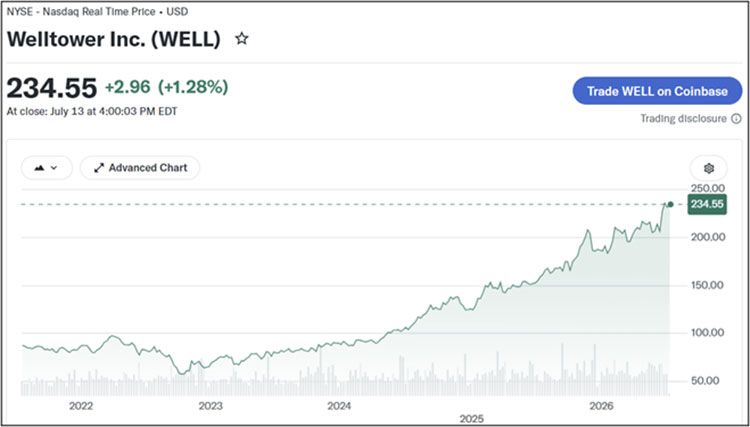
The third is finance. Welltower, the leading US healthcare REIT, has a market capitalisation of $165.5 billion, up 48% in the past year and 161% over five years. Separating ownership from operation lets institutional capital flow into senior facilities at scale. If Cambodia introduces a healthcare REIT framework, senior residences become investable assets. Asian institutional investors, pension funds and private equity can participate, and because Cambodia runs on dollars, REIT distributions carry no currency risk, linking directly to the dollar advantage in Part 6.
Figure 2: Welltower stock performance (5 years)
Three things the government must do
First, redesign the long-stay visa. Cambodia’s current ER visa for retirees is too short for genuine long-term residency. A programme offering longer stays than Thailand’s LTR or Malaysia’s MM2H, with simpler procedures, could attract hundreds of thousands.
Second, designate Siem Reap and Kampot as wellness zones: relax foreign doctor licensing, expand foreign condominium ownership, prioritise infrastructure.
Third, introduce a healthcare REIT framework. Private capital will not build senior communities without an exit mechanism. Korea launched its first healthcare REIT only in 2023 and it is still in infancy despite the country being one of the world’s most rapidly ageing societies. In contrast, US healthcare REITs account for 8% of the listed REIT market capitalisation. The gap is the opportunity. Cambodia, with the right framework, need not wait decades to follow.
Conclusion
This series has identified four strategic assets: a manufacturing window, a dollar economy, the Mekong, and the cultural heritage and climate that underpin a longevity economy. All four belong to Cambodia alone. All four remain underused. The next part turns to execution: how to allocate these assets across four cities, and how to build the institutions that make them work.
Next (Part 9): ‘Four Cities, One Strategy’: Parts 5 through 8 identified four strategic assets. But assets do not deploy themselves. Today nearly all growth flows into Phnom Penh while the rest of the country waits, and that concentration feeds the urban-rural divide and the debt cycle this series has diagnosed from the start. The fix is spatial asset allocation: Phnom Penh for finance, Sihanoukville for manufacturing, Battambang for food processing, Siem Reap and Kampot for wellness. Four roles, four cities, one strategy.
Author bio: Heemin Shin is a founding partner of Plateaux Capital, a private equity house based in New York, with prior roles as CFO of a Cambodian microfinance institution, managing director at Siguler Guff Company & LP, and founder of a fintech company he took to a successful exit. He writes in a personal capacity. Email: david@plateauxnewyork.com
-Khmer Times-