Hun Manet’s Visit to China: From AI Expectations to Realities
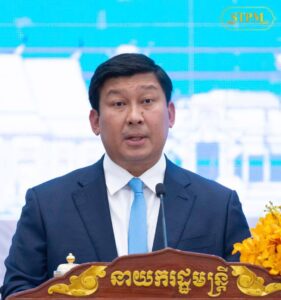
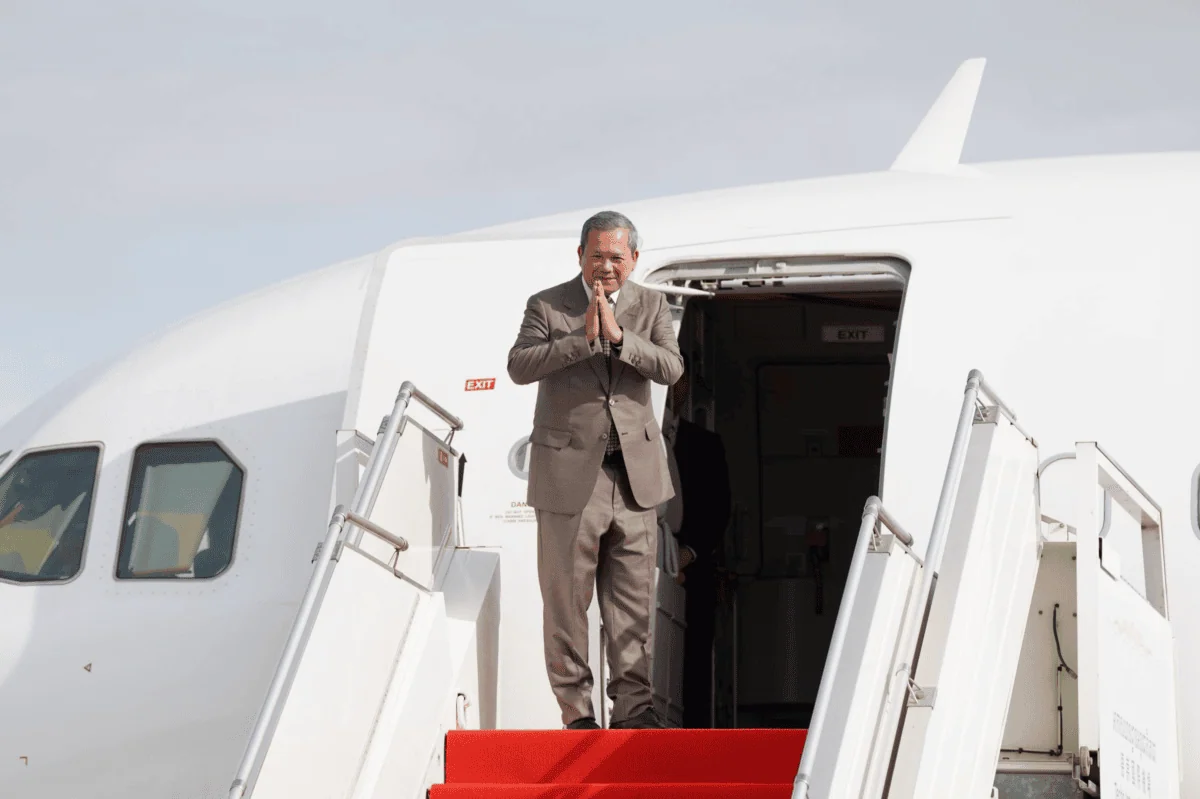 Prime Minister Hun Manet at the airport on July 15, 2026 before this departer to China. STPM
From July 15 to 17, Cambodian Prime Minister Hun Manet is undertaking a working visit to China.
The trip will culminate in his participation in the opening ceremony of the 2026 World AI Conference in Shanghai on July 17, themed “AI Partnership for a Brighter Future.” Accompanied by senior ministers and business leaders, he is scheduled to meet Chinese President Xi Jinping and Premier Li Qiang.
The visit occurs against a backdrop of deep historical ties, recent gestures like Cambodia’s visa-free pilot for Chinese tourists, and persistent questions about translating diplomatic warmth into tangible, sustainable development for both nations.
High expectations in the AI era
The visit is framed as an opportunity for Cambodia to ride the wave of global AI advancement through partnership with China, a leader in AI infrastructure, applications and governance discussions. For a developing nation like Cambodia, AI holds promise in areas such as smart agriculture, digital governance, education, healthcare and tourism management.
Cambodian officials likely anticipate technology transfers, joint ventures, training programmes and investment in digital infrastructure that could help leapfrog traditional development stages.
This aligns with broader economic hopes. In June, Cambodia launched a four-month visa-free pilot program for Chinese tourists, allowing stays of up to 14 days. The move aims to boost the post-pandemic tourism recovery, with Chinese visitors historically forming a major market. Phnom Penh clearly hopes for reciprocity or expanded Chinese facilitation for Cambodian travellers and businesses, signalling a desire for more balanced people-to-people exchanges.
Bilateral trade and investment are already significant. China is Cambodia’s top trading partner and investor, with substantial involvement in infrastructure, energy and real estate. The visit is expected to yield new agreements that deepen this cooperation under frameworks like the Comprehensive Strategic Partnership and the “Diamond Cooperation” model.
Historical context, geopolitical realities
Cambodia-China relations extend far beyond the current leaders. Successive Cambodian monarchs, including the late King Norodom Sihanouk and current King Norodom Sihamoni, along with former prime minister Hun Sen and now his son Hun Manet, have cultivated strong ties with Beijing. China has been a consistent provider of aid, investment and political support when Western donors applied pressure.
A notable episode was Cambodia’s 2012 ASEAN Chairmanship.
As chair, Cambodia blocked efforts to include strong language on South China Sea disputes in ASEAN statements, preventing unified criticism of China’s claims. This decision was widely seen as prioritising relations with Beijing over ASEAN consensus, especially amid tensions involving the Philippines and Vietnam.
Cambodia’s rationale centred on protecting its own sovereignty and avoiding entanglement in disputes that could undermine its bilateral partnerships. Phnom Penh continues to look to China for diplomatic backing on border and sovereignty issues.
While this loyalty has secured economic benefits, it has also drawn criticism. Cambodia’s heavy reliance on Chinese financing raises concerns about debt sustainability, transparency and strategic autonomy.
As of recent data, a substantial portion of Cambodia’s external debt is owed to China (around 36-41%, according to various estimates). Projects like roads, ports and energy facilities have modernised the country but sometimes face questions regarding debt servicing, local employment benefits, environmental impact and “debt-trap” risks — though Cambodia maintains these are manageable concessional loans.
In the AI context, expectations must confront realities. China excels in AI deployment at scale, but technology transfer is often selective, tied to commercial interests, data governance aligned with Chinese standards and geopolitical alignment. Cambodia’s capacity to absorb advanced AI — lacking in skilled human capital, regulatory frameworks and supporting infrastructure — limits immediate gains.
Grand announcements at conferences risk remaining performative without deep domestic reforms in education, digital literacy and innovation ecosystems.
What real mutual development looks like
The core challenge is moving from symbolic summits and historical goodwill to concrete, mutually beneficial outcomes that prioritise long-term national development over short-term political optics. For Cambodia, priorities should include:
• Diversification: Reducing over-reliance on any single partner. Balancing Chinese investment with engagement from Japan, France, South Korea, the EU, US and ASEAN neighbours to enhance bargaining power. Cambodia should provide visa-free for tourists from those countries, not only China.
• Capacity Building: Insisting on technology transfer clauses, joint R&D centres, vocational training in AI and digital skills, and local content requirements in projects.
• Sustainable Tourism and Trade: Using the visa-free pilot to gather data and push for reciprocal easing. Focus on high-value tourism and Cambodian exports (agriculture, garments, light manufacturing) to narrow trade imbalances.
• Debt and Transparency: Ensuring new loans include clear terms, feasibility studies and anti-corruption safeguards. Prioritising projects with high multiplier effects on employment and SMEs.
• Sovereignty: While seeking Chinese support on borders, Cambodia must carefully navigate ASEAN unity and its own strategic interests to avoid isolation.
For China, genuine partnership means:
• Equitable Investment: Moving beyond resource extraction or enclave projects to sectors that build Cambodian resilience, such as agro-processing, green technology and inclusive digital economy.
• Knowledge Sharing: Providing accessible AI tools, open-source contributions where possible and scholarships tailored to Cambodian needs rather than primarily commercial exports.
• Reciprocity: Easing barriers for Cambodian goods, services and people, recognising Cambodia’s gestures like visa liberalisation.
Both nations could collaborate on regional public goods: Mekong River management, climate resilience, health security and connectivity corridors that benefit broader Southeast Asia. True “All-Weather” friendship, as referenced in official rhetoric, requires addressing asymmetries rather than glossing over them.
Critically, over-romanticising the relationship risks policy blind spots. Cambodia’s development trajectory depends on good governance, rule of law, human capital and diversified diplomacy — not solely on alignment with any great power. China benefits from a stable, prosperous Cambodia as a gateway to ASEAN, but excessive influence could complicate Beijing’s broader regional image.
All in all, Manet’s visit to China, centred on the AI Conference, symbolises continuity in a vital bilateral relationship. The pomp of high-level meetings and AI-themed optimism is understandable, but critical thinking demands scrutiny of deliverables. Historical ties from kings to current leaders provide a strong foundation, and gestures like visa facilitation show goodwill.
Yet realities — debt burdens, capacity gaps, geopolitical trade-offs and uneven benefits — temper the hype.
The real test lies in implementation: specific, measurable projects that create jobs, transfer skills, protect sovereignty and foster inclusive growth.
Both sides should focus less on grandiose declarations and more on pragmatic steps — education partnerships, transparent infrastructure, diversified trade and joint innovation — that deliver “real development for our two nations”. Without this shift from expectations to accountable realities, such visits risk becoming rituals of familiarity rather than catalysts for transformation.
Cambodia’s future prosperity depends on leveraging strong friendships wisely, not depending on them exclusively.
Dr. Seun Sam is a policy analyst at the Royal Academy of Cambodia. The views and opinions expressed are his own.