Cambodia and the Strait of Hormuz
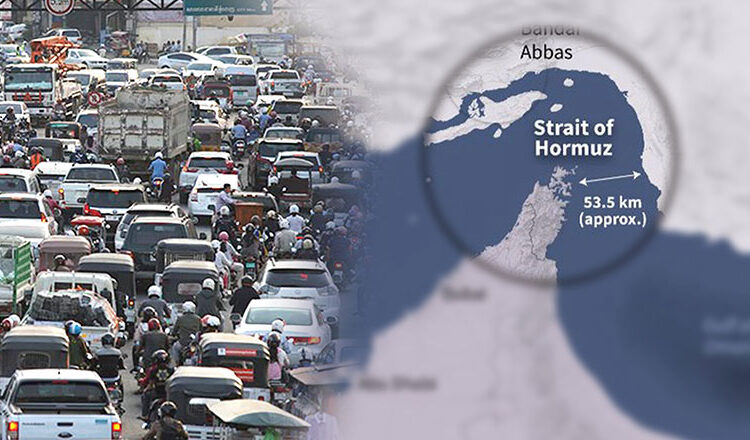 Households in Cambodia are feeling the impacts of a war occurring thousands of kilometres away in the Persian Gulf. Khmer Times
Opinion
I keep thinking about the moto-taxi driver who used to wait outside my apartment building in Phnom Penh.
Most mornings, before accepting a ride, he would glance at his phone and do a quick calculation. Was the fare worth the fuel? Could he make enough on the trip to justify the petrol he would burn getting there?
For much of this year, that calculation was never really his.
It belonged instead to diplomats in distant capitals, military commanders weighing their next move and negotiators trying to salvage one more ceasefire in a war thousands of kilometres away.
It belonged to the Strait of Hormuz.
Most Cambodians will never see the narrow waterway separating Iran from the Arabian Peninsula. Yet few places have had a greater impact on daily life in Cambodia this year. The war that erupted around Iran in February, and the repeated collapse and resurrection of ceasefire agreements that followed, affected the price of fuel in Phnom Penh as surely as if the conflict had been taking place on our own borders.
That is one of the defining realities of the modern economy: geography matters less than vulnerability.
When shipping through the Strait of Hormuz was disrupted in March, Cambodia felt the shock almost immediately. Oil prices surged. Fuel supplies tightened. Petrol stations across the country reported shortages or imposed limits. The effects rippled through the economy, raising transport costs and squeezing household budgets already under pressure.
The burden did not fall evenly.
For wealthier Cambodians, higher fuel prices meant paying more at the pump. For many others, they meant earning less.
A moto-taxi driver cannot simply pass on higher fuel costs to customers. A market vendor cannot easily charge more when buyers are struggling themselves. Farmers dependent on diesel-powered irrigation and transport cannot postpone planting because global oil markets have become volatile.
The costs were absorbed where they usually are: by people with the least ability to absorb them.
None of those affected had any influence over the decisions that triggered the crisis. Yet they paid the price first.
The government’s response was pragmatic. Rather than allowing the full increase in global fuel prices to reach consumers, it reduced duties and taxes while introducing measures aimed at accelerating the adoption of electric vehicles and alternative energy technologies.
Those policies deserve more attention than they have received.
Subsidies can soften the blow of a crisis. They cannot eliminate the vulnerability that caused it.
The more important question is why a disruption at a maritime chokepoint half a world away can so quickly alter the cost of living in Cambodia.
The answer is simple: dependence.
Cambodia imports virtually all of its fuel. Every spike in international energy markets therefore becomes a domestic issue. Every conflict that threatens shipping lanes becomes a concern for households in Phnom Penh, Battambang and Siem Reap. Every geopolitical crisis arrives eventually at the fuel pump.
The ceasefires that followed offered temporary relief. Oil prices retreated. Fuel costs eased. Consumers regained some breathing room.
But the pattern repeated often enough to expose a larger problem.
Each time a truce was announced, markets relaxed. Each time fighting resumed, prices climbed again. Cambodia’s economic fortunes seemed to rise and fall with developments over which it had virtually no control.
That should concern us more than the war itself.
The lesson of 2026 is not simply that global events matter. We have always known that. The lesson is that Cambodia remains unusually exposed to events occurring far beyond its borders.
A country cannot choose its geography. It can choose how vulnerable that geography makes it.
That is why the current push towards renewable energy, electric vehicles and greater energy diversification should not be viewed merely as environmental policy. It is economic policy. It is national resilience policy.
The next disruption may not come from the Persian Gulf. It could emerge from another conflict, another shipping crisis or another geopolitical confrontation that nobody sees coming.
Globalisation guarantees that distant events will continue to shape local realities.
What governments can influence is how much those events hurt when they arrive.
The ceasefire may hold. Oil prices may continue to fall. Tankers may move freely through Hormuz once again.
But the most important question is what Cambodia does after the headlines fade.
I think back to that moto-taxi driver outside my building, staring at his phone before deciding whether a ride was worth taking.
No ceasefire can permanently remove uncertainty from his life. Yet a more resilient energy system could ensure that his livelihood is not repeatedly determined by decisions made eight time zones away.
That, more than any temporary drop in fuel prices, is what Cambodia should take from this war. Are we prepared for future shocks? Our current energy policy is not future ready. The government must have a concrete, holistic energy security policy and roadmap.
The government’s efforts to promote electric vehicles and alternative energy are a start, but they should be expanded significantly.
Solar energy, in particular, offers one of the most practical paths towards greater energy security. Cambodia enjoys abundant sunshine throughout the year, yet household solar adoption remains limited by upfront costs and financing barriers.
The government should introduce targeted subsidies, low-interest loans and tax incentives to encourage households and small businesses to install rooftop solar panels.
Every home that generates part of its own electricity reduces pressure on imported energy and strengthens the country’s resilience to external shocks. Investments in decentralised solar systems would not only lower energy bills but also create new economic opportunities in installation, maintenance and related industries.
Support should also be directed towards those most exposed to fuel price volatility. Moto-taxi drivers and smallholder farmers bear a disproportionate share of the burden whenever global oil prices rise.
Temporary fuel subsidies during crises can provide relief, but longer-term measures are needed. Incentive programmes to help drivers transition to electric motorcycles, along with support for solar-powered irrigation systems and agricultural equipment, would reduce operating costs while strengthening livelihoods.
The goal should not be only to survive the next energy crisis. It should be to emerge less vulnerable when it arrives.
-Khmer Times-