Observation Is Not Recognition: ASEAN Observers Team Must Never Be Used to Normalise Unlawful Occupation
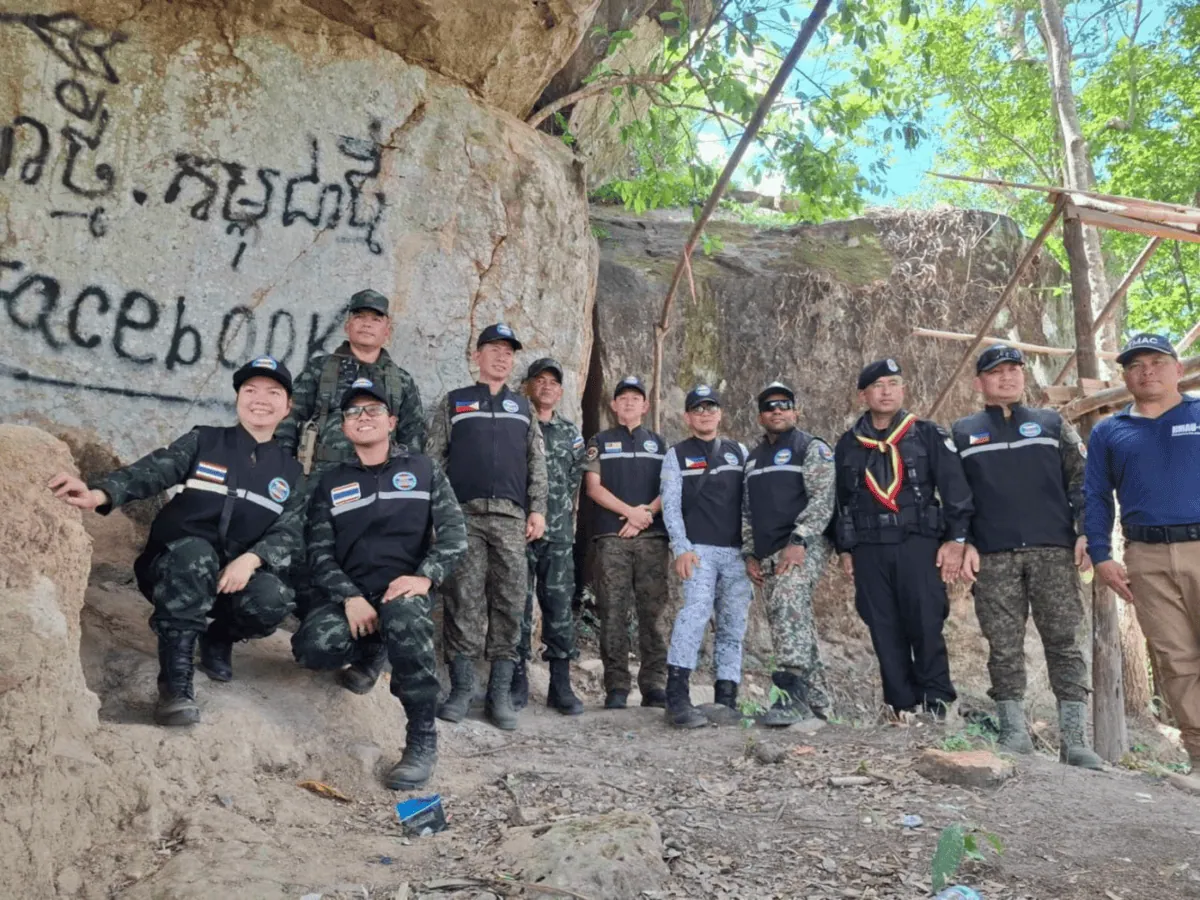 -The Thai military brought the Thailand-based ASEAN Observer Team (AOT) to visit the border inside Cambodian territory at the Khnar Temple area. Supplied
Every regional organisation is ultimately judged not only by the disputes it seeks to manage, but by its ability to remain above them. For ASEAN, whose identity is built upon peaceful dispute settlement, mutual respect and regional trust, impartiality is not merely a procedural requirement—it is the foundation of its credibility.
That is why Thailand’s recent decision to escort the ASEAN Observers Team (AOT) into the area surrounding Prasat Khnar should concern not only Cambodia, but every ASEAN member.
The issue is not the observers themselves. Cambodia has consistently welcomed ASEAN’s constructive role in promoting dialogue, reducing tensions and preserving regional peace. Nor is there any reason to question the professionalism or integrity of the ASEAN Observers Team.
The concern lies in the circumstances of the visit and the precedent it risks creating.
By taking ASEAN observers into territory that Cambodia maintains forms part of its sovereign territory under the applicable boundary treaties and maps, but which is currently under Thai occupation, the visit risks creating the impression — however unintended — that ASEAN is witnessing an ordinary administrative exercise rather than a disputed territorial situation. Observation is not recognition as a matter of law. Yet in international politics, carefully orchestrated appearances often carry consequences far beyond their legal intent.
This distinction matters because modern territorial disputes are no longer fought only with military deployments. Increasingly, they are contested through narratives, images, official ceremonies, tourism promotion, infrastructure projects and carefully managed visits by foreign delegations. The objective is rarely to change international law directly. Rather, it is to shape international perception gradually until an abnormal situation begins to appear normal.
This is the strategy commonly described as the normalisation of a fait accompli.
History demonstrates that unlawful territorial control is seldom legitimised through one dramatic act. It is normalised incrementally — one administrative measure, one official photograph, one international visit and one carefully crafted narrative at a time.
International law was designed precisely to prevent this process.
One of the cornerstones of the post-1945 international legal order is that territory cannot lawfully be acquired through the threat or use of force. Equally important is the principle of non-recognition of unlawful territorial situations. This principle requires states and international organisations to avoid acts that could reasonably be interpreted as recognising or legitimising territorial situations created in violation of international law.
The rationale is straightforward. If unlawful territorial situations could become lawful simply because they persist long enough or receive enough international exposure, the prohibition against territorial acquisition by force would gradually lose its meaning.
The international community has therefore consistently rejected attempts to convert military control into legal sovereignty through the passage of time or administrative practice.
Military occupation does not create sovereignty. Effective control does not extinguish lawful title. Unilateral administrative acts cannot replace internationally recognised treaties. Nor can public relations campaigns alter international boundaries.
Against this legal backdrop, the recent visit to Prasat Khnar deserves careful reflection.
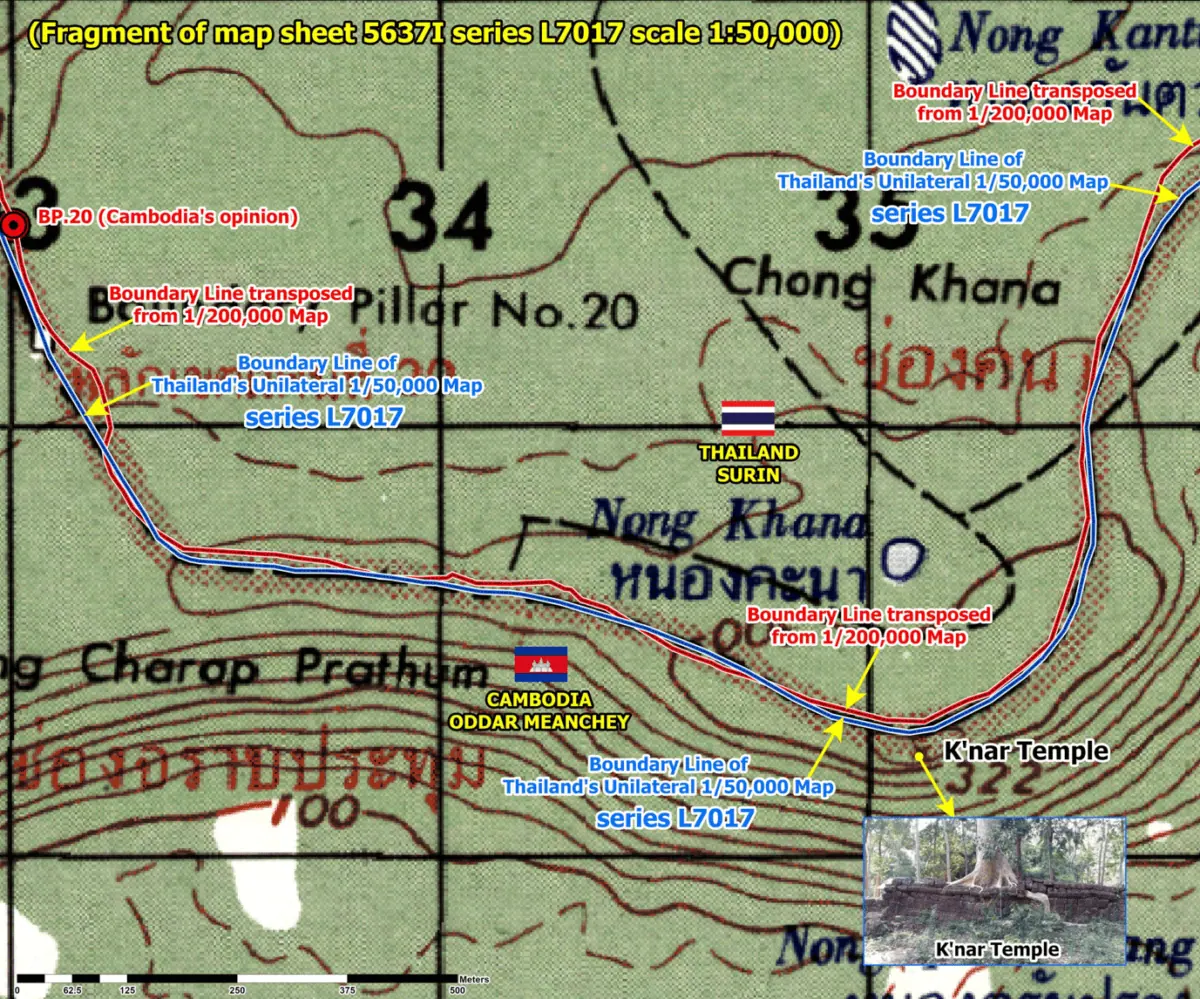
Cambodia’s position regarding Prasat Khnar is supported by the internationally recognised 1:200,000-scale maps prepared pursuant to the Franco–Siamese Boundary Treaties of 1904 and 1907, which constitute the agreed cartographic basis for the delimitation of the Cambodia–Thailand boundary. These maps place Prasat Khnar within Cambodian territory.
Significantly, even Thailand’s own unilaterally produced 1:50,000-scale Series L7017 map — which Cambodia has never accepted as having legal validity and which cannot alter the internationally recognised boundary — also depicts Prasat Khnar as lying within Cambodian territory. Thailand’s own map therefore contradicts the very narrative advanced through its current administrative control of the area.
This makes the recent visit particularly sensitive. When ASEAN observers are escorted into an area that Cambodia maintains is legally situated within its sovereign territory under the applicable boundary treaties and maps, but is presently under Thai occupation, the visit may inadvertently be portrayed as acceptance of a factual situation that Cambodia fundamentally disputes.
The concern is not the intention of the AOT. The concern is how the visit may subsequently be presented to domestic and international audiences as evidence that ASEAN has accepted Thailand’s administration of the area.
This is precisely how the normalisation of unlawful occupation operates — not through explicit recognition, but through the gradual accumulation of seemingly routine events. One official visit does not determine sovereignty. One observer mission does not alter international boundaries. But repeated official activities can gradually create the perception that an unlawful situation has become normal.
That is why observer missions require exceptional care.
The credibility of any observer mission depends not only on the neutrality of its personnel but also on the neutrality of its procedures. How visits are organised, who determines the itinerary, under whose authority access is granted and how the visit is subsequently presented to the public all shape international perceptions. Neutrality is measured not only by intention but also by appearance.
International organisations have long recognised this challenge. Across numerous territorial disputes around the world, international institutions routinely avoid actions that could prejudice competing legal claims or inadvertently legitimise contested territorial control. Such caution protects both the integrity of the mission and the credibility of the institution.
ASEAN should uphold the same standard. The ASEAN Observers Team was established to support confidence-building, transparency and de-escalation — not to become associated, however unintentionally, with unilateral narratives concerning disputed territory. Its presence should never be capable of being interpreted as endorsing, validating or normalising one party’s administrative control over territory whose sovereignty remains contested.
This is not merely a Cambodian concern. It is an ASEAN concern.
Today the issue involves Prasat Khnar. Tomorrow it could involve another disputed area elsewhere in Southeast Asia. The precedent established today may influence how ASEAN is perceived in future territorial disputes among its own members.
For precisely that reason, future observer visits to sensitive border areas should, wherever practicable, be coordinated transparently with both parties. Their mandate should remain focused on observation, confidence-building and conflict prevention — not on activities that may inadvertently reinforce unilateral territorial narratives.
Doing so would protect not only the credibility of the observer mission but also ASEAN itself.
Cambodia has consistently affirmed that disputes should be resolved peacefully through international law, existing treaties and mutually agreed mechanisms. That commitment remains unchanged. Cambodia welcomes impartial international engagement precisely because confidence in neutral institutions serves the interests of all parties. But neutrality must be carefully safeguarded.
History offers a clear warning. Unlawful occupations rarely become accepted overnight. They become normalised gradually — through repetition, routine and silence. One official ceremony. One infrastructure project. One tourism campaign. One international visit. One photograph at a time.
ASEAN must ensure that its observer missions never become part of that process.
Its greatest strength has never been military power or political coercion. It has been credibility, trust and the confidence that every member will be treated with equal respect under shared principles.
That credibility is too valuable to place at risk. Observation must never become recognition. And ASEAN must never allow its observer missions — even inadvertently — to contribute to the normalisation of an unlawful territorial situation.
Roth Santepheap is described as a Phnom Penh-based geopolitical analyst. The views and opinions expressed are his own.
-Khmer Times-