Thailand Must Honour International Boundaries, Not Unilateral Claims
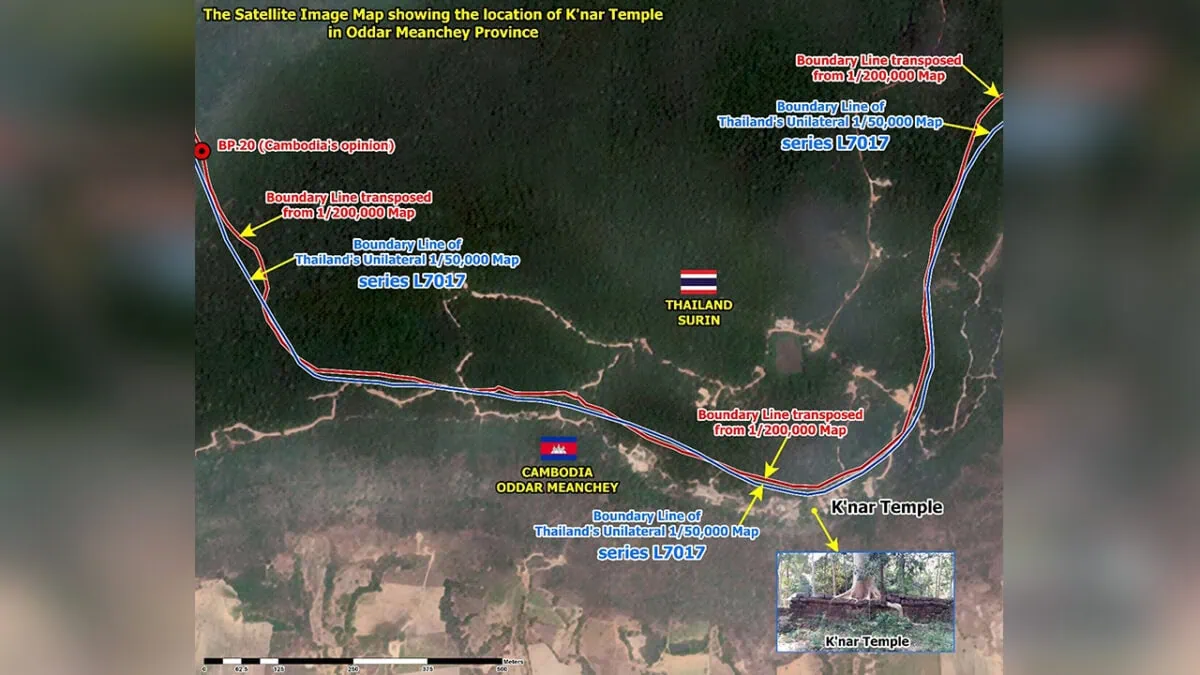 The boundary lines of a unilaterally drawn Thai map show that Khnar (K’nar) Temple is located in Cambodia. Supplied.
#Opinion
International borders cannot be rewritten by political convenience, military occupation or unilateral cartography. They derive their legitimacy from treaties, internationally recognised boundary instruments and the rule of law. That principle is essential not only for Cambodia and Thailand but for the stability of the international order itself.
The Cambodia–Thailand boundary was not created yesterday. It was established more than a century ago through the Franco-Siamese Treaties of 1904 and 1907, the work of the Franco-Siamese Boundary Delimitation Commission, official boundary records and the internationally recognised 1:200,000-scale maps. These instruments collectively defined a legally recognised international boundary that has long been accepted under international law.
Yet today, Thailand increasingly seeks to rely on unilateral actions and domestically produced maps to challenge that settled boundary. The irony is striking.
Thailand’s own unilaterally produced Series L7017 map — the very map Bangkok has repeatedly invoked in support of its territorial narrative — places Khnar Temple, Tamone Thom Temple, Ta Krabei and several other ancient Khmer temples on the Dangrek Mountains inside Cambodian territory.
Although Cambodia has consistently maintained that the L7017 map possesses no legal status because it was produced unilaterally and was never accepted by both States, the map nevertheless reveals an inconvenient truth: even Thailand’s own cartographic evidence contradicts many of the claims advanced today.
This is not a question of choosing between two competing maps. The legal boundary does not derive from Thailand’s L7017 map. Nor does it depend on unilateral interpretations made decades after the frontier had already been internationally delimited.
Rather, Thailand’s own map simply reinforces what the legally recognised boundary has demonstrated all along.
When both the internationally recognised boundary map and Thailand’s own military map independently place the same Khmer temples within Cambodian territory, it becomes increasingly difficult to justify claims based on political rhetoric or unilateral reinterpretation.
International law does not permit states to redraw established boundaries simply because they later become dissatisfied with them.
The principle is clear. A state cannot acquire sovereignty through unilateral assertion. It cannot manufacture legal title by producing domestic maps. Nor can military occupation, administrative practice or political declarations alter an internationally established frontier.
This is why international courts have consistently attached primary legal weight to treaties, agreed boundary commissions and mutually accepted delimitation instruments — not to maps created by one party alone for its own purposes.
Cambodia’s position has remained remarkably consistent. Cambodia relies on the internationally established boundary, the historical treaties, the official maps prepared by the Franco-Siamese Boundary Delimitation Commission and international law.
Cambodia has repeatedly called for disputes to be resolved peacefully through legal mechanisms rather than through force, unilateral actions or political pressure.
Thailand should do the same. Respecting international boundaries is not a concession to Cambodia. It is an obligation owed to international law itself.
Indeed, honouring legally established borders protects every nation, large and small. If States were free to reinterpret boundaries whenever politically convenient, no international frontier would remain secure.
The issue therefore extends beyond a handful of ancient temples. It concerns whether internationally recognised boundaries continue to matter. It concerns whether treaties remain binding. It concerns whether the rule of law prevails over unilateral action.
Thailand has an opportunity to demonstrate its commitment to these principles.
Rather than advancing claims that are contradicted even by its own cartographic records, Thailand should reaffirm the integrity of the internationally established boundary, respect existing legal instruments and resolve any remaining differences through peaceful legal processes grounded in international law.
History has already drawn the boundary. The law has already recognised it. The responsibility now is simply to honour it.
Roth Santepheap is described as a geopolitical analyst based in Phnom Penh. The views and opinions expressed are his own.
-Phnom Penh Post-