Borders Should Unite Khmer Blood, Not Divide It Opinion
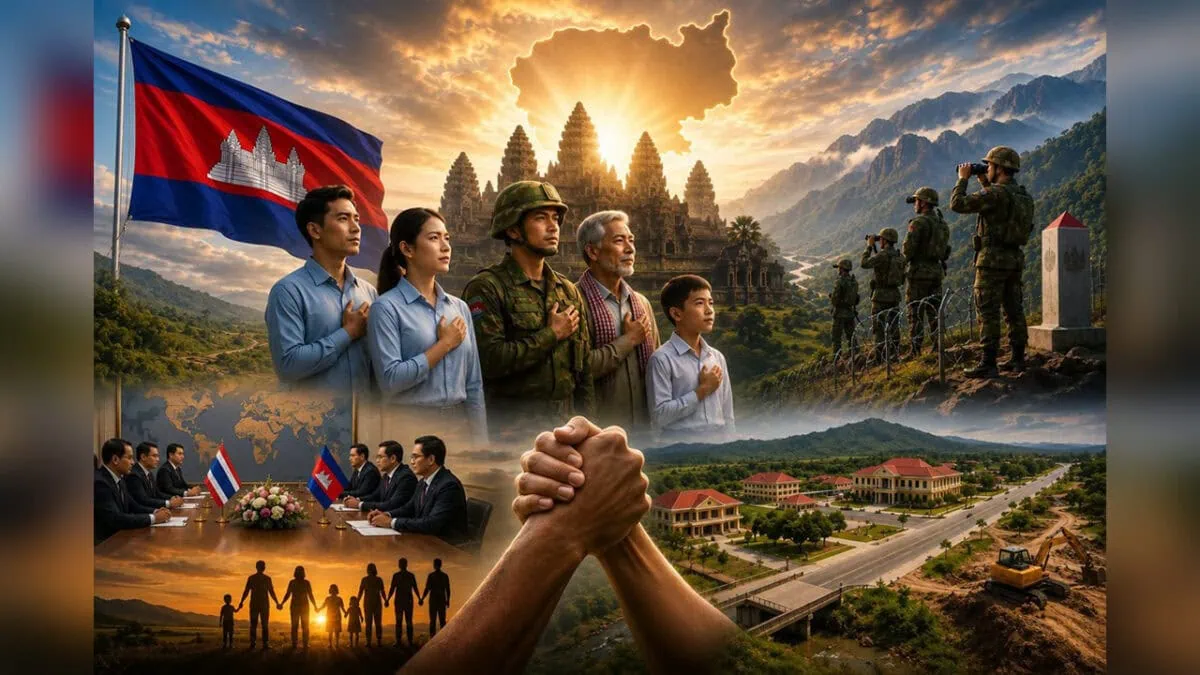 The author has called for unity among Khmer in the face of foreign aggression. Post AI
The border issue is not the affair of a single government mandate, nor the exclusive property of any political party. Rather, it is a matter of national survival and long-term national sustainability that demands the highest level of shared responsibility from all stakeholders. This includes the ruling party, opposition parties, politicians of all political tendencies, the armed forces, technical experts and the general public. Borders are the demarcation lines of sovereignty, symbols of territorial integrity and embodiments of national dignity. Therefore, all political parties must integrate border issues into their political platforms as a top national priority, both during electoral campaigns and after assuming power.
In an increasingly complex geopolitical environment, where the rules-based international order is gradually weakening, border issues with neighbouring countries remain highly sensitive and capable of triggering security crises at any moment if not managed with strategic foresight, diplomatic wisdom and strong national unity. In this regard, there are at least three major policy pillars that all political parties should adopt and eventually transform into national policy upon taking office.
First — A Policy for Resolving Border Issues with Neighbouring Countries
All political parties should clearly articulate their strategies, visions and legal mechanisms for resolving border disputes with neighbouring countries based on international law, historical maps, treaties, agreements and peaceful diplomatic mechanisms. Border disputes cannot be resolved through emotion, impulsiveness, personal sentiment or extreme nationalist rhetoric. Instead, they must be addressed through wisdom, credible legal and documentary evidence, and responsible diplomacy.
Second — Strategies and Tactics for Defending Borders, Sovereignty, and Territorial Integrity
All political parties should possess a long-term and coherent vision for strengthening national defence capabilities, modernising border security mechanisms, developing defensive strategies and utilising proactive diplomacy as a preventive tool against conflict. Protecting sovereignty and territorial integrity is not solely the duty of the armed forces; it is the supreme responsibility of the entire nation.
Third — A Border Development Policy
Citizens living along border areas represent a “living border” and serve as the most effective frontline defenders of national sovereignty. If border regions remain trapped in poverty and lack infrastructure connectivity, public services and economic opportunities, they will become vulnerable from national security, geopolitical and social stability perspectives. Therefore, border development must be regarded as an essential and long-term component of national security policy.
What is most crucial at this moment is not mutual accusation, suspicion or blame among Khmers themselves. The fundamental question we must ask is this: How can we peacefully, lawfully and effectively reclaim territories that are currently occupied, controlled and unlawfully held by invading Siamese forces?
This is the core issue that politicians of all political stripes must collectively reflect upon, research and seek common solutions for, rather than turning a matter tied to the destiny of the nation into a tool for cheap popularity or domestic political point-scoring. All politicians bear historical responsibility before future generations if national territory is permanently lost to foreign hands.
The border issue is a matter of paramount national importance that requires the highest degree of national solidarity. Leaders and politicians of all tendencies must know how to engage in closed-door discussions within the greater Khmer family with professionalism, responsibility and a profound sense of national conscience in order to formulate a unified strategy for protecting national interests.
We must not publicly expose or attack Cambodia’s internal strengths, weaknesses or strategic considerations, because such actions may inadvertently provide useful strategic information to the opposing side or invading forces that could later be exploited against us on the international stage.
Our Khmer ancestors left us a profound proverb: “A quarrel within the family is like stripping naked before relatives; a quarrel within the nation is like revealing treasure to thieves.”
This proverb remains deeply relevant today. When Khmers endlessly quarrel among themselves and publicly disclose sensitive information or national strategies, it not only weakens and fractures national unity, but also creates opportunities for foreign actors to exploit our divisions in pursuit of their own interests and expansionist ambitions.
Therefore, no politician should ever use the border issue as a political weapon to create national division or inflame social anger. Instead, we must forge a single national agenda that every political party and every Khmer citizen has a collective duty to protect and uphold. The border issue should be the glue that binds Khmer blood together in unity, not a bomb that detonates and scatters Khmer blood apart.
When territorial integrity and national sovereignty are transformed into a common national policy and a united voice of the nation, Cambodia will possess the internal resilience and strategic strength necessary to firmly and sustainably defend its sovereignty, territorial integrity and supreme national interests for generations to come.
Kin Phea is alternate member of the Royal Academy of Cambodia (RAC) and director General of the International Relations Institute of Cambodia. The views and opinions expressed are his own.
-Phnom Penh Post-