Cultivating the Future: A Strategic Roadmap for Cambodia’s Green and Modern Agricultural Transformation
 Cultivating the Future: A Strategic Roadmap for Cambodia’s Green and Modern Agricultural Transformation
#Opinion
As the Kingdom of Cambodia stands at a historic crossroads, transitioning from a lower-middle-income nation toward the ambitious Cambodia Vision 2050 of becoming a high-income country, the role of the agricultural and environmental sectors has never been more vital.
Under the visionary leadership of the Royal Government of Cambodia (RGC), the nation has navigated decades of transformation, from the post-war “Win-Win Policy” to the current Pentagonal Strategy, Phase I.
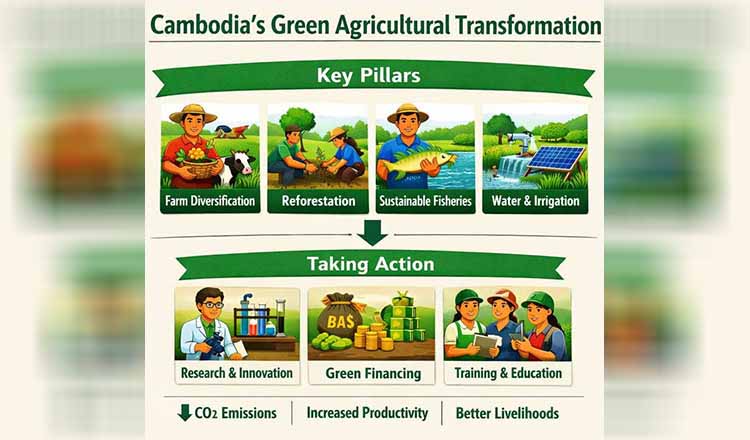
This strategy, which prioritizes Growth, Employment, Equity, Efficiency, and Sustainability, provides the perfect framework to modernize our economy while safeguarding our natural heritage. To further accelerate this progress, we can look toward a deepened strategic vision that aligns with current government priorities across five key pillars: innovation, reforestation, fisheries, integrated water management, and institutional strengthening.
1. Catalyzing Agricultural Diversification and High-Value Innovation
The RGC has correctly identified agriculture as a cornerstone of the national economy, contributing significantly to GDP and rural livelihoods. However, to meet the challenges of the 21st century, we must move beyond the traditional reliance on rice monoculture and manual labor.
While Cambodia has achieved commendable paddy surpluses, the current model often sees raw materials exported with little value-added, only for the nation to import finished agricultural products. Statistics from the National Agricultural Development Policy 2022-2030 indicate that only about 10% of Cambodia’s harvested products are processed domestically.
To bridge this “innovation gap,” we must support the RGC’s initiative to establish “Agro-Industrial Parks” and specialized clusters. By incentivizing local agro-processing, packaging, and storage, we can ensure that the economic profit remains within our borders, creating jobs for the youth and reducing poverty.
This shift toward a “Modern, Competitive, and Inclusive” sector requires not just new crops, but a fundamental change in how we view the agricultural value chain—turning our fertile soil into a sophisticated industrial engine.
2. A 20-Year Green Legacy: The Reforestation Vision
Environmental sustainability is the fifth side of the RGC’s Pentagonal Strategy, reflecting a deep commitment to climate change response. It is not too late to launch a national campaign to plant billions of trees, a vision that will bear fruit over the next 20 years. As we observe the lush landscapes of partners like Singapore, we see that their current beauty is the result of long-term planning and planting decades ago.
By committing to large-scale reforestation now, Cambodia can maintain and exceed its target of 60% forest cover, directly contributing to our goals under the Nationally Determined Contribution (NDC) to reduce greenhouse gas emissions by 23% by 2030. Furthermore, a green Cambodia is a competitive Cambodia.
Reforestation opens the door to the global carbon credit market, allowing the Kingdom to monetize its environmental stewardship. This strategic move ensures that “Green Cities” become the hallmark of our development, protecting our biodiversity while mitigating the droughts and floods that threaten our farmers.
3. Strategic Investment in the Blue Economy
Cambodia’s inland and marine fisheries are a national treasure, yet they face increasing pressure. To support the RGC’s Strategic Planning Framework for Fisheries, we should consider a focused investment policy—for instance, an annual allocation of $1 million specifically for the hatching and protection of fingerlings (baby fish).
This “seeding” of our natural lakes and ponds during the water-rising season would provide an exponential return on investment.
As these fingerlings grow and disperse through the Tonle Sap and other natural systems, they provide a sustainable, high-protein food source and economic security for millions of rural households.
This approach blends modern aquaculture science with the natural rhythms of our ecosystem, ensuring that our “silver scales” continue to glisten for generations to come.
4. Integrated Water Management and Institutional Strengthening
“Water” remains a top priority of the Pentagonal Strategy, essential for both life and industry. Even with fertile land, our productivity is often hampered by water shortages in the dry season. Therefore, expanding modern irrigation systems, such as solar-powered pumps and drip irrigation, is critical.
However, infrastructure must be matched by human capital. We must strengthen our educational and research institutions to produce a new generation of skilled agribusiness professionals. The Cambodian Conservation Agriculture Research for Development Center (CARDEC) is a prime example of the institutional foundation needed to test climate-smart technologies like “no-till” farming and cover cropping.
To maximize the impact of these technologies, we must continue to support the RGC’s transition toward Modern Agricultural Cooperatives (MACs). Unlike traditional models, MACs are professionally managed, market-linked, and capable of handling large-scale investments and water management tasks.
5. A Unified Mandate for Long-Term Development
The strategic insights shared here are born from real-world experience and a deep commitment to the nation’s progress. They are intended to be a humble contribution to the policy dialogues for the upcoming government mandate, ensuring that the successes of the past 25 years are consolidated and expanded.
The path to Vision 2050 requires a “long-term vision” but “immediate action”.
By aligning our national budget and development efforts with these five pillars—diversification, reforestation, fisheries, water management, and institutional reform—we can ensure that Cambodia’s growth is not only rapid but also sustainable and equitable.
The ASPIRE-AT program, with its focus on the “graduation ladder” (moving from support-ready to professional-ready), provides a clear blueprint for how we can elevate our rural producers into the global market.
Conclusion: Planting the Seeds of Prosperity
Cambodia has already demonstrated its ability to achieve “commendable progress” against all odds. From the restoration of peace to the successful management of global health crises, the RGC has laid a solid foundation. Now, we have the opportunity to take our “national pride to new heights,” as was done during the Angkor era.
The modernization of our agricultural sector and the greening of our environment are not just technical tasks; they are a legacy we leave for our children. By supporting the RGC’s strategic reforms and deepening our commitment to innovation and sustainability, we can transform the Kingdom into a “vibrant society” and a “high-income economy”.
The seeds we plant today—whether they are literal billions of trees or the metaphorical seeds of agro-industrial policy—will grow into the prosperity of Cambodia 2050. Together, as partners in development, we can ensure that the Kingdom remains strong, vital, and green.
……………………………
Mr. Thay Somony holds dual Master’s degrees, both earned with distinction: a Master of Aquaculture from Deakin University, Australia, and a Master of Business Administration from the Royal Agricultural University, United Kingdom. He is widely recognized as an expert in sustainable aquaculture and climate-resilient farming.
-Khmer Times-