Cambodia’s UNCLOS Step: Peaceful, Lawful and Necessary
 Cambodia’s UNCLOS Step: Peaceful, Lawful and Necessary
#Opinion
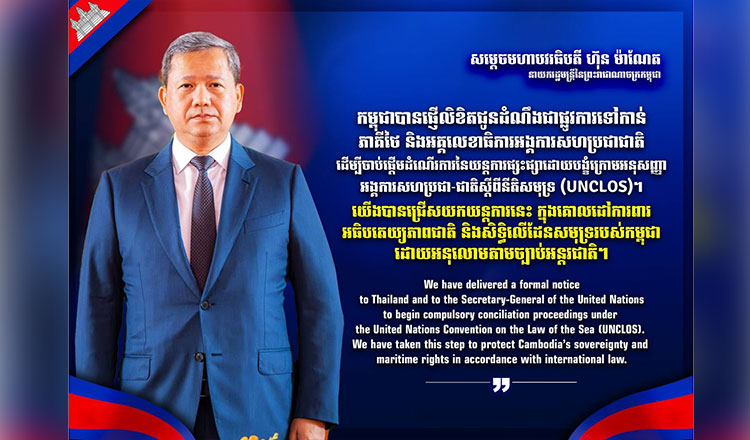
Thailand’s latest statement on Cambodia’s decision to institute compulsory conciliation proceedings under the United Nations Convention on the Law of the Sea is not only misleading; it reverses the order of events. Cambodia did not break the bridge of dialogue. Thailand did.
For more than two decades, the 2001 Memorandum of Understanding between Cambodia and Thailand served as the only bilateral framework specifically designed to manage overlapping maritime claims in the Gulf of Thailand. It was not perfect. It did not produce a final settlement. But it kept both sides inside a recognized negotiating structure. It preserved a channel for dialogue. It provided a practical basis for managing a sensitive maritime issue without confrontation.
That bridge was not destroyed by Cambodia. It was terminated by Thailand.
When Thailand unilaterally walked away from the 2001 MOU, it removed the very framework it now claims Cambodia should have continued to rely upon. Bangkok cannot dismantle the agreed bilateral mechanism and then accuse Phnom Penh of acting hastily for turning to an international legal process expressly provided under UNCLOS. Such an argument is not diplomacy; it is an attempt to shift responsibility.
Thailand says the 2001 MOU was no longer suitable to the “new context.” But if Thailand truly wanted a new and constructive framework, it could have proposed one through serious, respectful and continuous negotiation before terminating the existing arrangement. Instead, Thailand chose to end the only standing maritime framework first and explain later. That decision created the vacuum. Cambodia’s resort to UNCLOS is a lawful response to that vacuum.
Compulsory conciliation is not escalation. It is not confrontation. It is not an unfriendly act. It is a peaceful dispute settlement mechanism under international law. Both Cambodia and Thailand are parties to UNCLOS. Both have accepted the Convention’s legal architecture. When one party blocks, delays or dismantles the existing process, the other party is fully entitled to use the mechanisms that international law provides.
Thailand’s claim that Cambodia’s decision contradicts Cambodia’s call for restoring bilateral relations is equally unconvincing. Law and dialogue are not opposites. Conciliation under UNCLOS does not end negotiation; it supports negotiation. Its purpose is to help the parties clarify issues, narrow differences and move toward a mutually acceptable solution. The process produces recommendations, not an imposed judgment. It preserves the role of both states while bringing discipline, transparency and legal structure to a dispute that has remained unresolved for far too long.
In fact, Cambodia’s action should be understood as a responsible act of restraint. Cambodia did not choose pressure. It did not choose provocation. It did not choose unilateral exploitation. It chose a recognized, peaceful and rules-based process. That is exactly what responsible states should do when bilateral mechanisms have been broken by one side.
Thailand also suggests that Cambodia’s decision may harm trust and confidence. But trust is not harmed by law. Trust is harmed when one party unilaterally terminates an agreed framework. Trust is harmed when legal commitments are treated as disposable. Trust is harmed when a country seeks to control the process after it has already abandoned the process it previously accepted.
The reality is simple: the old bilateral framework has been broken by Thailand’s own decision. Cambodia cannot be expected to wait indefinitely in a legal vacuum created by Bangkok. Nor should Cambodia’s sovereign rights and maritime interests be held hostage to political calculations, nationalist rhetoric or shifting positions from the Thai side.
The Gulf of Thailand is not merely a map dispute. It concerns sovereignty, maritime rights, energy security, economic development and the future prosperity of both peoples. The responsible path is not to deny reality, but to manage it through law.
UNCLOS exists precisely for this purpose: to provide peaceful procedures when states cannot resolve maritime disputes through ordinary negotiation alone.
Thailand should therefore accept the reality it helped create. The 2001 MOU is gone because Thailand chose to terminate it. The previous bridge has been broken. The way forward now is not to complain that Cambodia has crossed into international law, but to engage sincerely in the process that both countries, as UNCLOS parties, have accepted.
Cambodia’s message should be clear and firm: we remain committed to peace, dialogue and good neighbourly relations. But dialogue must be meaningful, not used as a pretext for delay. Negotiation must be anchored in law, not unilateral advantage. Trust must be rebuilt through responsible conduct, not public statements that blame Cambodia for the consequences of Thailand’s own decision.
Compulsory conciliation is not the end of diplomacy. It is diplomacy guided by law.
If Thailand is confident in its legal position, it should welcome the opportunity to present it before a conciliation commission. If Thailand truly wants a mutually acceptable solution, it should participate constructively. If Thailand truly respects UNCLOS, it should stop portraying a lawful UNCLOS mechanism as a threat.
Cambodia has not chosen escalation. Cambodia has chosen the rule of law. Now Thailand must decide whether it will do the same.
Roth Santepheap is a geopolitical analyst based in Phnom Penh. The views expressed are his own.
-Khmer Times-