Cambodia stands tall in its own light
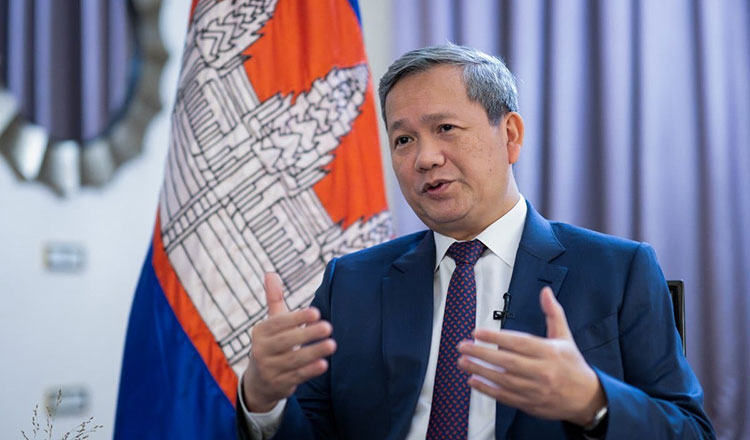 Prime Minister Hun Manet speaks in an interview with AFP in Brussels on February 25. AFP
#opinion
In the heart of Southeast Asia, Cambodia has long been a land of ancient wonders and remarkable resilience. From the majestic temples of Angkor to the vibrant streets of modern Phnom Penh, the Kingdom embodies a unique identity forged through centuries of history, struggle, and renewal. Yet too often, Cambodia is viewed through the lens of its larger neighbours or framed as a secondary player in regional narratives. This perspective does a disservice not only to the Cambodian people but to the truth. Cambodia should be seen as Cambodia — a sovereign nation charting its own course with determination, dignity, and an unwavering commitment to international norms.
This assertion is not mere rhetoric. It is grounded in Cambodia’s proactive stance on pressing global issues, particularly the fight against online scams, and its consistent respect for the rule of law on the international stage. As the Kingdom advances under the leadership of Prime Minister Hun Manet, it demonstrates that true sovereignty means addressing internal challenges head-on while contributing responsibly to the global community.
A decisive stand against online scams
One of the clearest illustrations of Cambodia’s independent resolve is its comprehensive campaign against online scam operations. In recent years, transnational criminal networks have exploited parts of the region, tarnishing Cambodia’s image. Rather than deflecting blame or minimising the issue, the Royal Government has launched one of Southeast Asia’s most robust crackdowns.
Cambodia admitted that it has issues with scams and Cambodia did not accuse other countries of being involved in them. Based on a UN report, the four countries mainly involved in scam issues are Thailand, Laos, Myanmar, and Cambodia, but there are countries that continue to accuse only Cambodia of having the problem.
In February last year, Mr Hun Manet established the Commission for Combatting Online Scams (CCOS), a high-level body coordinating efforts across ministries, police, and specialised units. This whole-of-government approach has yielded impressive results. Authorities have targeted hundreds of suspected scam sites, particularly in places like Sihanoukville, Phnom Penh, Poipet, and Bavet. Operations have led to thousands of arrests — over 5,000 suspects in one reported period — and the closure of dozens of compounds. By early 2026, Cambodia had deported thousands of foreign nationals involved in these activities, with a firm deadline set for April to eliminate the remaining scam centres.
The government has augmented enforcement with legislation. Parliament passed a new cybercrime law imposing harsh penalties, including up to five years in prison and fines reaching $125,000, with provisions for stiffer sentences for ringleaders. These measures aim not only to dismantle operations but to prevent their resurgence through sustained monitoring and suppression.
This campaign is Cambodia’s sovereignty in action. It balances domestic reform with international cooperation, addressing a problem that affects victims worldwide, including Cambodians themselves who lost tens of millions of dollars to scams in 2025. By taking ownership of the issue, Cambodia signals that it will not allow criminal elements — often foreign-led — to undermine its development or reputation. This is not the behaviour of a nation living in the shadow of others; it is the conduct of a confident state protecting its people and its future.
Critics sometimes highlight challenges, such as the scale of the problem, or call for even broader targeting of enablers. These points merit vigilance. Yet the trajectory is clear: Cambodia is actively “cleaning house,” as officials have described it, and institutionalising mechanisms like the National Counter-Cybercrime Committee to ensure the crackdown is sustained.
Upholding international law and multilateralism
Cambodia’s fight against scams aligns with a broader foreign policy rooted in respect for international law. The Kingdom’s Constitution and official policy emphasise permanent neutrality, non-alignment, peaceful coexistence, and peaceful settlement of disputes. Cambodia consistently supports multilateralism and contributes to global peace, including through participation in UN peacekeeping missions.
This commitment is evident in Cambodia’s approach to regional and international matters. Whether advocating for dialogue in border negotiations or co-sponsoring UN resolutions upholding state sovereignty and rejecting the use of force, Cambodia positions itself as a voice for rules-based order — particularly important for smaller nations. Its foreign policy prioritises national independence while fostering mutually beneficial relations with all countries, from ASEAN partners to major global powers.
Such a stance counters any narrative that portrays Cambodia merely as an extension or proxy of others. Instead, it highlights a principled independence: engaging constructively while safeguarding core interests like territorial integrity and neutrality.
Beyond challenges: Cambodia’s unique strengths
Focusing solely on security challenges overlooks Cambodia’s broader progress. The Kingdom continues its journey from post-conflict recovery to dynamic development. Tourism, a vital economic pillar, has shown resilience despite temporary setbacks, with efforts to promote “Safe and Green” destinations and cultural heritage. Economic growth targets remain ambitious, driven by manufacturing, exports, and services.
Cambodia’s cultural identity — its Khmer heritage, festivals, and warm hospitality — stands distinct. Angkor Wat is not just a monument; it symbolises enduring civilisation. The Cambodian people’s determination, evident in rebuilding after the Khmer Rouge era and navigating modern complexities, further defines the nation on its own terms.
Viewing Cambodia through the shadow of its neighbours diminishes these achievements. Comparisons are inevitable in a connected region, but they should not eclipse Cambodia’s agency. The Kingdom’s path — blending tradition with modernisation, sovereignty with cooperation — is uniquely its own.
Cambodia deserves to be recognised for what it is: a proud, sovereign nation confronting problems like online scams with resolve and upholding international law as a cornerstone of its diplomacy.
International partners should engage based on mutual respect, supporting Cambodia’s efforts without imposing external narratives.
As the Kingdom sets its sights on higher-income status and continued stability, its message is clear: Cambodia is not defined by the challenges it faces but by how it addresses them. The world should see Cambodia as Cambodia — a resilient contributor to regional peace and prosperity, standing firmly in its own light.
Dr Seun Sam is a policy analyst at Royal Academy of Cambodia. The views in this article are his own.
-Khmer Times-