Experts back Cambodia’s UNCLOS conciliation plan for overlapping maritime claims with Thailand
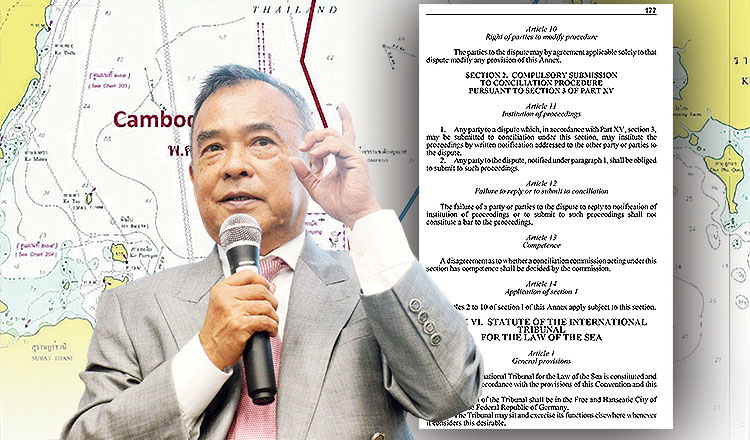 < Pou Sothirak, distinguished senior adviser to the Cambodian Center for Regional Studies, delivers a public lecture on ‘Cambodia-Thailand Maritime Overlapping Claims Area: Issues and Consequences’, in Phnom Penh on May 15. KT/Heng Chivoan >
#National
Synopsis: The government’s decision to pivot to the United Nations Convention on the Law of the Sea following Bangkok’s withdrawal from the 2001 maritime MOU is hailed as a rules-based, strategic effort to preserve peaceful negotiations.
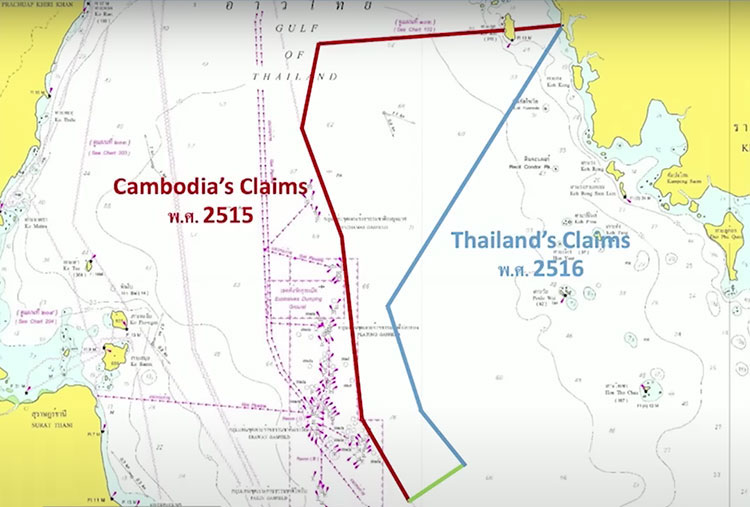
Cambodia’s pivot to the United Nations Convention on the Law of the Sea (UNCLOS) as its primary legal avenue to address overlapping maritime claims with Thailand is a calculated strategy aimed at preserving regional stability and future maritime cooperation, experts said.
The move follows Bangkok’s unilateral withdrawal from the 2001 Cambodia-Thailand Memorandum of Understanding on the overlapping claims area (OCA) in the Gulf of Thailand. The Thai Cabinet approved the revocation of the agreement, known in Thailand as MoU 44, on May 5, prompting Cambodia to announce it would initiate compulsory conciliation under UNCLOS to resolve the OCA.
Ambassador Pou Sothirak, a retired diplomat and distinguished senior adviser to the Cambodian Center for Regional Studies, said Cambodia was left with no choice but to seek an alternative legal avenue.
“We don’t have anything else at our disposal because Thailand already threw away the MoU 2001, which was a bilateral framework that we could use to discuss the overlapping claims area,” Sothirak said in an interview with Khmer Times. “Now that Thailand has cancelled it, Cambodia has to seek another framework.”
Sothirak made the remarks during a May 15 public lecture titled “Cambodia-Thailand Maritime Overlapping Claims Area: Issues and Consequences”. The event was hosted at AmCam Exchange.
He said Cambodia’s move to pursue compulsory conciliation under UNCLOS is consistent with international legal mechanisms and reflects the Kingdom’s status as a signatory to the convention.
According to Sothirak, the process will help safeguard Cambodia’s legal position in future maritime delimitation negotiations.
However, he noted that it remains unclear whether Cambodia intends to pursue delimitation of the entire overlapping area, establish a joint development arrangement, or combine both approaches under the conciliation process. He urged observers not to jump to conclusions and instead allow the diplomatic process to unfold.
Sothirak said both Cambodia and Thailand have shown a willingness to continue discussions, although Bangkok may still have concerns regarding procedures and the terms of reference for future negotiations. He suggested Cambodia continue clarifying its position to Thailand to strengthen mutual confidence.
“Cambodia only wants to resolve the issues peacefully. Cambodia does not want conflict or difficult problems in maritime areas,” Sothirak said, adding that anything can be settled through negotiation and diplomacy.
Sothirak expressed cautious optimism over continuing diplomatic engagement between the two countries, including discussions between foreign ministers. “We have to be positive about it because I think Thailand will also benefit from this procedure,” he said.
The ambassador noted that Thailand’s unilateral termination of the agreement may have been influenced by domestic political considerations, particularly during election campaigning when political leaders sought to demonstrate their commitment to protecting national interests. However, he added that the central issue remains the overlapping maritime claims area rather than sovereignty over Koh Kood Island, which Thailand considers settled.
Kin Phea, director-general of the International Relations Institute of Cambodia at the Royal Academy of Cambodia, said Thailand’s unilateral withdrawal from a bilateral framework for negotiation demonstrates a regrettable shift away from cooperative management towards legal confrontation.
“In contrast, Cambodia’s immediate activation of the UNCLOS compulsory conciliation is a calibrated, highly professional and rules-based response. This move showcases Cambodia’s strategic maturity and its unwavering commitment to international law,” Phea said.
He added that the legal process is expected to clarify both sides’ positions while increasing international scrutiny over the legitimacy of competing claims.
“In the near term, this legal process will clarify positions and heighten global scrutiny on the validity of claims. Strategically, Cambodia significantly strengthens its global credibility as a stable and law-abiding actor, whereas Thailand risks substantial reputational costs, reduced investor confidence and diplomatic isolation due to its foreign policy being repeatedly hijacked by volatile domestic politics and ultranationalist agendas,” Phea added.
Phea noted that hydrocarbon potential in the OCA remains a major factor driving the dispute, particularly as regional energy demand continues to rise.
Meanwhile, the Thai Senate is reported to have recommended also revoking the 2000 Memorandum of Understanding on border affairs, commonly known as MoU 2000, a move strongly rejected by Cambodia as a violation of international law.
The MoU 2000 is a binding international agreement signed by Cambodia and Thailand on June 14, 2000, to jointly survey and demarcate their shared land boundary. Formally known as the Memorandum of Understanding on the Survey and Demarcation of Land Boundary, the agreement establishes a legal framework requiring both countries to resolve border disputes peacefully and exclusively through the Joint Boundary Commission (JBC).
The agreement also recognises historical border definitions, including the 1:200,000-scale maps derived from the 1904-1907 Franco-Siamese treaties. Under the agreement, both countries are prohibited from conducting unilateral border surveys, altering disputed areas, or deploying military forces and infrastructure in contested zones.
Cambodia’s State Secretariat of Border Affairs said Thailand’s proposal to scrap the MoU 2000 was politically motivated and violated international law, noting the UN-registered agreement cannot be unilaterally cancelled.
In a related development on Sunday, Cambodia reaffirmed that the disputed farming area between Border Markers 48 and 49 in Banteay Meanchey province remains under its administration. This followed reports that Thai military personnel had prevented Cambodian farmers from ploughing land in the area.
-Khmer Times-