Beyond the Slur: The Crisis of Context in Global Reporting
 Beyond the Slur: The Crisis of Context in Global Reporting
#opinion
I believe in, and deeply respect, freedom of the press and freedom of expression. A free media is a mirror of society. But when that freedom is exercised without ethics, it can damage society and harm the very people it is meant to serve. When journalism stops reflecting reality with accuracy and instead distorts it through sensationalism, it ceases to be a public service and becomes a source of injury.
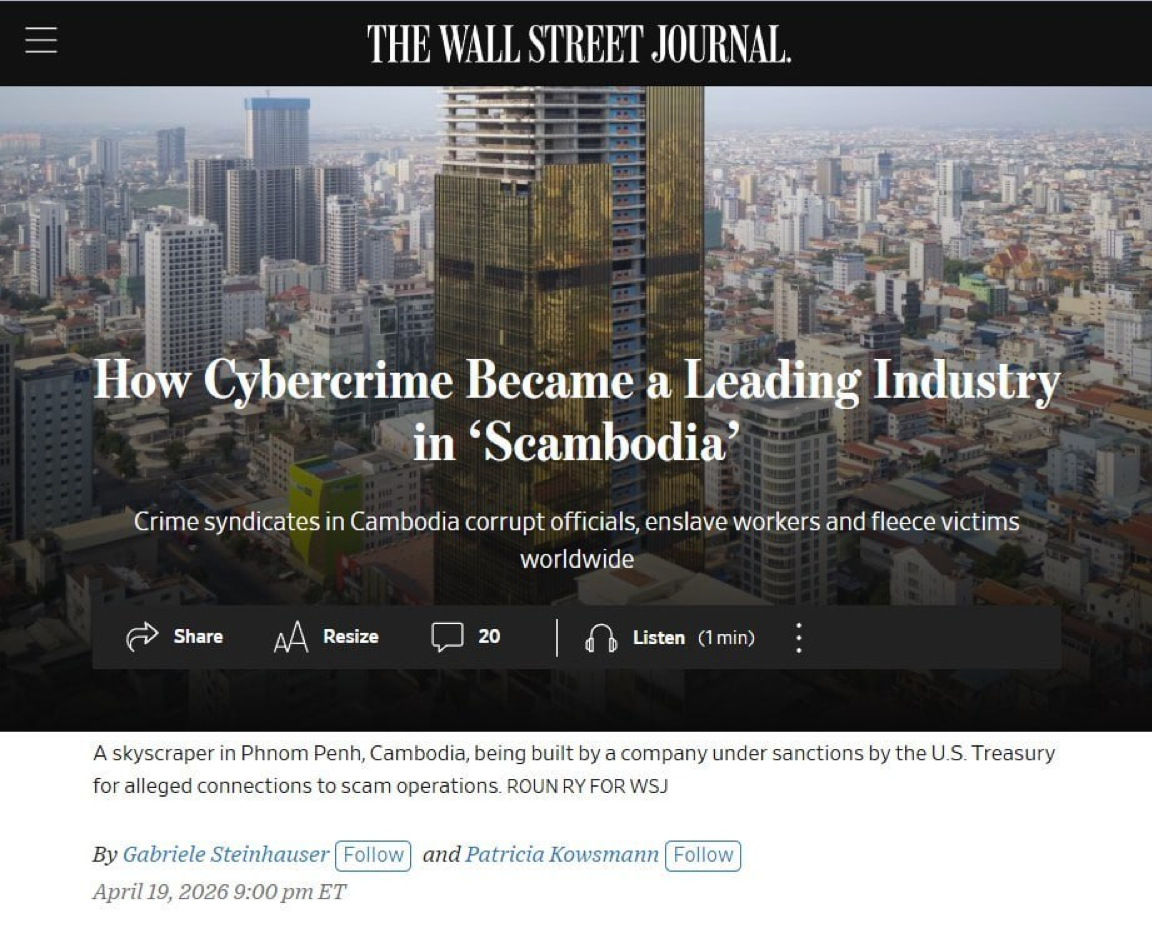
Nowhere is this more evident than in the recent trend of international reporting that has chosen to label an entire nation — Cambodia — with the derogatory moniker “Scambodia”.
The Ethical Abdication of The Wall Street Journal
For a publication that presents itself as a global standard-bearer in financial and business journalism, the use of the term “Scambodia” represents a serious ethical failure. In the legal profession, we are trained to value precise language and to understand the power of naming. Words are never neutral. They shape liability, responsibility and public perception.
By resorting to a slur to frame a complex issue involving human trafficking, cybercrime and transnational criminal networks, The Wall Street Journal abandons the very principles its readers expect: objectivity, precision and nuance. This is not merely a poor stylistic choice. It is a fundamental lapse in journalistic ethics.
When a serious publication adopts the language of caricature, it signals that it values sensationalism over accuracy. In doing so, it risks trading hard-earned credibility for digital attention. That is not the purpose of investigative journalism. Journalism should illuminate reality, not manipulate it for the sake of a more clickable headline.
The Illusion of ‘Catchy’ Reporting
When a global media outlet embraces such a term, it crosses a dangerous line — from reporting into reductionism, and from analysis into stigma. This is not simply a matter of tone. It is a matter of truth, responsibility and consequence.
Cambodia, like many countries in Southeast Asia, faces a real and serious challenge from transnational cybercrime networks. Even The Wall Street Journal acknowledges that many of these operations are run by foreign syndicates, often exploiting trafficked labour and operating across borders. But that is precisely the point the headline distorts: Cambodia is not the origin of this system. It is one of its battlegrounds.
To brand the entire country with a derogatory label is to erase that complexity and replace it with a convenient narrative.
The Anatomy of Unethical Framing
Journalism has a duty to provide context. When a media outlet reduces a sovereign nation of more than 17 million people to a pun, it fails in that duty. This failure appears in at least three ways.
First, there is selective outrage. Why is there no equivalent label for other jurisdictions where these criminal networks operate? Why is there no similar branding for the international financial systems and laundering channels that allow such crimes to flourish? Selective outrage is not journalism. It is framing.
Second, there is narrative construction at the expense of truth. The reporting itself acknowledges that Cambodian authorities have carried out nationwide crackdowns, including raids, rescues and enforcement efforts. These are the actions of a state attempting to confront a serious problem, not simply enable it. Yet such facts are overshadowed by a sensational headline that invites readers to see the country as the problem itself.
Third, there is the normalisation of stigma. In the digital age, sensationalism has become an easy shortcut to engagement. When major outlets prioritise the hook over the truth, they send a dangerous signal to the wider media ecosystem: that stigmatising an entire nation and its people is an acceptable price for clicks.
A Pattern of Ethical Erosion
Critics of modern journalism have long pointed to the growing divide between rigorous reporting and editorial sensationalism. When a publication with the stature of The Wall Street Journal leans into reductionist labelling, it deepens that divide and contributes to a broader erosion of public trust.
Sensational headlines do not merely attract attention. They can inflict reputational harm. They shape international perceptions, undermine tourism, discourage investment and make international cooperation more difficult on the very issues the reporting claims to expose.
When journalism turns a nation’s identity into a clickable device, it is no longer serving the public. It is serving the algorithm.
A publication that claims to hold power to account must itself be willing to answer for the impact, fairness and ethical consequences of its own language.
A Right to Dignity and Accountability
Cambodia therefore has not only a legitimate grievance, but also a fundamental right to defend its national dignity. To stand against the degradation of its sovereignty by media organisations that reduce a country to a caricature is not an act of censorship. It is an act of principle.
A formal and professional request for clarification or correction is not an attack on press freedom. It is a proper mechanism of journalistic accountability. It requires an editorial board to move beyond the excuse of a “catchy headline” and justify the fairness and accuracy of its framing.
If journalism is meant to hold power to account, then those who are the subject of reporting — including sovereign states—must also be able to hold journalists accountable for distortion, harm and ethical failure.
A Better Standard
Cambodia does not deny the existence of the problem. It is confronting it. But confronting transnational cybercrime requires international cooperation, not international ridicule.
If global media genuinely seeks solutions, it must move beyond sensational labels and toward honest, contextual analysis — analysis that recognises the transnational nature of these criminal networks, the role of foreign syndicates and the enforcement efforts taking place on the ground.
Anything less is not accountability. It is distortion.
The world deserves deeper and more courageous reporting: journalism with the discipline to resist the easy headline and the integrity to tell the more difficult truth. If the media is to remain a mirror of society, then its reflection must be accurate, fair, and above all, ethical.
Panhavuth Long is founder and attorney-at-law of Pan & Associates Law Firm. The views and opinions expressed are his own.
-Phnom Penh Post-