The Dismantling of the Mekong Peace: A Legal Post-Mortem of the ‘Anutin Doctrine’
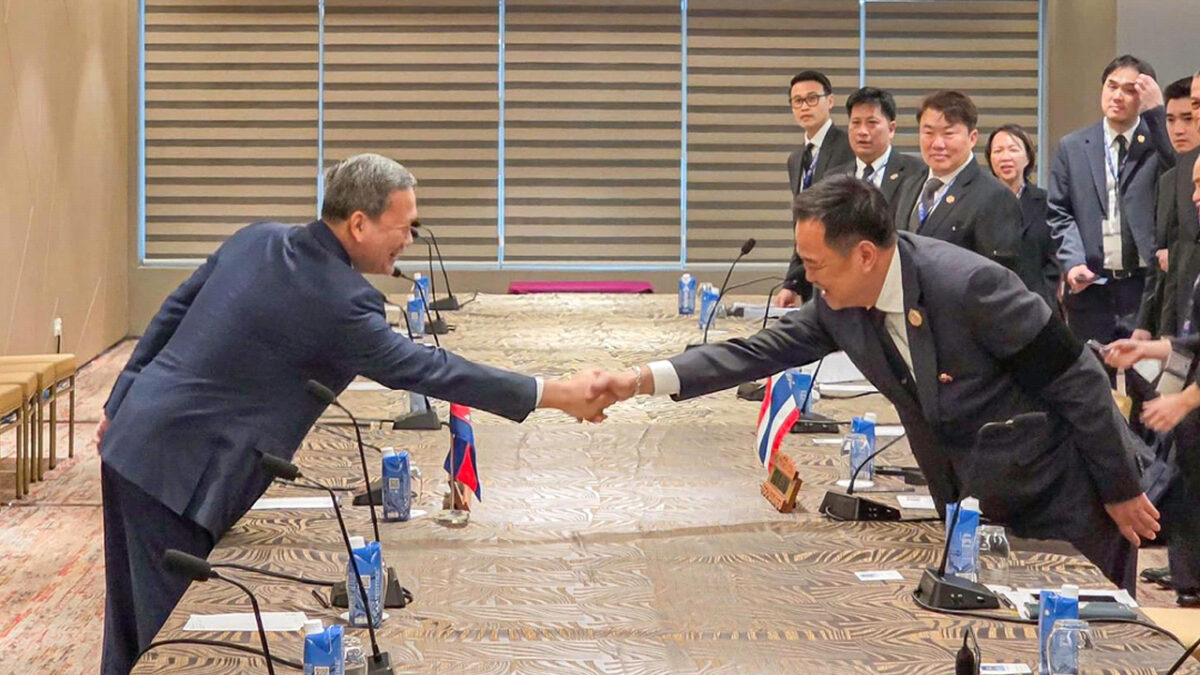 Prime Minister Hun Manet shakes hands with his Thai counterpart, Anutin Charnvirakul, on October 28 in Malaysia. Foreign ministry
#opinion
As Thai Prime Minister Anutin Charnvirakul takes the podium in Bangkok today to formalise a study into the cancellation of the 2001 Memorandum of Understanding (MoU 44), the regional legal architecture is not just shifting — it is being demolished. For twenty-five years, the Thai-Cambodian relationship was governed by the principle of pacta sunt servanda (agreements must be kept). Today, that principle has been replaced by a calculated policy of legal irredentism.
I. The Architecture of Deconstruction: MoUs 2000 and 2001
The current administration’s move to “revoke” the bilateral frameworks is a strategic attempt to move from the courtroom to the battlefield.
MoU 2000 (The Land Framework): By signalling a retreat from the joint survey process, the Thai Senate is attempting to nullify the requirement for consensus. This is a transition from cooperative delimitation to unilateral assertion. Legally, however, a “revocation” of a treaty registered with the UN does not erase the obligations of the neighbour. It merely creates a legal “grey zone” intended to justify military manoeuvres.
MoU 2001 (The Maritime Pivot): The move to scrap the 2001 agreement on the Overlapping Claims Area (OCA) is a transparent bid for $300 billion in natural gas resources. Without the “joint development” mandate, Thailand aims to exert pressure through naval presence rather than diplomatic parity.
II. The Sovereignty Shell Game: ICC and ICJ
The “trick” of Thai diplomacy has long been its ability to project an image of a “rule-of-law” model while carefully avoiding the consequences of international jurisdiction.
The ICC Shield: Despite signing the Rome Statute in 2000, Thailand has refused ratification for 26 years. This allows their leadership to remain immune to international accountability for the 2025 border crisis, which resulted in over 100 military casualties and the displacement of 140,000 civilians. It is the posture of a civilised state without the legal soul of one.
Selective Compliance: Bangkok’s relationship with the International Court of Justice (ICJ) remains purely transactional. They accept rulings when convenient and reject them as “sovereignty violations” when they lose, as seen in the recurring tensions over the Preah Vihear vicinity.
III. The Strategic Miscalculation:
Cambodia’s 2026 Pivot
The most significant shift, however, occurred in February 2026 with Cambodia’s formal ratification of UNCLOS. While Thailand has used its 2011 UNCLOS ratification to justify its maritime claims, it has ignored the convention’s requirements for peaceful dispute resolution.
By joining the “Constitution of the Oceans” this year, Cambodia has anchored itself to a global legal standard. Thailand’s current attempt to “limbo” Cambodia — tearing up bilateral agreements to keep the border undefined — is failing. While Bangkok retreats into a nationalist vacuum to satisfy the winners of the February 2026 elections, Cambodia has walked into the sunlight of international legitimacy. One cannot put a neighbour into a “legal limbo” when that neighbour is standing on the firm ground of a ratified global treaty.
IV. A Model in Decay
Thailand can no longer be viewed as a champion of the rule of law in Southeast Asia. A state that treats its international signatures as temporary inconveniences is not a leader; it is a liability.
The “Anutin Doctrine” of 2026 — characterised by the threat of border walls, increased troop recruitment and the shredding of MoUs — reveals a fundamental insecurity. It is an admission that Bangkok can no longer win the argument through law, so it seeks to end the argument through silence and “might”.
Conclusion:
As a lawyer, the verdict is clear: Thailand is not just withdrawing from treaties; it is withdrawing from the modern international order. By attempting to isolate Cambodia, Bangkok has only succeeded in isolating itself from the very legal standards it once claimed to uphold. The “Law of the Jungle” may offer short-term domestic gains, but it provides zero security in the face of 21st-century international scrutiny.
-Phnom Penh Post-