It’s time to ban smartphones in schools
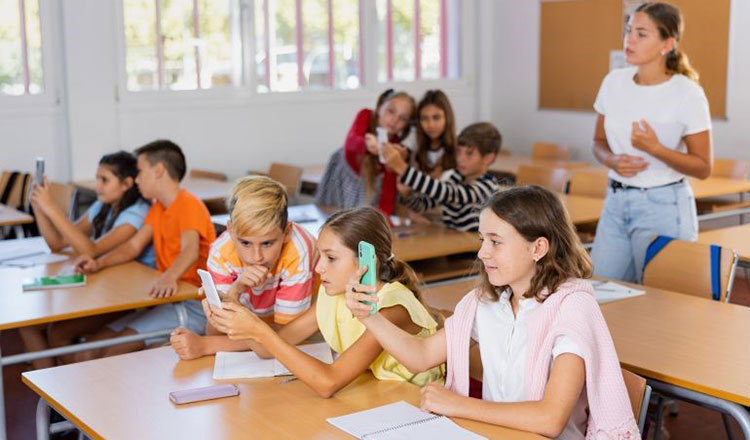 Teachers should not be required to compete with smartphones for the children’s attention in class. Shutterstock
#opinion
By this time, we are all familiar with the image of a harried schoolteacher trying to maintain control in a classroom where most students are transfixed by their smartphones rather than the dusty chalkboard. The dangers of social media to the minds of young and old alike are already well documented, and the amount of time students spend on their handheld devices continues to increase with each new study.
Researchers at the University of North Carolina at Chapel Hill tracked the real-time phone habits of middle and high schoolers and found something that should disturb every teacher and parent.
Phone use occurred at every hour of the school day, and no student in the study went an entire school day without using their mobile phone. Perhaps unsurprisingly, the students who used their phones most often also showed noticeably less self-control.
Published in JAMA Network Open, this new study monitored the phone habits of 79 students aged 11 to 18 over two consecutive weeks and found the average teen racks up more than two full hours of screen time during school time alone. That’s approximately one-third of their total daily phone use—and over a quarter of the entire school day! But the more disturbing discovery wasn’t how long students were on their phones. The alarming factor was how often the students were reaching for their devices, and how that nervous, knee-jerk habit appears to be linked to concentration levels.
Like infants reaching out for their favourite security blanket, students reached for their phones an average of 64 times during the school day, and those who grabbed their devices most often scored worse on a standard test that measured concentration and self-control. The study shows a link not just between phones and distraction, but between compulsive phone use and the kind of mental discipline adolescents need to learn and develop.
“That’s pretty alarming… It’s too much, not only because of the missed learning opportunity in the classroom,” researcher Lauren Hale, sleep expert and professor at Stony Brook’s Renaissance School of Medicine, told The 74.
“They’re missing out on real-life social interaction with peers, which is just as valuable for growth during a critical period of one’s life.”
To say that smartphones have become a pervasive feature of adolescents’ daily lives would be a gross understatement. More than 95% of American teens reported access to a handheld device, and nearly half described themselves as “almost constantly” online as of 2024. The authors of the study aimed to determine how this omnipresent force, which acts just like a drug for its millions of users, shapes adolescent development, “particularly in contexts such as school that are designed to foster sustained attention, academic engagement, and social growth.”
The authors of the study wrote: “Developmental theories of self-regulation suggest that adolescence is a period of heightened vulnerability to distraction, given ongoing maturation of prefrontal cognitive control systems alongside sensitivity to rewarding social information. The constant availability of smartphones, therefore, will increase social media distraction during school hours, creating unique challenges for adolescents’ ability to regulate attention and maintain focus on academic tasks.”
In other words, teachers face greater obstacles than ever before in controlling their classrooms. Needless to say, teachers should not be required to compete against smartphones in the classroom.
Across the study, phone use was monitored during every hour of the school day, from 8am until the final bell at 3pm. On average, screen time increased progressively from about 16 minutes at 8am to more than 22 minutes by 2pm. One particularly distracted student logged more than five hours of phone use during school across the study period.
High school students used their smartphones significantly more than middle schoolers, averaging roughly 23 minutes of screen time per hour, compared with about 12 minutes for younger students. Researchers also monitored which apps were getting the attention. It’s no surprise that social media behemoths, including Instagram, TikTok, and Snapchat, combined with entertainment apps like YouTube, accounted for almost 70% of total school-hours screen time. Incredibly, students averaged about 75 minutes on social media during the school day and nearly 50 minutes on entertainment apps, the report showed.
Did all this screen time negatively affect students’ ability to concentrate? To find out, researchers tested the high school students’ concentration using a go/no-go task, a standard exercise in which participants are instructed to press a button in response to one image but to withhold a response when they see another. This test measures a person’s ability to override an automatic impulse, a key attribute of self-control. Among those examined, students who picked up their phones more often during school performed worse.
The results of the study will assist school administrators and parents in the ongoing debate over whether smartphones should be banned in schools. Some nations, meanwhile, have gone further.
Australia has banned children under 16 from registering on social media, and Malaysia introduced a similar ban in January. The European Parliament is openly discussing following the example of these two countries.
Perhaps we should end here with a quote by Steve Jobs, the founder of Apple, who allegedly said his children were not allowed to use smartphones and computers, “because it takes two weeks to become an advanced user, but a childhood spent staring at screens costs something far more valuable: time for real development”.
The writer is an American journalist and the author of ‘Midnight in the American Empire: How Corporations and Their Political Servants are Destroying the American Dream’.
-Khmer Times-
—————-