Empowering SME innovation: Cambodia’s path to economic security
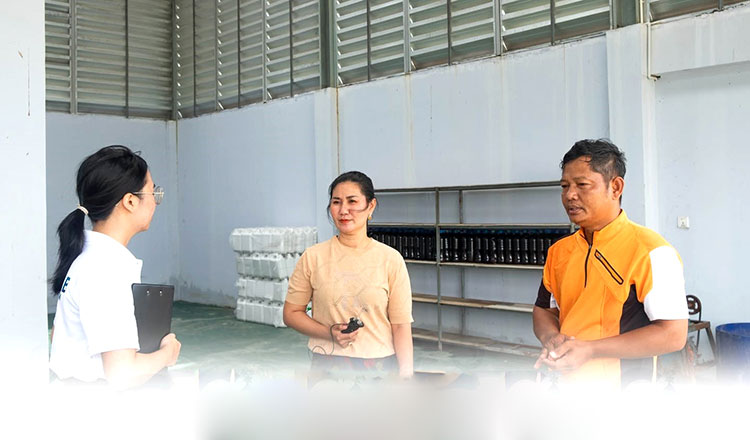 Cambodia must prioritise SME innovation if it hopes to build a resilient and competitive economy. InnoLab Kampong Thom
#opinion
Small- and medium-sized enterprises (SMEs) are the backbone of most economies. In Cambodia, they form the foundation of local production, employment, and community development. Yet for all their importance, Cambodian SMEs remain underpowered engines of growth.
Many operate with limited access to finance, weak technological capabilities, and insufficient digital skills. Market access is often constrained, and the ability to scale remains limited. These barriers prevent many promising businesses from reaching their full potential.
If Cambodia hopes to build a resilient and competitive economy, strengthening SME innovation must become a national priority.
Innovation is not merely about technology. For SMEs, innovation can mean improving product quality, redesigning packaging, adopting digital tools, exploring new markets or experimenting with new business models. Even modest improvements can significantly increase productivity and competitiveness.
Yet innovation requires support systems that many small businesses lack. Entrepreneurs—particularly those operating in provincial areas—often work in isolation, with little access to training, networks or mentorship. Without targeted support, the gap between Cambodia’s entrepreneurial potential and actual economic performance will persist.
This is precisely the challenge that initiatives such as InnoLab Kampong Thom aim to address.Launched to strengthen SME innovation capacity in Kampong Thom province, the initiative provides structured training, mentoring and ecosystem support for local entrepreneurs. Over the course of 10 months, participating SMEs have taken part in workshops and capacity-building programmes designed to help them rethink their business strategies and adopt innovation-driven approaches.
Participants are introduced to practical tools including design thinking, product and service innovation, and agile business models—skills increasingly necessary in today’s competitive markets. But perhaps the most important outcome has been a shift in entrepreneurial mindset.
Many SME owners traditionally focus on maintaining existing operations. Through the programme, they begin to see innovation not as a luxury but as a necessity. Innovation allows businesses to improve productivity, upgrade product quality and access new markets. It encourages entrepreneurs to move beyond survival-based operations toward growth-orientated strategies.
Equally important is improving SMEs’ access to markets. Cambodia imports many everyday consumer goods that local businesses could produce competitively. By strengthening production capacity, product quality, branding, and packaging, Cambodian SMEs can begin to substitute some of these imports while also developing products capable of competing in regional markets.
But training alone is not enough.The programme emphasises continuous mentorship, enabling entrepreneurs to test new ideas, address operational challenges, and apply what they learn to their businesses. Innovation rarely happens in isolation. It thrives within collaborative ecosystems.
Through InnoLab Kampong Thom, SMEs have been connected with experts, innovation networks and fellow entrepreneurs. These relationships allow knowledge to circulate, partnerships to emerge and businesses to learn from one another’s experiences.
Another valuable element of the initiative has been public recognition. With support from Khmer Enterprise, outstanding SMEs participating in the programme have received awards and national exposure. Such recognition does more than celebrate individual success; it signals that innovation and entrepreneurship are valued components of Cambodia’s economic future.
Storytelling has also played an unexpected but powerful role. Through documentaries, blog posts, and promotional videos, SMEs have shared their journeys with a wider audience. Visibility can transform a small business. Media exposure builds credibility, attracts customers, and opens doors to partnerships and investment.
None of this guarantees success. Not every new idea will succeed, nor should it. Innovation requires experimentation. The ability to test, learn and adapt is what ultimately drives progress.
But the results of the InnoLab programme demonstrate an important lesson: when SMEs receive the right combination of training, mentorship, financial support and ecosystem connections, they can transform how they operate.
As Cambodia continues its economic transition, supporting SME innovation must remain central to national development strategy. Dynamic SMEs strengthen local economies, reduce dependence on imports, create jobs, and stimulate domestic value creation.
Cambodia’s future growth will not come solely from large corporations or foreign investment. It will also come from thousands of entrepreneurs across the country who are willing to experiment, innovate, and build competitive businesses.
Programmes like InnoLab Kampong Thom show that with the right support, Cambodian SMEs can rise to that challenge.
The next step is to scale such efforts nationwide—ensuring that innovation ecosystems extend beyond major cities and reach entrepreneurs in every province.
If Cambodia can unlock the innovative potential of its SMEs, it will not only strengthen its economy. It will build a more resilient, inclusive and sustainable future.
Khoun Pichponleukanika is research lead at Angkor Social Innovation Park. The views expressed here are the author’s own.
-Khmer Times-
—————