Borders Are Defined by Law, Not by Military Activities
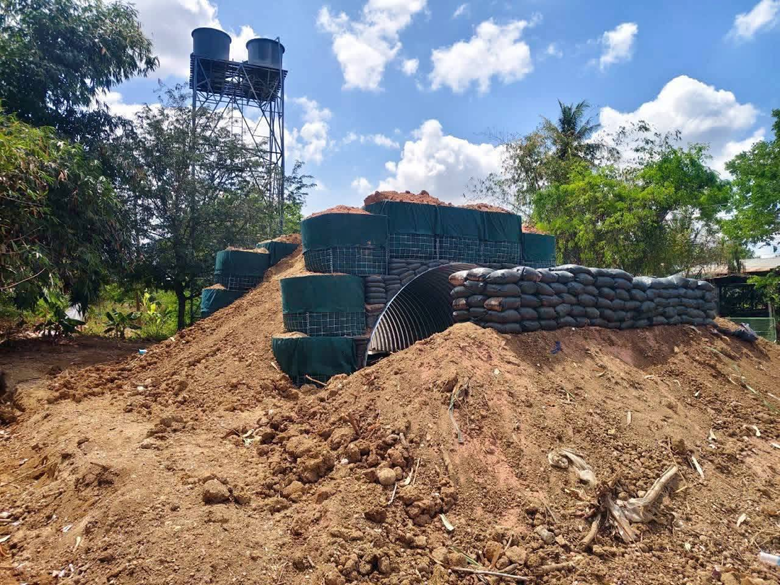 Thai bunkers were constructed in the border areas, after the December 27 ceasefire. Supplied
#Opinion
Recent reports about Thai military units facilitating land surveys, issuing land titles and constructing civilian bomb shelters near the Cambodia–Thailand border should concern anyone who values regional stability and international law. While these actions are presented as administrative support and humanitarian preparedness, their broader strategic implications cannot be ignored.
Borders are not defined by who builds structures the fastest, deploys troops the closest or conducts administrative activities the most aggressively. Borders are defined by treaties, by international agreements and by mutually recognised legal frameworks. This is the fundamental principle that has allowed ASEAN to remain a region of relative peace.
When military forces become involved in land measurement and civilian land titling activities in sensitive border areas, the question is no longer administrative. It becomes geopolitical.
The issue is not whether farmers deserve land titles. They do. The issue is whether military-backed administrative actions in contested or sensitive border areas risk creating what international relations scholars call “facts on the ground” — incremental changes designed to strengthen territorial claims over time.
History shows that such tactics often aim to slowly normalise a presence, not through negotiation, but through gradual administrative consolidation. What begins as land measurement can later be cited as evidence of effective control. What begins as temporary security infrastructure can later be framed as permanent necessity.
This is precisely why international border management mechanisms exist.
Cambodia and Thailand already have agreed mechanisms to address border issues, particularly through the Joint Boundary Commission (JBC). These mechanisms exist to prevent exactly this type of unilateral action from creating mistrust or unintended escalation.
If both countries truly want peace, then the path forward is simple: use the mechanisms already agreed upon, not actions that risk changing realities before negotiations conclude.
Cambodia has consistently demonstrated that it does not seek confrontation. It has repeatedly affirmed that it does not seek even one inch of Thai territory. But Cambodia also maintains a clear and equally legitimate principle: it will not allow even one inch of Cambodian territory to be altered through unilateral actions.
Peace is preserved not only by avoiding conflict, but also by avoiding actions that could plant the seeds of future conflict.
Constructing shelters, conducting patrols and supporting civilians may appear defensive. But when such actions are carried out alongside military deployment in sensitive border zones, perceptions matter. And in border politics, perception often shapes reality.
Responsible neighbours exercise restraint not only in military operations, but also in administrative actions that could be interpreted as strategic positioning.
ASEAN’s strength has always rested on a simple but powerful understanding: disputes must be managed through dialogue, not through pressure; through law, not through leverage; through cooperation, not through unilateral moves.
If Thailand believes in this principle, then transparency, coordination and respect for bilateral mechanisms should be the natural course of action.
The real test of commitment to peace is not in words, but in behaviour.
Cambodia remains committed to peaceful resolution, dialogue and international law. But peace must be mutual. Stability must be mutual. Respect must be mutual.
Because in the end, strong borders are not built by soldiers or shelters.
They are built by trust.
Roth Santepheap is a geopolitical analyst based in Phnom Penh. The views and opinions expressed are his own.
-Phnom Penh Post-
———————