If Thailand Truly Wants Good Faith, It Should Start by Practicing It
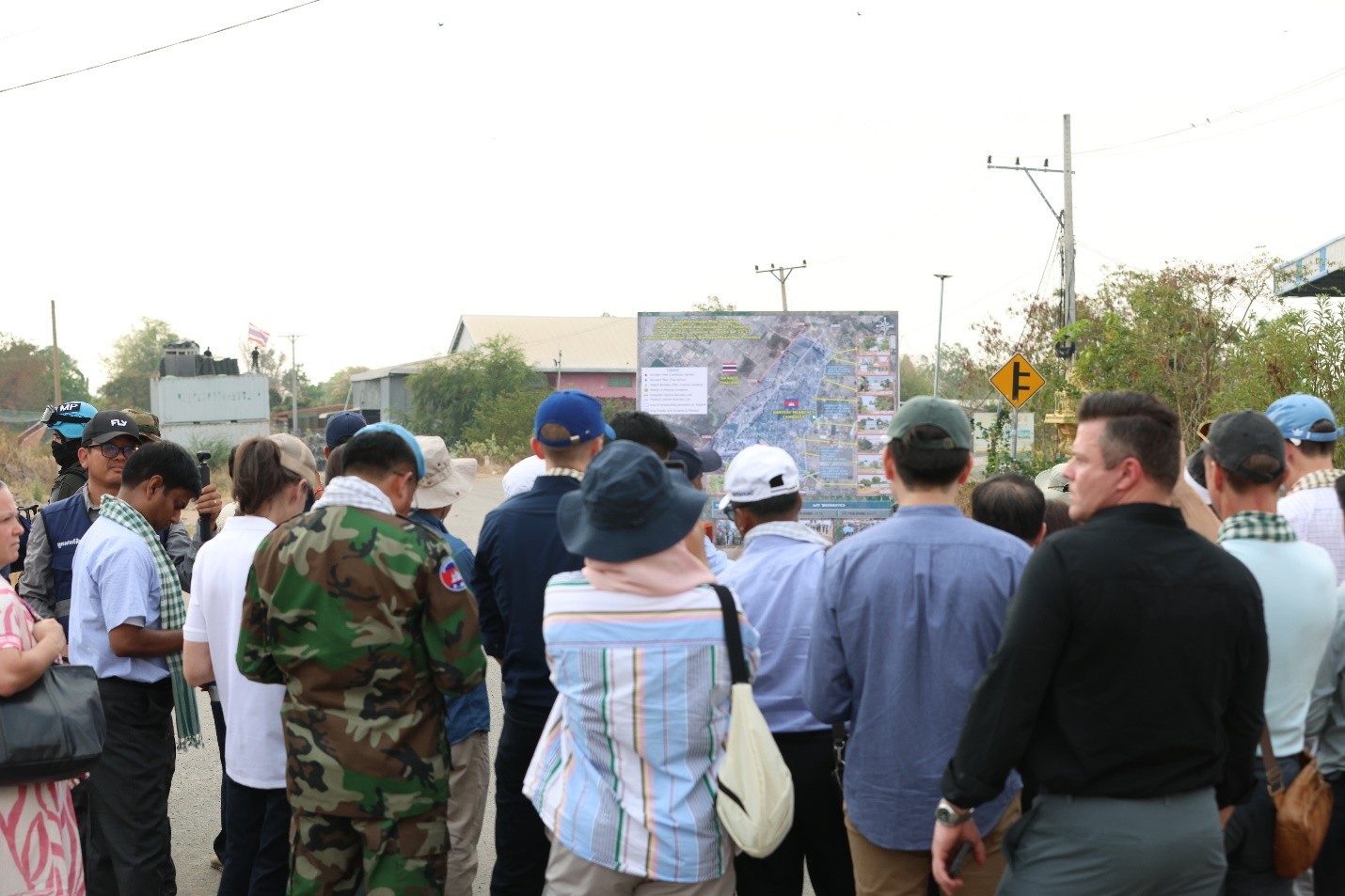 Foreign diplomats on recent visit the border area in Banteay Meanchey province. AKP
#opinion
Thailand’s latest accusations against Cambodia reveal a familiar pattern in border disputes: when legal clarity is uncomfortable, shift the conversation toward allegations; when technical mechanisms exist, delay them; when facts are contested, attempt to win the narrative war first.
But peace between neighbours cannot be built on selective storytelling.
Thailand’s claim that Cambodia lacks “good faith” deserves scrutiny — because the real test of sincerity is not what is written in statements, but what is demonstrated through actions.
Cambodia’s record is clear. It has consistently supported ceasefire arrangements, called for the activation of the Joint Boundary Commission (JBC) and reaffirmed that the border must be resolved based on treaties and international law, not by force. These are not the actions of a country seeking confrontation. They are the actions of a country seeking predictability and rules.
By contrast, Thailand’s repeated delays in convening technical mechanisms while simultaneously issuing public accusations raise legitimate questions about whether Bangkok is genuinely prioritising resolution or simply managing perceptions.
If stability is truly the objective, why delay the very technical processes designed to produce it?
If good faith is the standard, why rely on unilateral claims rather than joint verification?
If peace is the goal, why take actions on the ground that risk altering the status quo while negotiations remain incomplete?
These questions matter because the international community has seen similar patterns before. Border disputes rarely escalate because of maps alone. They escalate when one side attempts to strengthen its negotiating position through pressure rather than process. Cambodia has deliberately avoided that path.
Instead of responding to rhetoric with rhetoric, Cambodia has continued to emphasize mechanisms. Instead of responding to accusations with counteraccusations, Cambodia has emphasised verification. Instead of responding to pressure with escalation, Cambodia has emphasised restraint.
This contrast is important because credibility in modern diplomacy is built on consistency. Countries that repeatedly call for law while acting within legal frameworks strengthen their standing. Countries that invoke cooperation while delaying mechanisms risk weakening theirs.
Thailand’s narrative suggests Cambodia is the obstacle. Yet Cambodia is the party calling for meetings. Cambodia is the party calling for technical work. Cambodia is the party emphasising legal instruments already signed by both governments.
This contradiction is difficult to ignore. The reality is that boundary demarcation is not advanced through press statements. It is advanced through survey teams, technical discussions and political will. Every delay increases uncertainty. Every accusation without joint verification increases mistrust. Every unilateral justification increases risk.
The people living along the border deserve better than a cycle of accusation diplomacy.
What they need is leadership diplomacy.
Cambodia’s strategic choice has been clear: international law over unilateral pressure, negotiation over narrative escalation and long-term stability over short-term tactical advantage. This approach reflects not only Cambodia’s interests but also ASEAN’s core principles of peaceful dispute settlement and regional stability.
The real issue therefore is not whether Cambodia is acting in good faith. The real question is whether Thailand is prepared to match Cambodia’s consistency with equal commitment. Because ultimately, good faith is not proven by words like sincerity appearing in official statements.
Good faith is proven by whether a country is prepared to: Engage without delay, verify before accusing, avoid unilateral changes and allow agreed mechanisms to function. Cambodia has demonstrated that choice.
Thailand now faces a simple diplomatic test: continue managing the narrative, or start resolving the problem.
Roth Santepheap is a geopolitical analyst based in Phnom Penh. The views and opinions expressed are his own.
-Phnom Penh Post-
———————-