The engine of growth: How Cambodia’s G-PSF transformed a post-war economy
 The G-PSF is proving to be essential machinery driving Cambodia towards a high-income future. Analytics & Insights Asia
#opinion
In the late 1990s, Cambodia stood at a precarious crossroads. The nation was finally emerging from three decades of devastating conflict that had levelled its institutions and decimated its professional class. Simultaneously, the Asian Financial Crisis was tearing through regional economies. It was against this backdrop of instability that an ambitious experiment in governance was born: the Government-Private Sector Forum (G-PSF).
Today, what began as a “life raft” for a struggling business community is evolving into a model of inclusive economic development. As Cambodia navigates the Royal Government’s 7th Mandate, the G-PSF is proving to be essential machinery driving the nation towards a high-income future.
Rising from the ashes
To understand the G-PSF’s significance, one must look at the vacuum that preceded it. The wars extending from the 1960s into the 1990s didn’t just destroy infrastructure; they erased institutions and, with the devastating loss of people so went institutional memory. When the last of the Khmer Rouge surrendered in 1999, the country lacked the “soft infrastructure”—associations, chambers, and advocacy skills—necessary for a market economy.
While international donors focused on the public sector, the private sector was largely left to rebuild itself. This public sector bias from international development partners is a global phenomenon that continues to stunt economic development.
Recognising this gap, then-Prime Minister Hun Sen established the G-PSF in 1999. It was a strategic decision. In a time when the government primarily spoke to external donors, the G-PSF created a formal bridge to the domestic business community. For it to work, however, required the courage, determination and persistence of all public and private sector stakeholders.
From hesitation to world best practice
The early years were characterised by a steep learning curve. The Forum is structured around Working Groups that are co-chaired by a minister and a private sector representative. This was revolutionary: it granted the private sector an equitable seat at the table. In the late 1990s and early 2000s this places this dialogue on par with international development partners that held annual consultative group meetings.
By 2002, with support from the International Finance Corporation (IFC) and the Australian government, the G-PSF began to professionalise. It shifted from a nascent dialogue platform to a process driven, results-orientated mechanism.
The impact was quantifiable. A 2007 assessment funded by the World Bank and the Australian government estimated the Forum’s direct economic impact in the hundreds of millions of dollars.
Perhaps more importantly, the majority of stakeholders believed the G-PSF had contributed directly to peace and stability. By creating a transparent, rules-based environment for business, the Forum gave the private sector a role in the country’s economic development.
The new era: Accountability and data
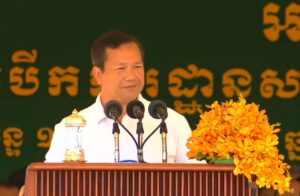
In the 7th RGC Mandate begins under the leadership of Mr Hun Manet, the G-PSF is undergoing its most significant structural evolution in two decades.
In November 2023, during the 19th G-PSF, a pivotal decision was made to move the Secretariat to the Council for the Development of Cambodia (CDC). Under Deputy Prime Minister Sun Chanthol, the CDC has introduced a level of accountability previously unseen.
The RGC now possesses a mechanism that reaches across every ministry involved in the system. When a business leader raises an issue in a Working Group, it no longer disappears into a bureaucratic void. It is tracked, monitored, and reported on through the newly established G-PSF Coordinating Committee.
On the private sector side, Oknha Keth Meng, President of the Cambodian Chamber of Commerce (CCC), has championed a “deepening” of the dialogue. By leading high-level Private Sector Co-Chair meetings, he is ensuring that the business community speaks with a unified, evidence-based voice.
A tech-forward future
The true litmus test for this modernised system will arrive in mid-to-late 2026 with the 20th G-PSF. This summit will be the first of its kind, powered by a new digital infrastructure funded by the Australian government.
The upcoming G-PSF dashboard and website will provide a transparent look at the Forum’s progress. Currently, of the 180 decisions made during the 19th G-PSF all are on track for implementation. When the 20th Forum convenes, participants won’t just be talking about ideas; they will be reviewing a data-driven record of success.
This shift toward transparency is not just for the benefit of domestic firms. For foreign investors, a “rules-based business enabling environment” is the most persuasive argument for bringing capital into the country.
The ‘G20’ standard
While the G-PSF remains a work in progress, it is no longer an experiment. It has become a critical function of the Cambodian state. Notably, the model aligns with global standards; all G20 economies utilise a variant of this dialogue, such as the Business 20 (B20).
However, challenges remain. The next phase of growth requires building even more institutional capacity. As more specialised business associations emerge in Cambodia, the G-PSF must find ways to integrate them, creating a “career pathway” for association leaders to engage with the government at the highest levels.
From the “life raft” of 1999 to the digital dashboard of 2026, the G-PSF has proven that inclusive economic growth isn’t an accident—it’s the result of a persistent, courageous dialogue between those who govern and those who build.
The author served as program manager for the IFC/Australian government-funded G-PSF Coordinating Bureau from 2002-07. He developed the Public Private Dialogue for Results (PPDR) model and returned to Cambodia (2023-25) to support the CDC and CCC in implementing these modern standards.
-Khmer Times-
—————-