Cambodia’s Pain Is Real — and the World Must Stop Ignoring It
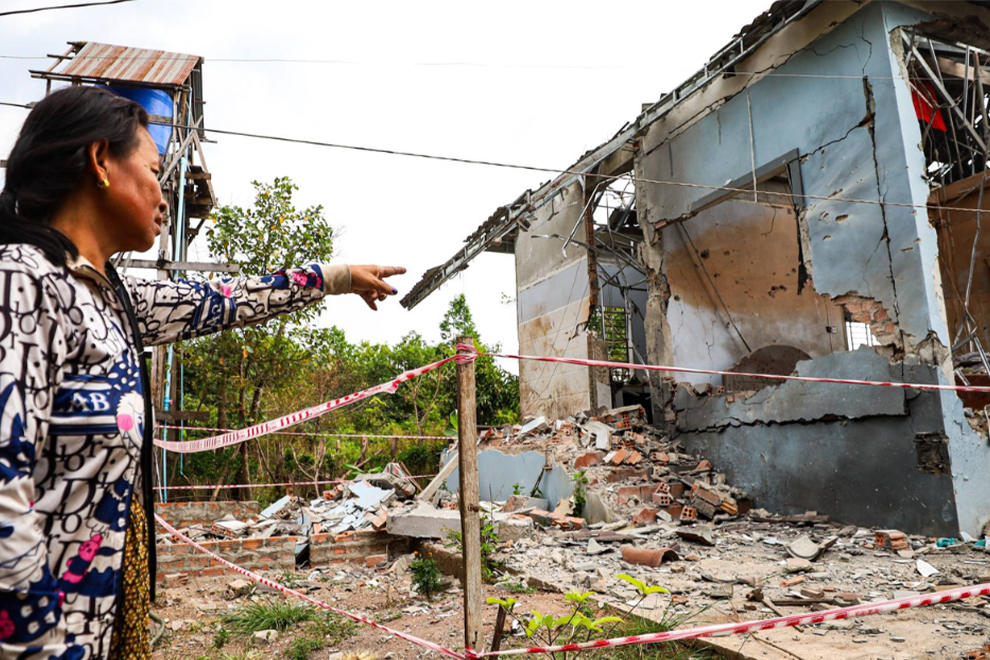 A woman points to her home which was destroyed during recent fighting in Choam Khsant district, Preah Vihear province. AKP
#Opinion
One of the most painful realities for Cambodians is not only the violence itself, but the silence that surrounds it internationally. International media often treats Cambodia–Thailand conflict as a small border issue, unworthy of sustained attention.
But for Cambodian citizens, the consequences have been massive, devastating and life changing. When global media refuses to look closely, it does not remain neutral — it indirectly allows suffering to be erased.
Cambodian civilians have faced displacement, fear, and loss on a scale that the world has barely acknowledged. Homes were looted, infrastructure was destroyed and local economies were disrupted. Entire communities were forced to flee, leaving behind their land, their livelihoods and the stability they had spent years building. The border should have been a bridge for trade and cooperation, but it has been transformed into a zone of insecurity and uncertainty.
More than one million Cambodians were displaced by the conflict, and for many families the suffering did not end even when fighting slowed. Thousands have still not been able to return home — not because they refuse peace, but because their homes and farmland remain under the control of the Thai military. Displacement is not only a humanitarian crisis; it is the destruction of identity, dignity and future. When people lose their land, they lose the foundation of their lives. Any peace agreement is meaningless if civilians cannot safely return to their communities and rebuild what was taken from them.
Cambodian communities have also witnessed destruction of infrastructure, looting of homes and severe disruption of local economies. The border should have been a bridge for trade and cooperation, but it has been turned into a space of fear. Even today, signs of continued militarisation remain visible, including barriers such as shipping containers, razor wire and reinforced positions on land under Thai control. These physical structures are not simply security measures — they are symbols of unresolved injustice.
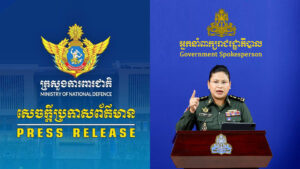
According to official Cambodian sources, including statements by the Cambodian Mine Action Centre (CMAC), the Ministry of National Defence and government spokespersons, Thailand carried out airstrikes inside Cambodian territory and has reportedly used cluster munitions and even poison gas against areas affecting Cambodian civilians.
These claims, if confirmed, constitute far more than a border dispute — they amount to an armed attack and a serious escalation of hostilities. The use of cluster bombs and chemical or toxic agents raises grave concerns under international humanitarian law, particularly regarding the protection of civilians and the prohibition of weapons that cause indiscriminate harm.
In such circumstances, continuing to describe the situation merely as “tensions” or “clashes” is not neutrality; it is the deliberate minimisation of violence. When military force is used across borders to bomb communities, displace populations and destroy civilian infrastructure, the legal and moral conclusion is clear: it is a war of aggression, and it demands urgent international attention, independent investigation and accountability.
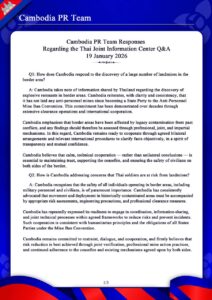
These events are not merely Cambodian claims — they are reflected in the international response itself. The presence of unexploded ordnance and explosive remnants on Cambodian territory has been publicly recognised through demining programs supported by foreign governments. The fact that partners such as the US and Japan have provided millions of dollars in assistance for clearance operations demonstrates that the destruction has produced long-term humanitarian consequences.
Under international law, the contamination of civilian land with explosive remnants engages questions of state responsibility, including the duty to prevent indiscriminate harm and the obligation to provide reparations when unlawful military actions result in civilian suffering.
Demining aid is not a symbolic gesture — it is a response to real and continuing danger. When international donors must fund the removal of lethal remnants left behind, it confirms that the violence has gone far beyond “border tensions”. It is the aftermath of war-level aggression, and accountability cannot be avoided through diplomatic language.
International media has not only failed to report the full reality of this crisis, it has also failed to recognise the true scale of Cambodian civilian suffering. While global outlets often speak loudly about human rights and justice, they remain largely silent when Cambodian homes are destroyed, civilians are displaced, and livelihoods are wiped out.
This silence is not neutrality — it creates imbalance by shaping international perception in a way that minimises Cambodia’s pain and weakens its voice. A conflict does not become less serious simply because it happens in a smaller country. If international journalism is genuinely committed to truth, fairness and human dignity, it must stop treating Cambodia as a footnote and begin reporting Cambodia’s damages with the same urgency, depth, and seriousness given to other nations.
International media must stop treating Cambodian suffering as a side note. Journalism cannot claim neutrality while ignoring the destruction faced by Cambodian civilians. Global outlets must go beyond short headlines and diplomatic summaries — they must send reporters to Cambodian provinces, document the ruined homes, the damaged infrastructure, the displaced families and the long-term humanitarian consequences of this violence.
Cambodia should not need to be a powerful country to deserve serious coverage. Cambodian lives are not less valuable because Cambodia is smaller, and civilian suffering is not less tragic because it happens far from global capitals. If the international press truly believes in truth, human rights and accountability, then it must report Cambodia’s damages with the same intensity, depth and urgency given to any other nation. Silence is not professionalism. Silence is complicity.
Cambodia does not ask the world to take sides. Cambodia asks the world to tell the full story. The displaced families, the destroyed homes, the shattered infrastructure and the communities living under fear deserve more than silence. If the international community truly believes in justice, then it must recognise Cambodian suffering as equal to any other.
Cambodia’s pain is real. And the world must stop ignoring it.
Panhavuth Long is founder and attorney-at-law at Pan & Associates Law Firm. The views and opinions expressed are his own.
-Phnom Penh Post-
———————