France urged to intervene in Cambodia-Thailand border row
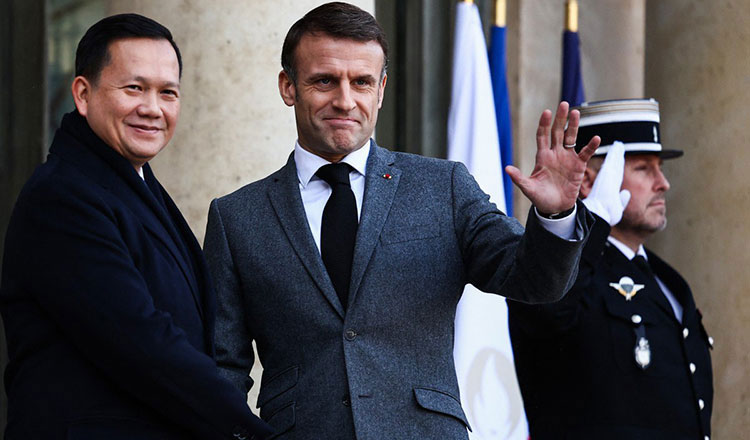 Image: French President Emmanuel Macron (R) greets Prime Minister Hun Manet in a meeting at the Palais de l’Élysée Palais in Paris. Palais de l’Élysée
#National
Synopsis: Senior Cambodian adviser calls on Paris to recall its historical role and provide key colonial-era documents to help resolve the territorial dispute.
A former Cambodian diplomat has urged the French gov`ernment to recognise its historical responsibility and step in to help Cambodia and Thailand resolve the border dispute, which in the last six months has clobbered relations between the two Southeast Asian neighbours.
Pou Sothirak, now the Distinguished Senior Adviser to the Cambodian Centre for Regional Studies (CCRS), said this yesterday in an exclusive interview with Khmer Times.
France holds a key position in resolving the dispute based on its colonial history and the international deals it inked with Thailand on behalf of Cambodia, he said.
Sothirak was speaking after the Cambodian Ambassador to France Luy David said on social media that Paris is willing to share historical records and official maps that could serve as evidence or reference materials to support a legal process or negotiations aimed at settling the border row with Thailand.
“France is ready to provide documents and maps to help resolve the border issue between Cambodia and Thailand through legal means,” David wrote.
In mid-June last year, French President Emmanuel Macron reassured Cambodian Prime Minister Hun Manet during his Paris visit that France would support facilitating the provision of key documents to both sides for the ongoing border dispute process at the International Court of Justice (ICJ). Macron’s pledge came after the May 28 skirmish between Cambodian and Thai forces.
Phnom Penh had said then that it would take the row to The Hague.
However, no concrete steps have so far been taken by the French, and Cambodia-Thailand diplomacy is at an all-time low following the July and December major military clashes at the border.
“Cambodia was a French protectorate from 1863 to 1953, and during this period, the French administration played a central role in defining Cambodia’s territorial boundaries, including areas bordering Thailand,” Sothirak said.
Many of the official maps and treaties that formed the basis for Cambodia’s modern borders were drawn, verified, or influenced by French authorities. The modern dispute still draws reference from the 1907 Franco-Siamese Treaty, Sothirak added.
“However, as of today, we have not seen any significant action taken by the French on the issue,” he said.
The border tensions originated during the French colonial era, beginning with conflicts between France and Siam (now Thailand) in the late 19th century. After the 1893 Paknam Incident, Siam was forced to cede territories east of the Mekong River to France and accept a demilitarised buffer zone, formalised in the 1893 treaty. Subsequent agreements—the 1904 Franco-Siamese Convention and the 1907 Franco-Siamese Treaty—revised these arrangements, leading to a territorial exchange in which Siam handed over Battambang, Siem Reap and Sisophon to French Indochina in return for Dan Sai and Trat.
The Annex I Map, part of the official documentation resulting from the treaty, depicts the border in the Dangrek Mountains, notably placing the Preah Vihear Temple within Cambodian territory.
The map’s significance was underscored in 1962 when the International Court of Justice (ICJ) ruled in favour of Cambodia’s sovereignty over the Preah Vihear Temple, citing Thailand’s prior acceptance of the map as a key factor.
Much later, a Memorandum of Understanding (MoU) between Thailand and Cambodia on the survey and demarcation of the land boundary, simply known as MoU 2000, was signed between Var Kimhong, Cambodia’s Adviser to the Royal Government in Charge of State Border Affairs, and Sukhumbhand Paribatra, Thailand’s Deputy Minister of Foreign Affairs. The document was to serve as a foundational agreement for the peaceful resolution of decades-long border issues between the two nations after the establishment of the Cambodian-Thai Joint Commission on Demarcation for Land Boundary in 1997.
The 1907 treaty and the 2000 MoU were central to the ICJ’s ruling affirming Cambodia’s sovereignty over the Preah Vihear Temple and its surrounding area.
“Cambodia has been respecting and referring to the French map and the two agreements when it comes to dispute settlement, while Thailand, on the other hand, is trying to rely on its unilaterally drawn maps,” Sothirak said.
“Thailand has been criticising the old maps as out-of-date, but according to international laws, as long as there is no new treaty to replace the agreement and maps, these old materials remain effective and essential.”
Sothirak called on the French government to accept the moral and historical responsibility and step up to help the two countries settle their differences to prevent further damage. The French playing the role of a third-party observant, he stressed, is “too general and not enough.”
“In the age of colonisation, France was a superpower that controlled Indochina and many other countries in Africa. Its sphere of influence still exists worldwide,” he said.
“Therefore, the French government has issued a public announcement in good faith and allocated more efforts in helping Cambodia and Thailand stop the argument and fighting.”
Sothirak added that France has also yet to put forth detailed explanations of the historical documents and maps to guarantee their validity and effectiveness.
“It is not fair that Cambodia is adhering to all these legal mechanisms while the French have not issued any statement as someone who had entered the agreement on behalf of Cambodia, while Thailand is still trying to kick them in its negotiation with Cambodia,” he said.
“It is a critical time for the French to respect the moral commitment and present a legal basis and clarification for both parties to discuss and settle the dispute once and for all.”
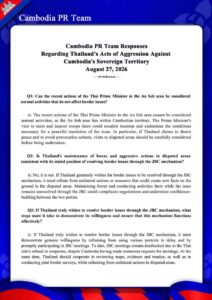
Meanwhile, as confirmed by Cambodian government spokesman Pen Bona yesterday, Cambodian ministries and institutions in the past six months have issued nearly 700 diplomatic complaints, statements, press releases, responses and letters of clarification regarding the dispute with Thailand.
Among those, 383 were from the Ministry of National Defence, 83 from the Ministry of Interior, 64 from the Ministry of Culture and Fine Art, 49 from the Ministry of Foreign Affairs and International Cooperation, 27 from the Cambodian Human Rights Committee, 25 from CMAA, 20 from the Border Affairs General Secretariat, 16 from CMAC and one from the Ministry of Cult and Religion.
Over 200 press briefings have also been organised during the same period.
“At the same time, the Ministry of Foreign Affairs and International Cooperation has also held 14 meeting sessions to report to the heads of foreign missions and representatives of international cooperation and organised 4 trips for them to visit and observe the situation in affected provinces along the border,” Bona said.
-Khmer Times-