International Litigation Is Not a Press Conference
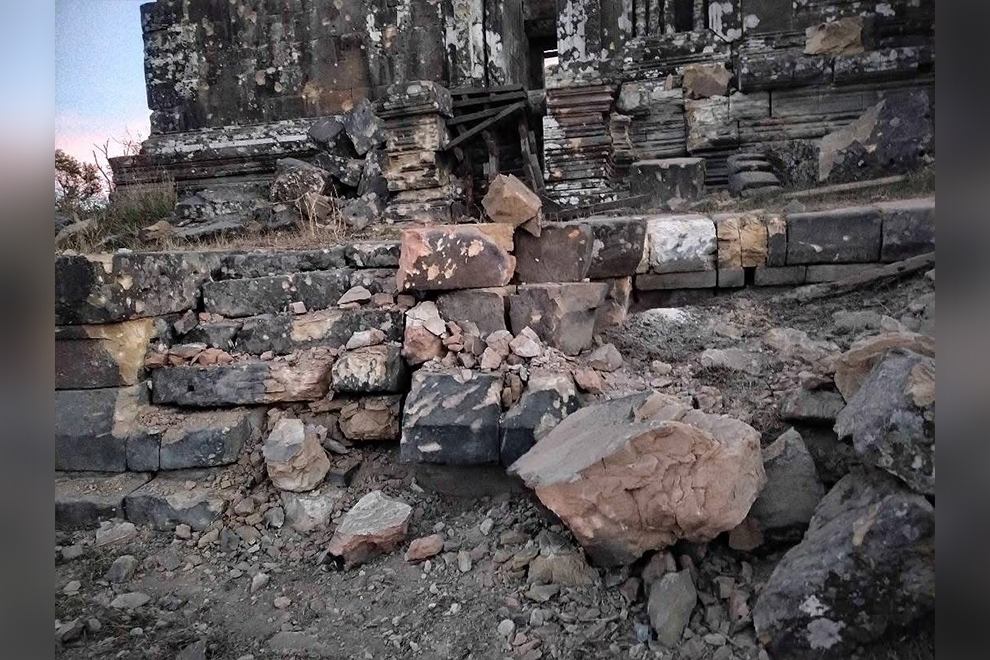 Preah Vihear Temple, ruled by the ICJ in 1962 as belonging to Cambodia, suffered serve damaged from the Thai military shelling in December 2026. Supplied
#opinion
Calls for legal action must be grounded in strategy, not emotion — because a failed case may weaken Cambodia’s position for years to come.
In recent months, Cambodian public discussion has increasingly focused on one urgent demand: that Cambodia should bring Thailand before an international court. Many citizens view international litigation as the clearest path to accountability and the protection of Cambodian sovereignty. This sentiment is understandable. In periods of heightened national concern, public pressure naturally gravitates toward decisive and visible legal action.
However, international litigation is not a political announcement. It is a formal legal process governed by jurisdiction, admissibility, evidence and procedure. For this reason, any decision to pursue litigation must be approached with discipline, realism and patience.
At the time of writing, there is no official public confirmation that Cambodia has filed a case against Thailand before the International Court of Justice (ICJ), nor that a dispute between Cambodia and Thailand is currently pending before the Court.
Likewise, there is no official public indication that Cambodia, as a state, has initiated any formal proceedings against Thailand before the International Criminal Court (ICC). This article therefore does not assume that Cambodia has filed or will file a case, and it does not seek to undermine any diplomatic or legal measures that may be taking place privately.
Public silence should not automatically be interpreted as inaction. In matters involving sovereignty and territorial integrity, governments frequently avoid public declarations because premature statements can create legal, diplomatic and strategic risks. International litigation is not undertaken for public approval. It is undertaken to secure a long-term legal position and a binding outcome.
At the same time, the government should not merely reassure the public — it should demonstrate progress through transparent legal and diplomatic steps. Strategic restraint must not become permanent indecision.
For this reason, it is important to distinguish between litigation as leverage and litigation as a strategy to obtain a judgment.
Litigation may sometimes be invoked publicly to demonstrate resolve or to increase diplomatic pressure. Even without immediate judicial proceedings, the credible prospect of litigation can encourage a state to engage seriously in negotiations and to activate existing bilateral mechanisms, including the General Border Committee (GBC) and the Joint Boundary Commission (JBC). In this sense, litigation — real or proposed — can function as leverage.
However, litigation intended to produce a binding result requires a fundamentally different level of preparation. International courts do not respond to political sentiment. They operate strictly on legal competence and procedural rules. A state must establish a clear jurisdictional basis, formulate precise legal claims, prepare admissible evidence and anticipate procedural objections. Even where grievances are serious, cases can fail if jurisdiction is disputed or if the evidentiary record is insufficient.
This is why demands for immediate litigation should be treated carefully. A prematurely filed case may be dismissed. A case lost on the merits may have long-term consequences. In some circumstances, an unfavourable ruling may strengthen the opposing state’s legal position and reduce future options for negotiation. The strategic risk of failure must therefore be weighed alongside the political appeal of taking visible legal action.
At the same time, Cambodian civil society organisations and private actors who seek to document facts, preserve evidence and explore international legal pathways should not be dismissed. Such efforts may contribute to broader accountability and may support future legal or diplomatic processes. However, private initiatives are not a substitute for formal state litigation. Their standing, jurisdictional reach, and legal effect differ fundamentally from proceedings initiated by Cambodia as a sovereign state.
Public reports have also circulated that certain groups may file submissions or communications before the ICJ and ICC. Such claims should be approached with legal caution. The ICJ is a court for disputes between states, and individuals or political organisations cannot initiate proceedings on behalf of Cambodia. Similarly, communications sent to the ICC do not automatically result in formal cases. The ICC Prosecutor must first determine jurisdiction and decide whether to proceed.
None of this means international law is irrelevant. On the contrary, international law remains one of Cambodia’s most important tools. But international litigation is not a slogan. It is a legal process shaped by procedure, evidence, timing and long-term national interest.
Mechanisms for peaceful settlement already exist, including the General Boundary Committee (GBC) and the Joint Boundary Committee (JBC). If these mechanisms remain stalled or ineffective, and if Thailand continues to disregard the principle of status quo, Cambodia may consider additional legal and diplomatic options. However, if Cambodia proceeds to international litigation, it should do so only with full preparation and with a clear objective: securing a favourable and sustainable outcome.
For Cambodia, the responsible approach is not to litigate loudly, but to litigate intelligently. If Cambodia chooses to go to court, it must do so not to satisfy public pressure, but to protect its sovereignty through lawful, effective, and strategically sound action.
International litigation is not a press conference. It is a long-term legal process — and Cambodia must approach it with discipline and care.
Panhavuth Long is a founder and attorney-at-law at Pan & Associates Lawfirm. The views and opinions expressed are his own.
-Phnom Penh Post-
———————