Beyond Protest Notes: How Cambodia Can Make Its Sovereignty Claims Effective
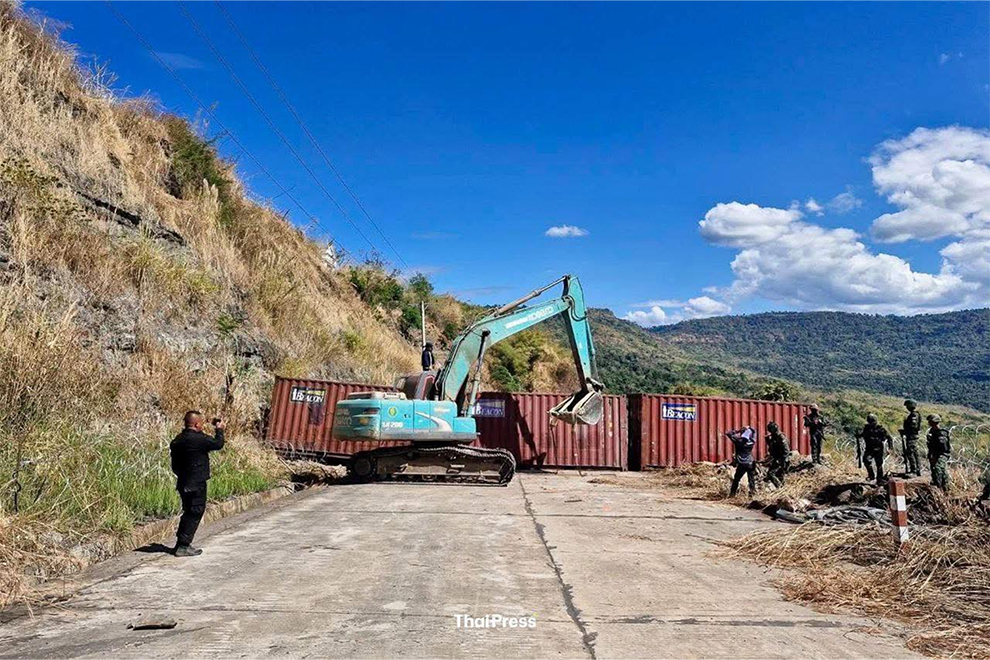 Thai military has placed shipping container barriers in the An Ses area of Preah Vihear province, drawing strong protest from Cambodia. Thai Press
#opinion
Diplomatic protest notes are a legitimate, lawful and expected response to actions affecting sovereignty and territorial integrity. In international law, they perform a vital function: preserving a state’s legal position, preventing acquiescence and formally recording objection. For the Cambodian public, such protests are generally welcomed and understood as responsible statecraft — especially when grounded in peace, restraint and respect for international norms.
Yet while protest is necessary, it is no longer sufficient on its own. Where contested territory is subject to de facto control and unilateral activity continues on the ground, effectiveness requires moving beyond expression toward concrete, institutionally anchored action. In modern international relations, legitimacy is shaped not only by the correctness of a claim, but by how that claim is translated into leverage.
Protest Is Necessary — but Not Sufficient
Diplomatic protests matter. In territorial disputes, silence can be costly: failure to object may later be interpreted as implied consent. Cambodia’s timely and consistent objections therefore carry real legal weight.
However, from a policy perspective, protest alone rarely changes behaviour — particularly when the other party already exercises effective control. Repeated notes or statements, if not followed by structured escalation, risk becoming procedural gestures rather than instruments of influence. International law does not reward repetition; it responds to process, evidence, and institutional engagement.
Effective Sovereignty Defence Follows a Pattern
States that have successfully defended sovereignty under conditions of power imbalance tend to follow a recognisable sequence:
1. Formal protest
2. Internationalisation of the dispute
3. Institutional anchoring
4. Legal clarification or adjudicative readiness
Cambodia has already moved beyond the purely bilateral stage. The challenge now lies in consolidation and lawful escalation — not repetition.
ASEAN: Politically Useful, Legally Limited
ASEAN remains an important diplomatic platform. Raising the issue within ASEAN underscores Cambodia’s commitment to regional peace and dialogue. However, ASEAN’s consensus-based structure and non-interference principle limit its ability to address situations involving alleged occupation or unilateral control.
Strategically, ASEAN should reinforce Cambodia’s image as a responsible regional actor — not serve as the primary mechanism for protecting sovereignty claims. Over-reliance risks stagnation rather than progress.
From Appeal to Evidence: Why France Matters
In this context, Prime Minister Hun Manet’s request to France for access to historical documentation relating to the Cambodia–Thailand border represents a strategically sound move. As the former colonial administering authority, France holds archival records, maps and administrative materials directly linked to the legal demarcation established under the 1904 and 1907 Franco–Siamese treaties.
This step is not symbolic. It strengthens the evidentiary foundation of Cambodia’s position. Once formally obtained and authenticated, such materials can guide bilateral engagement and support future interaction with international institutions. This is how diplomacy evolves from expression into leverage.
From UN Engagement to Fixed Legal Positioning
Cambodia has already taken the critical step of placing the dispute within the UN system. By engaging the General Assembly and the Secretary-General and ensuring its objections are entered into the official UN record, Cambodia has internationalised the issue and safeguarded its legal position against any claim of acquiescence.
What must follow is not incremental correspondence, but decisive consolidation. Cambodia’s UN engagement should now mature into a fixed legal posture — one that clearly defines consequences.
A strong next step would be to formally state on the UN record that any administrative, military or cultural activity conducted without Cambodia’s consent in disputed areas is legally void, incapable of producing sovereign effect, and fully subject to future international legal challenge. This does not escalate conflict; it locks in rights and prevents normalisation.
In parallel, Cambodia should submit a consolidated legal dossier integrating treaty law, archival evidence, cartography and records of protest. Once established, this dossier should become the authoritative reference point for all future diplomatic and institutional engagement.
Finally, Cambodia may clarify — without threat — that continued unilateral conduct will trigger escalation through lawful international mechanisms, including advisory or contentious proceedings where appropriate. In international practice, such signalling shapes behaviour by introducing legal certainty.
Cultural Heritage Must Be Internationalised
Cultural heritage is one of Cambodia’s strongest positions — but only if framed strategically. Sites such as Tamone and Ta Krabei should not be treated merely as symbols or border markers.
Under international law, cultural heritage located in occupied or contested territory is subject to heightened protection obligations. Unilateral restoration or administrative control risks not only physical damage, but legal distortion.
By submitting evidence-based reports to UNESCO and relevant expert bodies, Cambodia can reframe heritage harm as a matter of international responsibility, separate from border negotiations. This widens scrutiny and raises the legal cost of unilateral action.
The Real Risk: Normalisation Through Inaction
The greatest danger Cambodia faces is not open conflict, but quiet normalisation.
When foreign authorities manage sites, host delegations or conduct routine activity without sustained international challenge, those acts gradually acquire perceived legitimacy.
International law does not erase sovereignty through force — but it disadvantages states that fail to assert rights consistently and strategically.
From Voice to Leverage: The Remaining Strategic Window
Cambodia’s position is already on the international record. Further repetition, without new legal substance, will yield diminishing returns. The dispute has been internationalised — but not legally clarified. That distinction matters.
While a full contentious case before the International Court of Justice would be the strongest escalation, current political realities make consent unlikely. However, advisory proceedings through the UN General Assembly remain a viable option. Narrowly framed, such opinions can clarify the legal consequences of effective control by force or unilateral conduct in contested territory — particularly regarding cultural heritage. Though non-binding, they reshape legal expectations and reputational cost.
Complementing this is selective third-party legal facilitation, including archival cooperation and technical expertise. The engagement with France illustrates how legal history can be converted into contemporary leverage.
What unites these options is their nature: institutional, cumulative and law-centred — not rhetorical or confrontational. Sovereignty is rarely lost in a single act. It erodes when unlawful situations are allowed to settle into normality.
Cambodia’s voice has been heard. The task now is to embed that voice into legal records, institutional processes and international expectations — so that time works in Cambodia’s favour, not against it.
The strategic window is narrow, but it exists. How Cambodia occupies it will shape not only the current dispute, but the long-term resilience of its sovereignty claims.
Long Panhavuth is founder and attorney-at-law at Pan & Associates Lawfirm. The views and opinions expressed are his own.
-Phnom Penh Post-
———————-