True peace seems to be slipping further away as the ceasefire between Cambodia and Thailand remains fragile
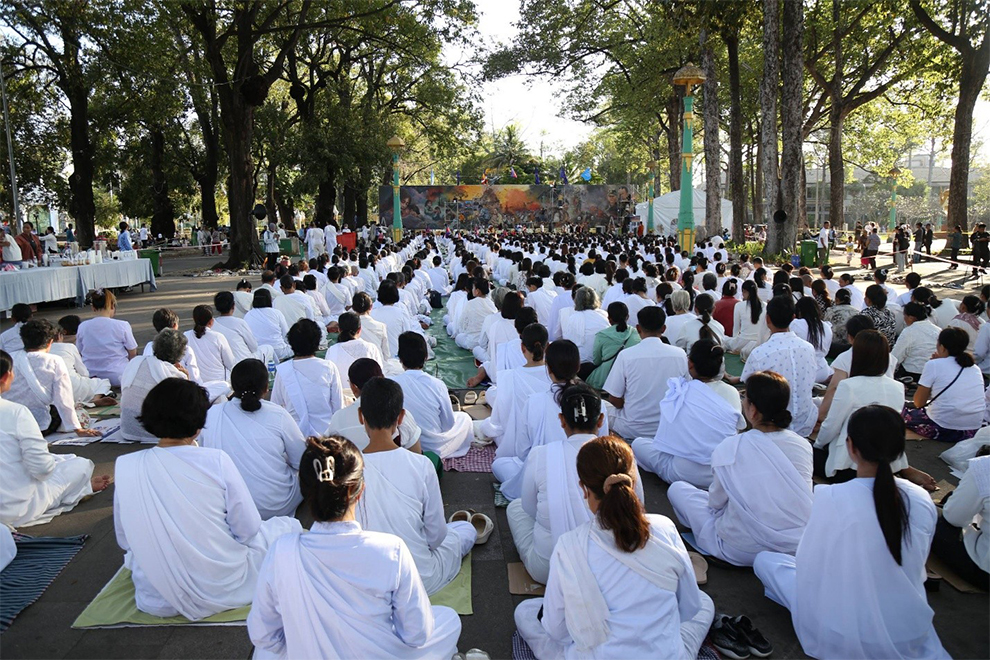 Buddhist followers meditate in front of the ‘Art for Peace’ mural in Siem Reap in December 2025. AKP
#opinion
The fragile ceasefire between Cambodia and Thailand illustrates a broader and more troubling global condition such as the steady erosion of what may be called true peace. Peace today appears increasingly distant, not merely because of localised conflicts, but because the foundational principles that once governed international relations — respect for international law, multilateral consensus and moral restraint — are gradually being sidelined. What is emerging instead is a world order driven predominantly by power, strategic interests and unilateral decision-making.
From a critical perspective, the last century has witnessed a profound transformation in global governance. In the aftermath of two world wars, international law and institutions were established to prevent domination by force and to protect weaker states.
However, in recent decades, this normative framework has weakened. Global order is no longer shaped primarily by shared rules and collective agreements, but increasingly by the interests of powerful states that possess economic, military and political leverage. The principle that “might does not make right” has quietly given way to a harsher reality in which power often defines legitimacy.
This shift reflects a realist worldview in international politics, where the strong dictate outcomes and the weak are compelled to comply. Justice, once understood as fairness and mutual respect, is now frequently interpreted through a pragmatic lens — what benefits the powerful is justified, while the voices of smaller or weaker nations are marginalised. As a result, consensus-based diplomacy has lost its central role, replaced by coercion, pressure and strategic alignment.
According to the standpoint of Buddhist philosophy, this global imbalance can be understood as a manifestation of deep-rooted moral and psychological causes. The Buddha identified greed (lobha), hatred (dosa) and delusion (moha) as the fundamental sources of suffering. In the contemporary geopolitical context, these defilements manifest as excessive ambition, fear-driven aggression and distorted perceptions of security and dominance. When these forces intensify, the moral compass of societies and states begins to deviate. The world no longer moves “straight”, guided by ethical principles, but instead veers sideways, driven by desire and ignorance.
Consequently, societies that are weaker in economic strength, military capability, diplomatic influence and political power become vulnerable to repeated oppression and manipulation. Their mistakes are not merely internal failures but are often the outcomes of external pressure and structural inequality in the international system.
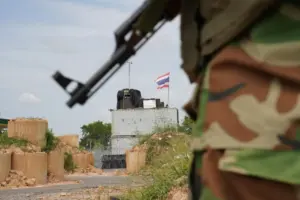
The ongoing tensions along the Cambodian–Thai border serve as a concrete example. Despite the existence of a ceasefire, repeated acts of aggression and military provocation — often justified through shifting narratives — undermine trust and stability. Such actions reveal how ceasefires, when not supported by genuine political will and respect for sovereignty, become fragile tools rather than durable solutions. They also expose how international mechanisms often fail to protect weaker states when enforcement depends on power rather than principle.
On a broader scale, the behaviour of major powers further reinforces this instability. Increasingly, weaker and poorer nations are pressured to choose sides — to align themselves with one superpower or another. Recent developments in Venezuela and parts of South America demonstrate how geopolitical competition transforms sovereign states into strategic battlegrounds. In such an environment, neutrality becomes difficult, and independence is compromised.
Starting from the perspective of practical political theory, national interest has become the primary catalyst shaping alliances and determining geopolitical destiny. Friendships between states are no longer rooted in shared values or long-term cooperation, but in immediate strategic or economic gain. When interests become the sole measure of partnership, trust erodes, alliances become transactional and the global community fragments into competing blocs.
This trajectory leads not to peace, but to deeper division. A world governed solely by competition and interest is inherently unstable. In contrast, Buddhist ethical thought offers an alternative vision, coexistence through restraint, compassion and sharing rather than domination. The principle of non-competition — recognising sufficiency instead of excess — emerges as a vital moral virtue in an interconnected world.
Finally, sustainable peace cannot be imposed by power nor preserved through fear. It can only arise from a genuine commitment to mutual respect, moral responsibility and equitable coexistence between the strong and the weak. Without a return to these values, ceasefires will remain fragile, international law will continue to erode, and true peace will remain an ever-receding horizon.
Dr. Prak Samphose is a lecturer at the Graduate School of Preah Sihanouk Raja Buddhist University. The views and opinions expressed are his own.
-The Phnom Penh Post-