Thailand cluster munitions leave lingering threat to civilians in Banteay Meanchey
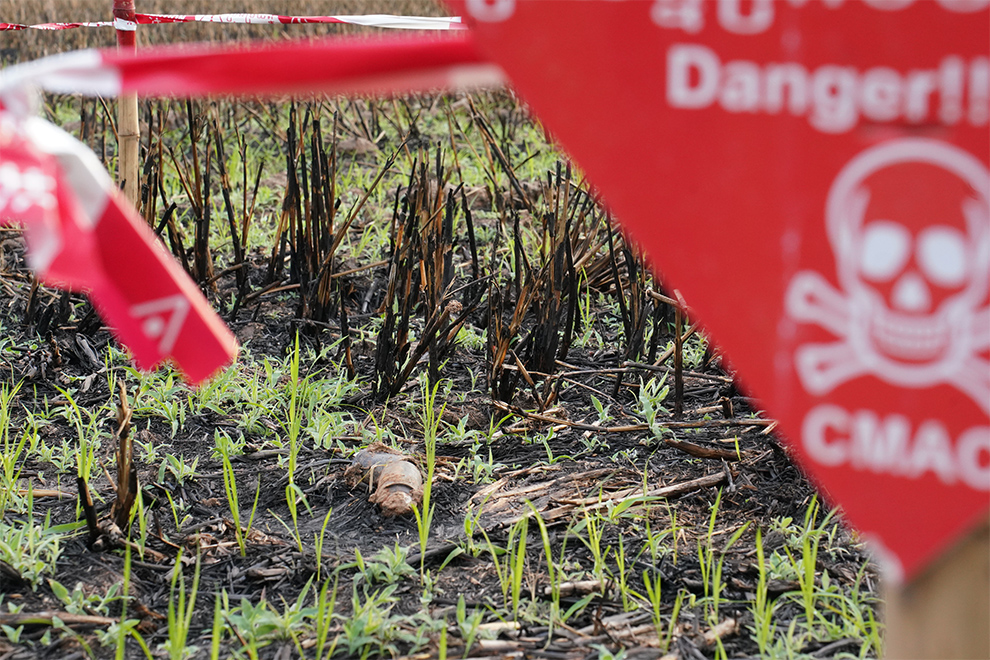 When a cluster munition round is fired, the size of the impact area is 200 metres by 200 metres. Hong Raksmey
#National
Cambodian demining officials have warned that cluster munitions fired by Thai soldiers during recent border fighting are continuing to endanger civilians, contaminating tens of thousands of hectares of residential land and farmland in the northwest province of Banteay Meanchey.
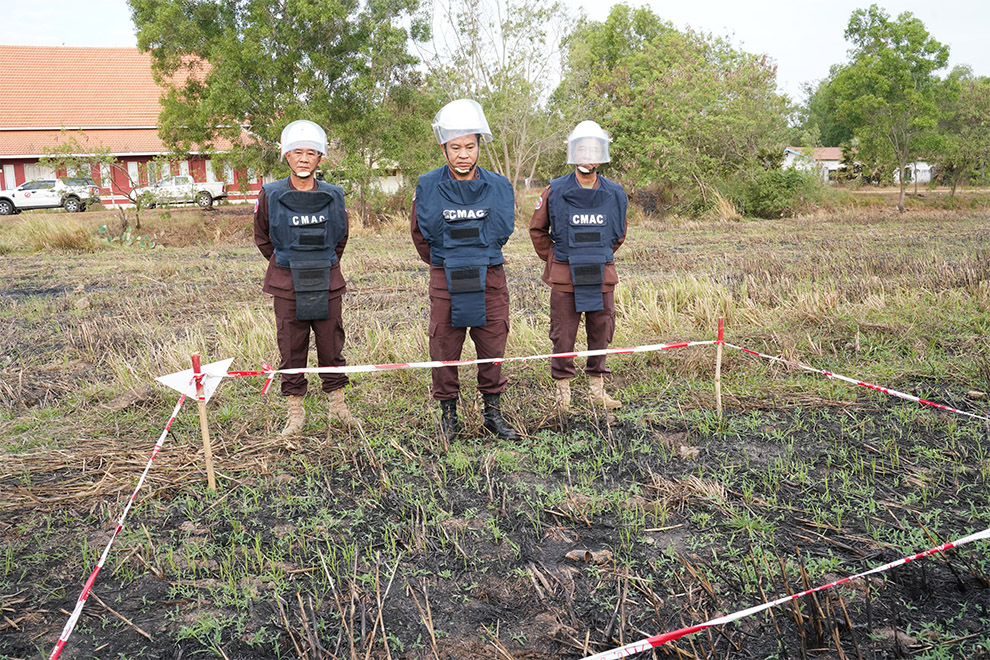
Brigadier General Neth Ratha, head of Demining Unit 1 of the Cambodian Mine Action Centre (CMAC), outlined the scale of the threat while speaking to reporters near the O’Chrov district office on February 4.
He said the weapons have affected more than 30,000 hectares of land, disrupting communities and livelihoods across the province.
The contamination stems from fighting linked to what Cambodian officials described as a Thai invasion between December 8 and 27, 2025, and has impacted 121 villages in eight districts.
Ratha said CMAC’s immediate priorities are to educate refugees and residents about the dangers posed by unexploded ordnance, rapidly remove munitions found near homes and public buildings, and ensure a safe return for displaced families.
“Third, we have cleared and responded immediately so that the people and refugees can return to their homes safely, and fourth, our team has conducted research on the extent of the impact of the Thai war of aggression,” he said.
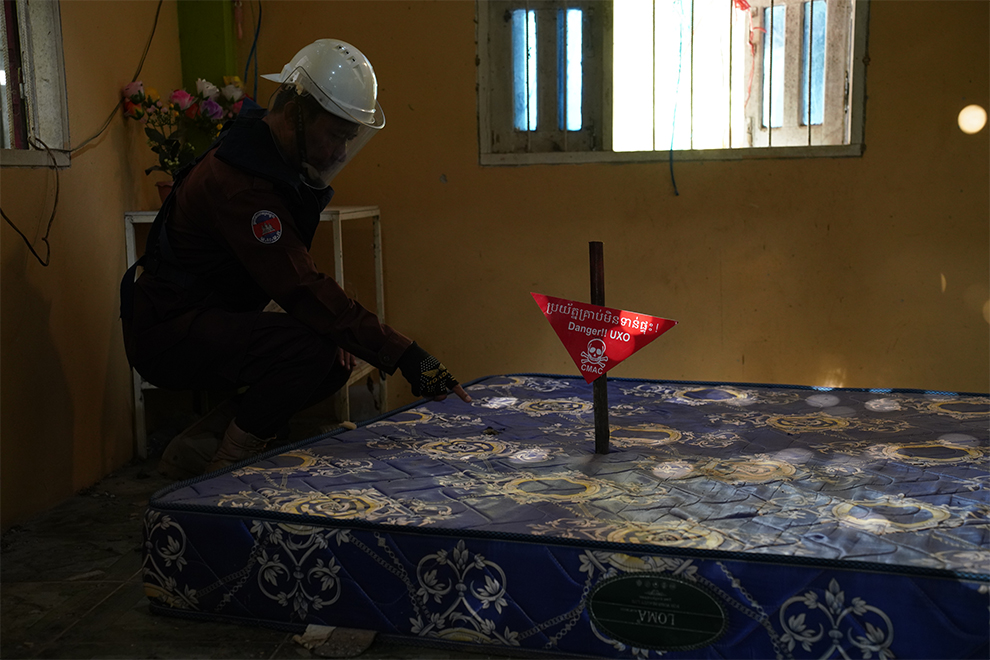
Between December 28, and January 31, CMAC teams identified explosive craters at roughly 2,500 locations, along with 133 unexploded shells and bombs on the surface of the ground, and 138 unexploded shell craters buried beneath it.
“The overall area affected by shells, drones and cluster munitions is 35,161 hectares,” noted Ratha.
According to him, Thai forces fired 155mm artillery shells loaded with two types of cluster munitions — M-46 and M-85 — into residential zones and near the O’Chrov district administrative office.
“Both types of cluster munitions are highly dangerous, easily explosive, and produce a lot of shell fragments. When a cluster munition is seen, the size of the impact on the ground is 200 meters by 200 metres,” he warned.
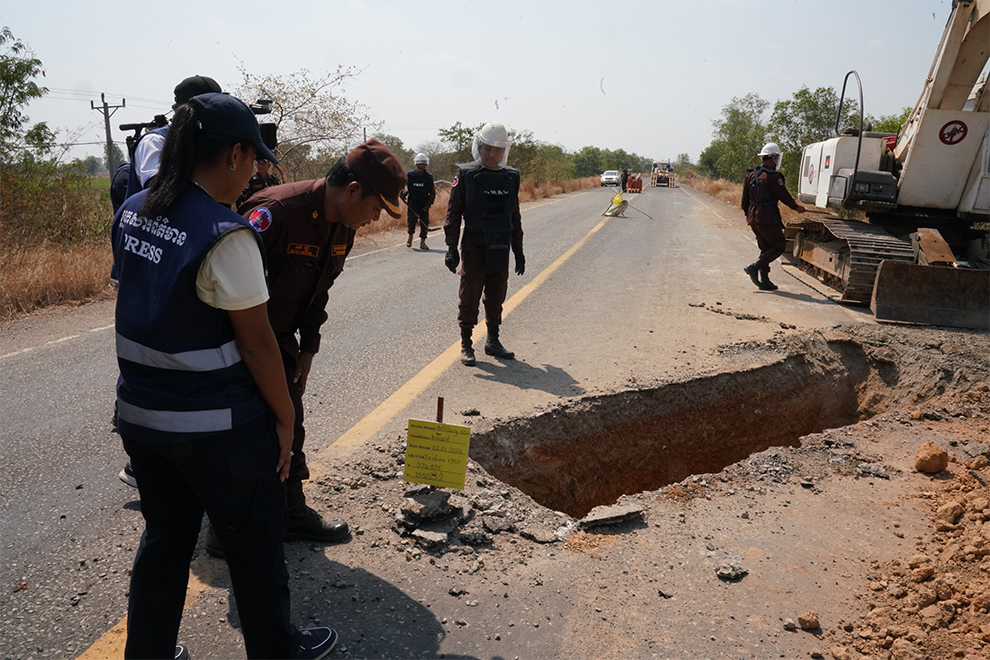
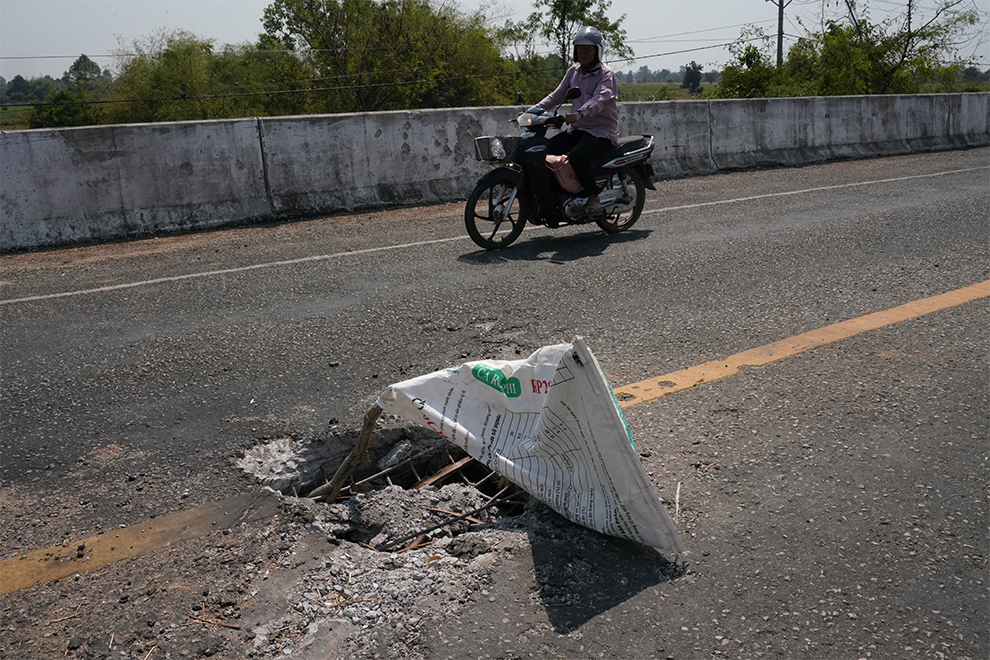
At another site, CMAC official Long Wutthiya described a 155mm bomb dropped along National Road 58 that penetrated about 1.5 meters into the ground.
Identified as an NR 269 — the “mother” munition of the Israeli-manufactured M-46 cluster bombs — it landed in O Kambot village, Kok Romeat commune, Thma Puok district during the December clashes.
“My team came to investigate on January 2,” Wutthiya said, as he confirmed the munition’s origin and type.
He cautioned that cluster munitions function as a “double killer”.
If they fail to detonate on impact, they remain on the ground and effectively become landmines, posing a lethal risk to anyone who steps on them.
Work conducted in January found approximately 60 NR 269 and M-196 or M-195 cluster munitions scattered across Banteay Meanchey province.
The renewed concerns echo earlier warnings from Human Rights Watch. During a previous round of fighting, in July 2025, the rights group urged both Thailand and Cambodia to refrain from using cluster munitions and to ratify the Convention on Cluster Munitions, adopted by 111 countries.
International humanitarian law requires all parties in armed conflict to distinguish between combatants and civilians and prohibits attacks that fail to differentiate between military and civilian targets or that cause excessive civilian harm relative to anticipated military advantage, the organisation noted.
Although neither country has joined the convention banning the weapons, Human Rights Watch considers any deployment of cluster munitions in populated areas to be unlawfully indiscriminate.
The group also said Thailand previously used the weapons during a border dispute with Cambodia in February 2011.
For communities in Banteay Meanchey, however, the danger is immediate and long-term. Unexploded cluster submunitions can remain active for years, threatening farmers returning to their fields and children playing near their homes — a legacy of war that continues long after the fighting has stopped.
-Phnom Penh Post-
————————–