Thailand violates ceasefire by creating ‘new facts on the ground’ as civilians and businesses disrupted, says foreign ministry
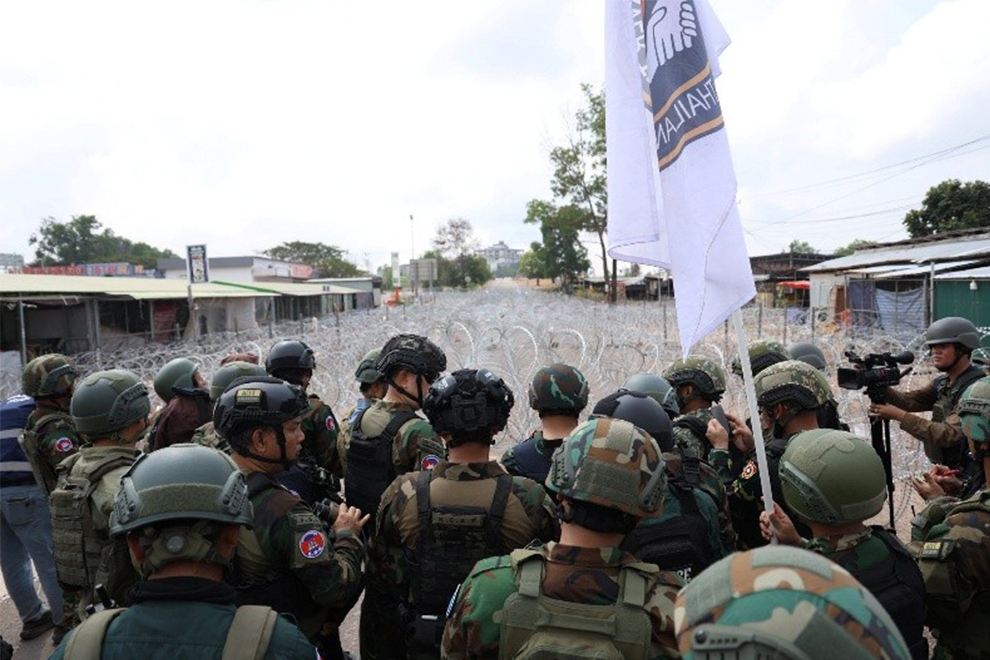 Pursat provincial governor Khoy Rida accompanied the ASEAN Observers Team (AOT) to four locations where the Thai navy forces laid razor wire in Cambodian territory. Supplied
#National
Cambodia has accused Thailand of breaching agreed ceasefire and de-escalation measures by deploying razor wire and military forces inside Cambodian territory, actions the government says amount to creating “new facts on the ground” that undermine peace efforts and obstruct civilians from returning to their homes.
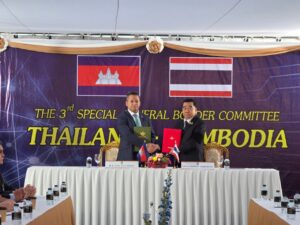
In a strongly worded January 17 statement, the Ministry of Foreign Affairs and International Cooperation said Thai forces disrupted security conditions in civilian areas, tightened military control and disrupted everyday economic activity, despite clear commitments under the December 27, 2025 Joint Statement of the Cambodia–Thailand General Border Committee (GBC).
“Thai armed forces that alter the security environment in or around civilian areas, consolidate military control and create new facts on the ground, thereby directly undermining de-escalation efforts and hindering the safe and dignified return of civilians to their homes and properties,” said the ministry.
The protest follows the January 16 deployment of Thai naval troops at the Thmor Da International Point of Entry in Pursat province, where razor wire was laid more than one kilometre inside Cambodia, temporarily blocking roads, surrounding shops and preventing residents and traders from moving freely.
“These actions raise serious concerns over Cambodia’s sovereignty and territorial integrity,” the ministry said, adding that the deployments were inconsistent with Item I of the Joint Statement adopted at the 3rd Special Meeting of the Cambodia–Thailand General Border Committee (GBC) on December 27, 2025.
That joint statement, the ministry stressed, was designed as a comprehensive framework to de-escalate tensions, protect civilians, restore normal life and resolve disputes peacefully — “not to entrench military presence”.
Thai naval forces installed razor wire deep inside Cambodian territory following a 21-day incursion across several locations in Cambodia.
Tensions in the Thmor Da area escalated after Chinese shop-owners shops dismantled razor wire on January 15 and raised Chinese national flags in front of their businesses in an attempt to resume operations.
The following morning, Thai forces returned in large numbers, reinstalled the wire, removed the flags and extended barricades to block the “Pig’s Snout” junction road, a key route linking the area to Koh Kong province.
Videos and images circulated on social media showed Thai troops re-encircling commercial premises and closing access to the junction, prompting concern among traders and residents as the situation showed no immediate sign of de-escalation.
Veal Veng district deputy police chief Sum Kimseng said Cambodian civilians stayed away from the barricades due to the heavy Thai military presence, while only Chinese shop owners approached the troops to remove the wire.
“No Cambodian residents went near the razor wire,” he said. “They stayed about five to seven metres away.”
Pursat deputy governor Heng Sopheana confirmed the road closure earlier on January 16 but said Thai troops later removed the wire and withdrew, allowing traffic to resume.
Thailand’s navy spokesperson Parach Rattanachaiphan said the razor wire had been installed by the Trat Marine Special Forces to define troop deployment lines and manage control of the area, citing a joint statement signed by the defence ministers of both countries on December 27.
However, Cambodian officials pointed out that the same joint statement explicitly requires both sides to halt all military activities, avoid provocative actions and allow civilians to return freely to their homes without obstruction.
The situation has drawn the attention of the ASEAN Observer Team (AOT), which travelled to Veal Veng district on January 16 to inspect conditions on the ground.
The team visited three sites in Thma Da commune, including O’Phluk Domrei, the Hun Sen Thma Da Health Centre and the Chey Chomneah Pass.
Maly Socheata, spokesperson for the Ministry of National Defence, said Cambodia had strictly adhered to the ceasefire and all relevant agreements since they came into effect.
“Cambodia always provides full support to the AOT and emphasises the indispensable importance of strengthening the role and mandate of the team to verify and ensure the full and effective implementation of the ceasefire,” she said, adding that transparency and accountability were essential to rebuilding mutual trust.
Pursat provincial governor Khoy Rida described the situation as far more serious than a routine border incident, calling it a clear example of invasion and occupation.
He said Thai forces were holding four locations inside Cambodian territory, including Chey Chumneh Bridge, the Phluk Damrei area and Checkpoint 56, which is linked to a special economic zone.
According to Rida, more than 80 families have been affected, with 39 families losing their homes entirely and others unable to return due to security concerns as their residences are surrounded by razor wire.
“This is not a temporary standoff,” he said. “It is a continued occupation.”
The governor said damage had been reported to administrative buildings, health facilities, commercial structures and critical infrastructure, including the water-gate bridge.
He added that Cambodian authorities had explained the situation in detail to the AOT delegation, rejecting claims that Cambodia had threatened or invaded Thailand.
“We clarified clearly that Cambodia is not the aggressor,” Rida said. “It is Thailand that has invaded and threatened us.”
The foreign ministry reiterated Cambodia’s calls for Thailand to fully implement all provisions of the December 27 GBC joint statement, and other relevant agreements, in good faith.
While reaffirming its commitment to peaceful resolution in accordance with international law and bilateral mechanisms, the ministry stressed that borders must not be altered by force.
As ASEAN observers assess the situation, Cambodian authorities say restoring civilian safety, reopening access routes and preventing further unilateral military actions remain urgent priorities for stabilising the border and preserving regional trust.
-The Phnom Penh Post-