Denial Is Not De-Escalation: Why Thailand’s Border Narrative Fails the Facts
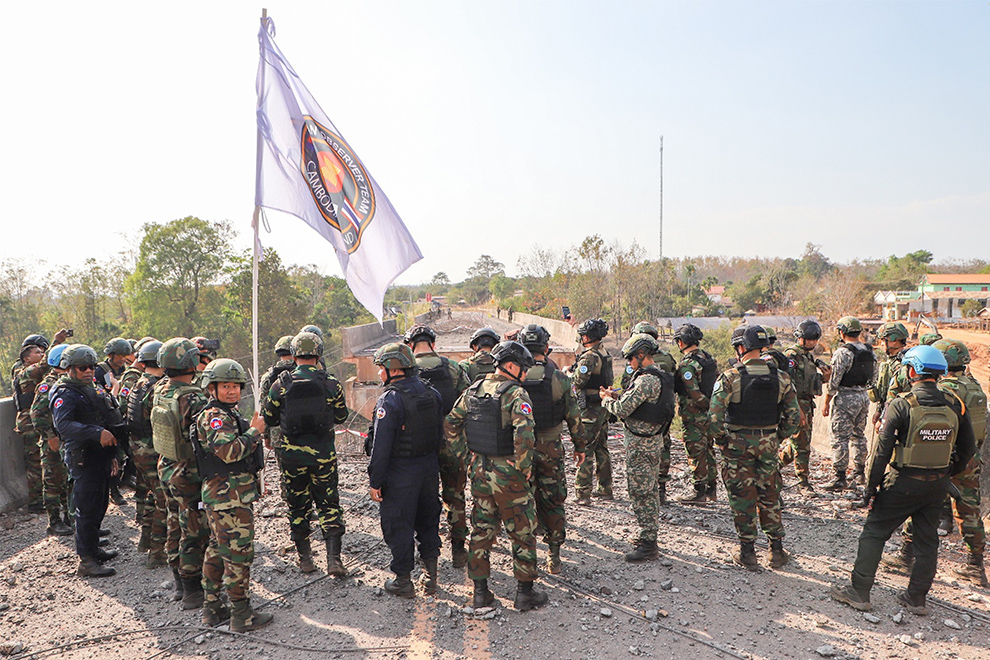 The ASEAN Observer Team (AOT) visit Mer Teuk Bridge in Pursat province, which was destroyed by Thai airstrikes. Supplied
#opinion
Thailand’s latest Joint Press Center statement on the Cambodia–Thailand border is less a clarification than a carefully crafted denial. By insisting that Thai troops stationed in civilian areas do not constitute an “occupation”, Bangkok relies on semantics to obscure facts on the ground — and in doing so, undermines both trust and de-escalation.
International practice is clear: what matters is not the label, but the impact. When foreign armed forces control access to villages, restrict civilian movement and prevent displaced residents from returning home, the situation meets the functional definition of military occupation. Rebranding such control as “presence” does not change its effect on civilians — or its legal implications.
Thailand’s invocation of the December 27, 2025, Joint Statement is particularly revealing. That agreement was intended to reduce tensions, not to legitimise prolonged military control over civilian spaces. De-escalation means withdrawal, restraint and restoration of normal civilian life — not the normalisation of armed deployment under diplomatic cover.
Equally troubling is Thailand’s categorical denial that civilians have been affected. Cambodian communities along the border have experienced displacement, loss of livelihoods and restricted access to their homes. These are not allegations circulated by “foreign media”; they are realities confirmed by local authorities and observed on the ground. Under International Humanitarian Law, parties are obligated not only to avoid harming civilians but to actively facilitate their safe return. Prolonged militarisation of civilian zones violates this principle.
Thailand’s response to the ASEAN Observer Team (AOT) further exposes the weakness of its position. While professing support for ASEAN observation, Thailand dismisses findings that document damage linked to Thai military actions, demanding additional verification only when conclusions are inconvenient. Observation cannot be selective. ASEAN mechanisms either matter, or they do not. Accepting the process while rejecting its outcomes erodes regional credibility and mutual confidence.
Most telling is what Thailand does not meaningfully deny: the entrenchment of forces, construction of fencing and consolidation of control in sensitive areas. These actions create irreversible facts on the ground while diplomacy is ongoing. They are not defensive gestures — they are unilateral moves that shift the status quo and heighten long-term risk.
Peace is not preserved by fortifying disputed areas. It is preserved by restraint, reciprocity and respect for international norms. Hashtags and press releases cannot substitute for accountability.
Cambodia has consistently called for objective ASEAN-led verification, genuine implementation of de-escalation commitments, and a return to civilian normalcy in affected areas. These are not provocations. They are reasonable, lawful and necessary steps toward lasting stability.
Calling occupation “de-escalation” does not make it so. Only actions — not words — will determine whether peace is truly the goal.
Roth Santepheap is a geopolitical analyst based in Phnom Penh. The views and opinions expressed are his own.
-The Phnom Penh Post-