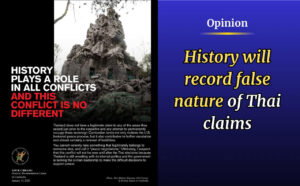
Clarifying the Roots of Thailand’s Role in the Cambodian Refugee Crisis (1979)
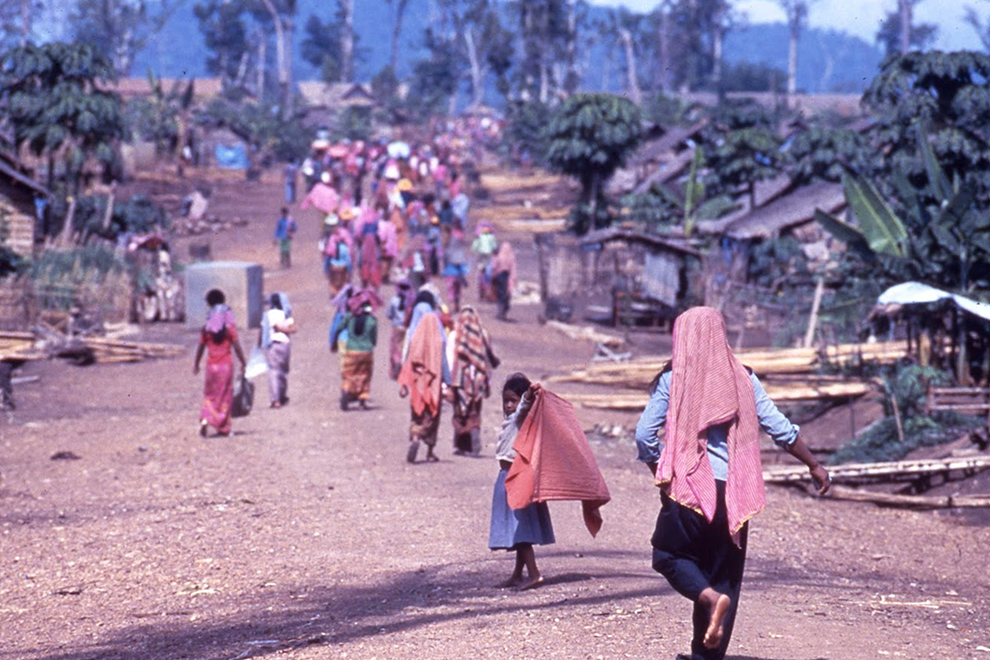 [Cambodian refugee families walk along a path near the Thai border in the early 1980s. DC-Cam]
-Opinion-
I write this not to embarrass any nation — not the US, not China — but to offer clarity to the Thai people about the deeper context behind Thailand’s involvement in aiding Cambodian refugees after the fall of Democratic Kampuchea (the Pol Pot regime).
In late January 1979, following the Vietnamese invasion that toppled the Khmer Rouge, hundreds of thousands of Cambodians fled toward the Thai border. On January 29, 1979, Chinese leader Deng Xiaoping arrived in Washington, D.C., for a historic nine-day visit. During his meetings with President Jimmy Carter, the crisis in Cambodia was a key topic of discussion.
At the time, the world was being pulled deeper into Cold War divisions. The Vietnamese occupation of Cambodia was seen by the West and China as a proxy for Soviet expansionism in Southeast Asia. In this context, Cambodian refugees were not only victims of war — they were also caught in a geopolitical struggle. Their presence along the Cambodia–Thailand border became a buffer against the perceived fear that communism could spread into Thailand.
Cambodia was not only a victim of war but also suffered a second killing field at Phnom Trap — Ghost Mountain — where countless lives were lost in silence.
The outcome of the US–China talks was strategic: the United States agreed to pressure Thailand to provide sanctuary for Cambodian refugees and to allow anti-Vietnamese resistance groups to operate along the Cambodia–Thailand border. China, in turn, supplied arms and support to these resistance forces.
Thailand’s role, therefore, was not a simple act of humanitarian generosity. It was shaped by intense geopolitical pressure—from Washington, from Beijing and from the broader international community.
The UN responded by establishing the United Nations Border Relief Operation (UNBRO) to coordinate humanitarian aid along the Thai-Cambodian border. However, efforts to reach a political solution at the UN Security Council were repeatedly blocked. The Soviet Union, a key ally of Vietnam, used its veto power to stall consensus among the Permanent Five (P5) members.
The Thai government gained significant benefits from UNBRO. Yet to this day, Thai authorities are accused of allowing some Cambodian refugees to remain settled within Thai territory. Why did the Thai government fail to take timely action at that moment? Why was this issue allowed to linger unresolved for so long, despite the clear presence of remaining refugees?
Let us be clear: Thailand’s involvement in the Cambodian refugee crisis was not merely an act of goodwill. It was a calculated response to Cold War dynamics, shaped by international pressure and strategic interests during one of the most volatile moments in Southeast Asian history.
Tesh Chanthorn is a Cambodian citizen who wants peace. The views and opinions expressed are his own.
-The Phnom Penh Post-