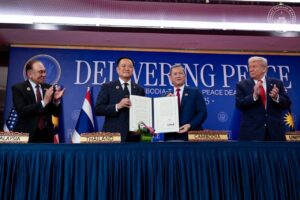
The Hypocrisy of the High Ground: Anutin’s Border Theatre and the Erosion of the Peace Accords
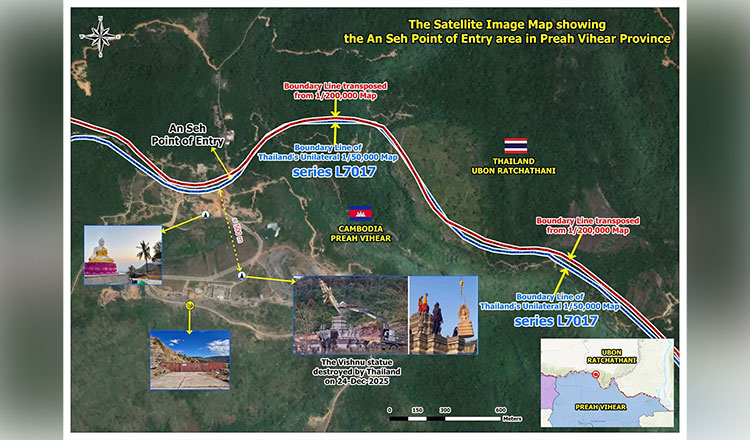 Thai Prime Minister entered occupied area in the An Seh area, deep beyond their unilaterally produce map as marked in blue. SSBA
There is a profound, almost cinematic irony in Thai Prime Minister Anutin Charnvirakul’s frontier manoeuvres. Standing atop disputed heights in sovereign territory— such as his high-profile inspection tour of Hill 500 in the An Seh/Chong An Ma sector — insulated by the very military presence his government claims is purely defensive, Anutin displays masterclass-level audacity: he lectures Cambodia on respecting the “status quo” and adhering to the letter of the peace declarations.
To watch Bangkok systematically carve up, fortify and container-barricade contested borderlands, only for its head of government to hop a military chopper and scold the neighbouring nation for failing to match Thailand’s “peaceful posture,” is more than a diplomatic insult — it is a textbook exercise in bad-faith realpolitik.
An assessment of the activities conducted by the Royal Thai Armed Forces along the Cambodia-Thailand border reveals a pattern of operational consolidation, infrastructural buildup, and strategic positioning that Phnom Penh views as a direct breach of bilateral peace commitments, ceasefires and joint declarations.
Unilateral Infrastructure and Territorial Consolidation
Cambodian diplomatic and military authorities have repeatedly protested what they classify as systematic encroachments in disputed or sensitive frontier zones. Key actions by the Thai military include:
Land Clearing and Road Construction: Thai engineering units have engaged in heavy land clearing, road building and the establishment of fortified military positions in contested areas. Phnom Penh argues these actions violate the status quo and attempt to create irreversible “facts on the ground”.
Consolidation of Strategic Heights: Following successive rounds of border flare-ups and subsequent ceasefires, Thai forces have maintained tactical control or heavily reinforced positions around critical high-ground features and historical flashpoints, including areas near Prasat Ta Krabei (the Ta Mone/Ta Krabei temple complex areas) and surrounding sectors.
Accusations of Creeping Annexation: While the Thai military’s Joint Information Center (JIC) maintains that these engineering and security works are defensive measures designed to protect sovereign territory and personnel, Cambodian analysts frame them as structural violations intended to choke off contested access points and alter the demarcation baseline outside of agreed bilateral mechanisms like the Joint Boundary Commission (JBC).
Legal Subversion: Weaponising Ceasefires into Permanent Occupations
The core dispute goes far beyond tactical friction; it strikes at a fundamental betrayal of a comprehensive, cumulative chain of bilateral commitments.
The peace framework was never a standalone promise or a mere emergency stopgap. It represents an unbroken historical trajectory of binding obligations across three distinct functional categories:
Core Respect & Restraint Obligations: Rooted in the July 28, 2025, Putrajaya Truce, the August 7, 2025, GBC 13-Point Agreement, the August 22–27 RBC meetings, the October 26, 2025, Kuala Lumpur Joint Declaration and the December 27, 2025, GBC Joint Statement, both nations are permanently bound to prohibit the threat or use of force, maintain the ceasefire, avoid provocative actions and refrain from the unilateral expansion of the dispute.
Active Military Restrictions: The framework mandates a complete freeze on force increases and troop advancements toward the other side’s positions. Crucially, it prohibits constructing or enhancing military infrastructure or fortifications beyond a nation’s own side — barring both parties from using engineering works as a vehicle to alter the landscape in unsettled sectors.
Continuing Implementation Duties: A government cannot claim full compliance merely because it has refrained from firing. The agreements establish an active duty to communicate through local and ministerial channels, cooperate on humanitarian demining (without prejudicing demarcation), facilitate safe civilian return under ASEAN monitoring, and — most importantly — utilise the RBC, GBC and JBC to pursue a definitive peaceful settlement.
The parties deliberately created two parallel tracks: Track 1 (Security), which mandated ceasefires, frozen forces, and non-provocation, and Track 2 (Settlement), which required active dialogue, JBC survey, and demarcation. The danger arises when Track 1 becomes a permanent military reality while Track 2 is stalled.
As explicitly laid out in the bilateral architecture, the agreements do not merely require the guns to fall silent; they impose a continuing obligation to resolve the underlying border dispute through peaceful means, international law and the agreed bilateral mechanisms — particularly the JBC — while avoiding actions that expand the scope of disputes or create new facts on the ground. A ceasefire freezes the conflict — it does not freeze the dispute into permanent territorial entitlement.
The Physical Hardening of the Frontier and Executive Provocations
Despite binding commitments under the December 27 framework — which explicitly mandates that both sides must not increase forces along the entire border, must not undertake provocative actions, must not enter the other side’s territory or positions as they existed at the ceasefire and must refrain from constructing or enhancing military infrastructure or fortifications beyond their own side — Bangkok’s actions reflect a blatant disregard for the legal text:
Border Walls and Container Blockages: Thai authorities and security-aligned networks have increasingly relied on heavy-duty barriers, such as stacked shipping containers and modular fencing around friction zones like Thma Da and Banteay Meanchey to completely seal off unofficial crossings and curb unauthorised movement under the guise of an internal “Border Wall” policy. Phnom Penh rightly condemns these physical barricades as unilateral attempts to alter landscape realities in un-demarcated or contested sectors — a direct violation of status-quo agreements, which mandate that neither side take physical steps that prejudice future boundary negotiations.
Dual-Use Civil and Military Infrastructure: Border engineering works span civil pretexts (customs posts, anti-scam checkpoints and infrastructure roads) alongside blatant military consolidation (reinforced bunkers, observation posts on strategic heights like Hill 500 and logistics tracks). Cambodia maintains that Thailand is weaponising “development” and “border security” as covers to entrench its military presence, systematically anchoring itself into terrain that is legally unsettled under bilateral mapping frameworks.
Organised Inspections and Executive Provocations: Anutin’s frontline tour of Chong An Ma/An Seh under the pretence of a routine morale visit unmasks the strategy. Defending the trip as a legal act authorised under the December 27 Joint Statement because he holds the paper, Anutin treats the bilateral freeze as a license to fortify.
Even more galling is the casual dismissal of diplomatic blowback. When confronted with Cambodia’s sovereign protests and warnings regarding legal accountability over what amounts to an intentional political stunt to project jurisdiction over occupied land, Anutin waves away the friction with the haughty insouciance of a leader who believes international law only bends to domestic optics — shrugging off potential legal threats and rumoured arrest warrants with a breezy, dismissive attitude (“Really? What do you want me to say?”) — while Bangkok smugly lectures on dialogue.
Yet, Thailand itself has repeatedly and publicly affirmed this framework, noting in official statements that dialogue should proceed on the basis of “facts, sincerity and good faith”, mutual respect and adherence to agreements. Good faith is therefore not a rhetorical invention of Phnom Penh; it is written directly into the cumulative bilateral compacts that Bangkok finds convenient to cite selectively.
The Good Faith Test: Cambodia’s Repeated Calls vs. Thai Stalling
The true measure of good faith lies not in press releases, but in willingness to engage the institutional mechanisms established to resolve the dispute. While Bangkok frequently lectures on adherence to bilateral channels, Phnom Penh has repeatedly taken concrete diplomatic action by sending formal notes and proposing dates to resume Joint Boundary Commission (JBC) meetings and deploy Joint Survey Teams to clear outstanding demarcation lines.
Yet, these persistent Cambodian overtures have faced a consistent pattern of administrative stalling and postponements from the Thai side. This reveals a stark contradiction in Bangkok’s strategy: Thailand seeks to freeze Track 2 (boundary survey and peaceful settlement through the JBC) while aggressively weaponising Track 1 to build unilateral physical facts on the ground. A party acting in true good faith does not dodge the negotiation table while pouring concrete and stacking shipping containers across unsettled terrain.
Strategic Implications
Whatever either side’s substantive territorial claim may be, both nations have already bound themselves to resolving the dispute peacefully, through international law and established bilateral mechanisms, in good faith. The core of the dispute rests on a fundamental contradiction: Phnom Penh views Thailand’s physical consolidation, fortification of contested heights and refusal to revert to pre-conflict baseline positions as a material betrayal of the Peace Declarations. Conversely, Bangkok asserts its actions are reactive responses to security vulnerabilities, unverified provocations and cross-border security threats.
These synchronised steps — piling up container walls, pushing heavy engineering works, and staging executive visits to disputed heights — demonstrate a calculated Thai strategy of normalisation through physical dominance. For Cambodia, each physical block and political tour serves as concrete proof that Bangkok is discarding joint peace declarations in favour of a fait accompli on the ground.
If Thailand truly respects the Peace Declarations, it must answer a fundamental question: The peace framework requires both parties to freeze military escalation while preserving and actively pursuing the peaceful settlement of the underlying border dispute through the JBC and other established bilateral mechanisms. Can either party legitimately use a temporary military position under the ceasefire to create new facts that prejudge the international boundary? A peace built on unilateral occupation is nothing more than an aggression waiting for its next ignition point.
Long Panhavuth is founder and attorney-at-law at Pan & Associates Lawfirm. The views and opinions expressed are his own.
-Phnom Penh Post-